Showing posts with label characters. Show all posts

Monday, September 29, 2014

The Center of Balete


Center. That is the way Baleten-ons referred to the Municipal Health Office since my childhood days. And it stuck until to now. I am particular to this reality as the family used to reside behind the old Puericulture Center of Balete where both my father and mother worked. When my mother got hired as Rural Health Midwife for Balete Rural Health Unit, the family decided to relocate and bought a small house behind it. It was easy to recognize one another then as there were only a handful of households in the poblacion. It was simply either one is from Ilaya or Ilawod.

The "Center" is geographically situated at the heart of the poblacion along with the old Town Hall, the Band Stand and the Church. It served as the boundary for the "taga-ilaya" and "taga-ilawod". It was implicitly regarded as a neutral place where animosity is temporarily set aside among the "warring gangs" of Ilaya and Ilawod. As the bell tolled to call the community to Angelus, any contest by the rival gangs were to be set aside, at least for a while. At nighttime, its spacious covered patio was a rendezvous for the Romeos and Juliets of the Poblacion.

The "Center" is known by many names. Originally, it was the Puericulture Center of Balete when it was first established in 1957. A cholera outbreak struck the community in the early 50's and the government relied on the humanitarian interventions of the National Federation of Women's Club of the Philippines (NFWCP) as there was no health personnel assigned in Balete at that time. While it is true that as early as 1921, the Public Welfare Commission was already tasked of supervising and organizing puericulture centers in the countryside with a mandate that all centers should have a doctor, a nurse, a midwife and a social worker, all to be paid by the government, the lack of funds delayed its establishment in Balete. It took the persistence of the strong-willed Pacita Calizo-Cortes, the chapter president of NFWCP, to bring in funds that pave for the eventual establishment of the "Center" and later on, its satellites in Aranas and Calizo.
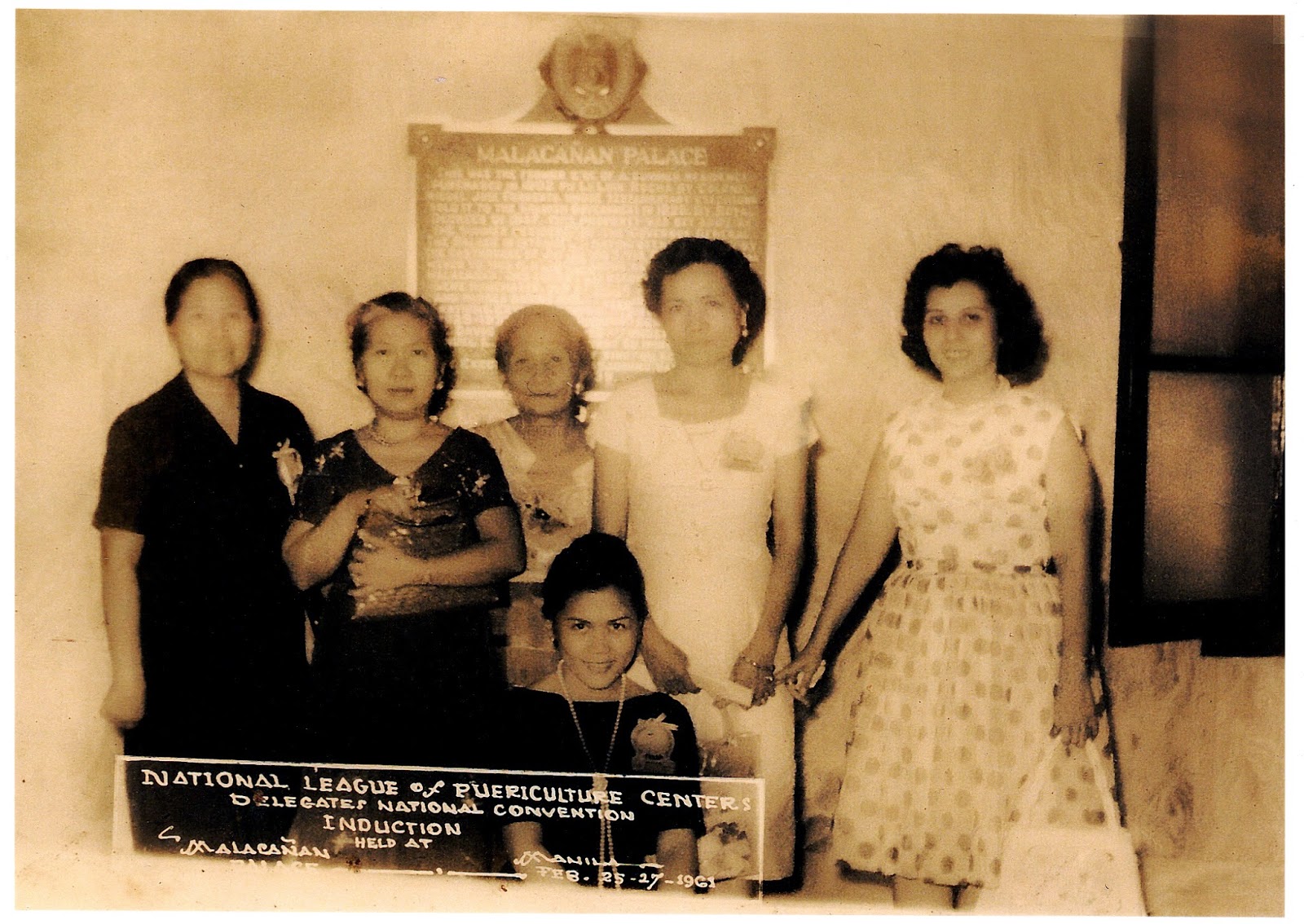
The fine lady with a bag is the late Pacita Calizo-Cortes during her attendance to the
1st National League of Puericulture Centers National Convention
 at the Malacañang Palace in February 25, 1961
(Photo courtesy of Ms. Cecile Cortes-Vergara)

In 1961, the World Health Organization, the United Nations Children's Fund, the Philippine Charity Sweepstakes Office and provincial governors funded the construction of puericulture center buildings across the country. Remnants of the PCSO-funded centers are still standing up to now in Barangay Aranas and Barangay Calizo although the lack of appropriate documents--Deed of Donations--prevented the local government from undertaking their rehabilitation. But with the dearth of health personnel where there was only one midwife who rounded the barrios as the doctor and the nurse were "center-based", the people relied so much on the active involvement of the NFWCP for their health and sanitation needs and in their absence, from the community cirujanos (not to be confused with the cirujanos ministrates—male nurses—of the Spanish era) and herbolarios (or albularyo). Thus, that generation remembers its one and only president as the Florence Nightingale of Balete for her advocacy in promoting health and sanitation among the rural folks. Her death in 1963 therefore was regarded as a great lost that eventually led to the fading out of her Women's Club even before the onset of the Marcos years. 

During the Martial Law years, the "Center" became known as Rural Health Unit where it welcomed batches of newly graduated health practitioners doing their mandatory Rural Health Service. Nurses and midwives reached out into the barrios to provide the needed health services to complement (or counteract—whatever) the Community-Based Health Practitioners' efforts at reaching out to the rural masses. 

The passage of the Local Government Code in 1991 dramatically brought changes which devolved health services and its personnel administration under the local government units (LGUs). The "Center" took form to be called thus as the Municipal Health Office with the Municipal Health Officer as its Department Head. As if wanting to radically change everything in it, a powerful earthquake pulverized the building in June of that year. But the spirit of Pacita held on. Through the appeal of her daughter, Ma. Cecilia Cortes-Vergara, who was the confidential secretary then of Secretary Raul Manglapus at the Department of Foreign Affairs, then Department of Health Secretary Alfredo Benzon appropriated certain amount for the immediate construction of a new health center. 

With the new "Center" rising out from the rubles of the old and beloved puericulture center, the local officials were said to have committed to rename it in honor of the memory of Pacita Calizo-Cortes and a way of saying thank-you to Ms. Vergara. In as much as it was now under the LGU, the Sangguniang Bayan by virtue of the LGC can and has the power to rename it upon consultation with the National Historical Institute (now National Historical Commission of the Philippines). Eventually, a signage bearing the name "Pacita Calizo-Cortes Memorial Health Center" was installed prominently atop the new "Center" (people keep on calling it that way even if it the old structure is no more and the new one has a different feature and name).

A recent (June 26, 2014) milestone ordinance enacted by the Sangguniang Bayan of the Municipality of Balete is a ratification of the use of name "Pacita Calizo-Cortes Health Center" as the official name of the Municipal Health Office. It is a belated legislative intervention to rectify the inadvertence of the past. The people of Balete have noted the signage for the past 23 years but no one bothered to inform the public who Pacita Calizo-Cortes was and why was a public, a health edifice for that matter, has to be named after her. She was not even a government official nor held a government position during her time.

So you ask me who is Pacita Calizo-Cortes and why the “Center” is officially named in her memory. The Sangguniang Bayan provides us the clue. Allow me then to quote in toto its brief introduction to Ordinance No. 35, s. 2014:
“The late Pacita Calizo-Cortes is beloved by the people of Balete in her time for her dedication and commitment in promoting health programs especially for the poorest of the poor. She was said to have selflessly reached out to barriofolks of Balete who were maligned by cholera outbreak in the 50’s. She worked hard for the eventual establishment of the Puericulture Center, the precursor of the Rural Health Unit which was the reason why up to now, people call it with affection as the “Center.” She served as its president since its establishment until her death in January 5, 1963. The younger generation however needs to be reminded of her legacy while at the same time we deemed it proper to preserve her memory as a relevant chapter in the history of our town.
“Pacita F. Calizo – Cortes was the youngest daughter of Adriano C. Calizo, former Gobernadorcillo of Balete way back in 1882, to Doña Petra Feliciano-Calizo. Her contemporary referred to her as the Florence Nightingale of Balete. Her elder brother was Miguel F. Calizo, Presidente Municipal (Municipal Mayor) of Balete during the American period in 1923-1925; during the Japanese occupation in 1941-1945; and from 1946-1947 when the Philippines was savoring its newly gained independence.
“The Rural Health Unit of Balete has carried the name “Pacita Calizo-Cortes Memorial Health Center” for many years now. While national government agencies, particularly DOH and Philhealth recognized it as the Balete Rural Health Center, the people of Balete are well aware of the name of that venerable lady as the one imposed on its signage.
“It is for these reasons then that the Local Health Board of the Municipality of Balete, heeding the request of the Heirs of the late Pacita Calizo-Cortes, recommended the ratification of the use of her name as the official name of the Rural Health Unit of Balete, Aklan.  For aesthetic consideration per the recommendation of the National Historical Commission of the Philippines, the word “memorial” shall be omitted thus.”

The Sanggunian Bayan acted on the matter based upon a resolution unanimously adopted by the Municipal Health Board of Balete on May 8, 2014. The resolution was favorably endorsing the letter of the Heirs of the late Pacita Calizo-Cortes who were seeking its intervention to affirm with legislative mandate the use of the name of their mother as the official name of the center.
A nurse under the Nurses to the Barrio Program
reached out to the remote barangay of Guanko.

The poblacion has dramatically changed over the years and with it comes new orientations, new values, new priorities for a diversified community. The “Taga-ilawod” and the Taga-ilaya” are still there adapting and adjusting to the changes that came with the “sprouting” of new communities in growing urbanization of Balete. The rivalry is no longer as intense as before, and yet, the Center remains their spontaneously agreed boundary.  

Friday, May 16, 2014

Balete Community College's Humble Beginnings

Balete Community College earns the title as the first and foremost tertiary institution in rural Balete. It stands as one of the only four community colleges in the Province of Aklan. Its becoming is a story worth telling.

 Its Humble Beginning


While it is not mandated of a 4th class municipality like Balete, Aklan to operate and afford tertiary education for its people, the circumstances it finds itself in are indicative that it carries the load towards its desired end despite its poverty and capacity gaps. These circumstances were offshoots of an extension program introduced in 1998 by then Roxas Memorial College of Arts and Trade (RMCAT) that paved the way for the birth of the community college in 2004.

Late in 1998, officials of RMCAT in their attempt of preserving the college’s independence from the impending integration with Aklan State College of Agriculture parleyed with Mayor Teodoro V. Calizo, Jr. to allow it to utilize makeshift huts (remnants of an agricultural fair during the Civic Fiesta) located in a property owned by the local government as its classrooms for its extension program offerings by SY 1999-2000.  With the promulgation of Republic Act 9055 in April of 2001, RMCAT was eventually absorbed by the newly converted Aklan State University (ASU) (formerly Aklan State College of Agriculture) thus making its extension program under the auspices of the latter. For reasons unknown to the local government unit of Balete, ASU despite the increasing number of enrollees in the extension program and its vast and richer resources sent feelers that it is turning over to the LGU the operations of the program otherwise it will just close it by SY 2004-2005. Hostage to take the bull by its horns and bite the bullet, the LGU released ASU from its obligations by assuming full control of the program with this Sanggunian enacting the Balete Community College Charter in November of 2003, hence its humble beginnings.

 Our Centerpiece Programs and Feathers in Our Cap


The time when the LGU assumed full control of the community college, it was already committed to prioritizing education as one of its centerpiece programs down from Daycare up to high school level that aside from the mandatory Special Education Fund (SEF), it funded other development projects to advance basic education in the municipality. It secured a sizeable grant/loan (14.4 Million Pesos) from the World Bank through the LOGOFIND project to modernize three ill-equipped National High Schools in Balete thus affording them with several classrooms, laboratories complete with devices and equipment, other state-of-art information communication technology equipment, books and other school facilities. Such loan is still being paid for by the LGU up to this time.

Through its pioneering utilization of its joint Executive-Legislative Agenda in 2004 and later of its Comprehensive Development Plan, it managed to make much of the little fund that it had for which it prosecuted various sustainable programs and projects to approximate its vision-mission statement. Its consistency and sustained programs coupled by adhering to the principles of good governance, transparency and accountability has won for itself the distinction of being primus inter pares in the field of local governance for 4th to 6th class municipalities throughout the entire country when it was conferred with the Seal of Good Housekeeping Award in 2010 along with nine (9) other municipalities by no less than the late Secretary Jesse Robredo of DILG. Such feat was doubled in 2011 prior to the demise of the secretary. In 2012, it was conferred again with the same seal, this time categorized as Silver Grade.

Gaps


It is sad to say however that time and again, the LGU’s hands are tied to limit only to a certain percentage (2% at the most) in its meager budget appropriations for BCC as pertinent laws set the utilization of SEF only to elementary and secondary education while under the Local Poverty Reduction Action Plan/Bottom-up Budgeting (BUB and now known as Grassroots Participatory Budgeting Program) program, projects for the development of the college is prohibited. The LGU was earlier inhibited at allocating certain portion of the grant/loan from the LOGOFIND subprojects for BCC’s development as World Bank was stringent at sticking to the original proposal for which the LGU was screened through the eye of a needle prior to its approval.

The LGU has also to comply with the Personal Services limitation (55% ceiling cap) prescribed by the Local Government Code. As if adding insult to the injury, Local Budget Memorandum No. 67 released by the Department of Budget and Management last June 28, 2013 mandated LGU’s that by 2014, annual budget shall include among others counterpart funds for projects considered in the budgets of implementing national government agencies under the BUB while directing the reversion of losing local economic enterprises departments back under the general fund appropriations.

            The local officials are not blind to the fact that even in this era of ‘Daang Matuwid’ and before Yolanda wrought havoc in the area, most of the educational institutions run by the government at all levels fall short of the standards where teachers in far-off Guanko, in the mountainous Sitio of Benitinan and Sitio Centro of Barangay Oquendo or even in the nearby Morales Elementary School, to mention but a few, are forced to conduct classes inside dilapidated classrooms or even makeshift ones constructed voluntarily by parents and barangay officials as in the case of Cortes Integrated School; where for lack of elementary and secondary teachers employed by the Department of Education, the local government hires additional teachers on contractual basis (at a rate of three thousand pesos per month) to augment the teaching staff in all the four (4) national high schools and one (1) integrated school; where for lack of reading materials, it has used its connections with private individuals for them to donate modest books to some of the elementary schools.

  The Threat of CHED


A couple of team of Higher Education Development Specialists of the Commission on Higher Education  from Central Office, Manila and from its Regional Office based in Iloilo City were strongly recommending the immediate phase out of three (3) out of the four (4) degree programs being offered by the Balete Community College, Balete, Aklan. In their respective reports dated December 12, 2012 and July 4, 2013 respectively, each team noted/reiterated that ‘(w)ith all the major noted deficiencies, the Bachelor of Science in Hotel and Restaurant Management (BSHRM), Bachelor of Elementary Education (BEED) and Bachelor of Science in Industrial Education (BSIE) programs of the Balete Community College, Balete, Aklan are recommended to comply with the noted deficiencies on or before the end of the Second Semester, Academic Year 2012-2013, otherwise, an IMMEDIATE CLOSURE ORDER shall be issued effective First Semester, Academic Year 2013-2014.’ Both reports were endorsed to the Presidential Action Center, Malacañang, Manila, a copy of the latest of which was furnished the Local Government Unit of Balete, Aklan on July 29, 2013.

 Balete’s Proactive Response


The concerned local officials interposed no objection to the recommendation made by the CHED monitoring teams as they understand that being Higher Education Development Specialists they are trained and stipulated by the book to fit in pitiable tertiary institutions into the molds of policies, standards and guidelines set by the Commission. They understand fully well that BCC is no Ivy Leaguer and that with its cheap tuition fees and subsidized income, no erudite doctors or master degree holders in their right mind would seek employment thereto and rub elbows with the lowly and the naïve, let alone lend their names for it to meet the minimum requirement set by the commission.  All of the members of the Sangguniang Bayan as well as the Municipal Mayor are however wondering why Balete Community College is being singled out when its only bias is to provide its poor constituents their rightful piece of pie to higher education in an affordable and contextual manner that they may not end up being tuba gatherers.  Thus, in a couple of resolutions, they expressed their sentiments and their course of actions taken being responsible officials. The same resolutions were furnished the Office of the President, the CHED officials, the Committee on Higher Education at both the upper and lower houses, and the Congressional District Office of the Lone District of Aklan for the information and consideration of the concerned offices.

Given the opportunity, before the start of the 2nd Semester of SY 2013-2014, good natured, qualified and well-intentioned educators accepted key positions to satisfy the wishes of CHED. With the help of the community, local officials, faculty and students, the gaps noted by the commission were slowly being filled up.

 A Spring of Hope


Presently, CHED has amended its reactive ways and the BCC remains operative under the stewardship of a doctor of education as its College Dean (Dr. Arturo I. Zonio, who is working almost on a voluntary basis as the College cannot afford paying him even a modest amount for his kind), a program head and some 22 other contractual instructors. It has produced thirty-three graduates for the SY 2013-2014 for its four program offerings, namely BSIE, BSIT, BSHRM and BEED. Its tuition fee per semester is pegged at most at Php. 4,350 for BEED and BSHRM and at least at Php. 1,350 and Php. 3,150 respectively while for BSIT and BSIE the average tuition is at Php. 3,120 per semester.  The college has a working budget of Php. 1,170,114.40 as against an annual expenditure of Php. 1,194,083.25 and an income of Php. 1,319,466 for the FY 2013.

It remains bullish at providing affordable yet quality education to barriofolks who otherwise cannot afford tertiary education given the exigencies of life they have to contend with. The presence of BCC is a blessing, a spring of hope to nourish the dream of the poor and marginalized.  

Monday, April 7, 2014

The Richness of the Jal-o (Manggad kung Hae-o)

The words used by a community in describing certain reality or experience are indicative to their rich awareness of the things around them. They also serve as clues to the richness and diversity of the environment where they are situated at a certain time. Conversely, the cessation or death of certain words point to a fact that the things they described have ceased to be. These realities are happening down by the Jal-o River. The words in Inakeanon hereunder are clues to the dynamism of culture and the generations that have had used them, not to mention the vibrant environment:

a. Fishes

  1. Bagtis (goby)
  2. Obog (dusky sleeper)
  3. Bae-a (goby)
  4. Sugi (river garfish)
  5. Puyo (climbing perch) 
  6. Pantat (broadhead catfish)
  7. Haeo-an (true murrel)
  8. Aeogsuk (snakehead murrel)
  9. Kilo (spotted scat)
  10. Mub-ead (scat) 
  11. Danggit (scat)
  12. Mangagat (snapper)
  13. Bugok (yellow snapper)
  14. Inid (white dotted grouper)
  15. Paeangan (long-spined glass perchlet)
  16. Aliso (mangrove red snapper)
  17. Baeanak (broad mouthed mullet) 
  18. Gusaw (blue mullet)
  19. Sili (freshwater eel)
  20. Ogdok (giant moray)
  21. Poyoy (finger eel)
  22. Nipa-nipa (brackish water eel)
  23. Sap-sap (pugnose ponyfish)
  24. Eawayan (common ponyfish)
  25. Tambasakan 
  26. Bang-eos (milkfish)
  27. Tilapia (blue tilapia) 
  28. Amuean-buean (tarpon)
  29. Awa (ladyfish)
  30. Lap-lap 
  31. Tabagak (freshwater sardinella) 
  32. Tamban (freshwater sardinella)
  33. Tabyos
  34. Bueogwas (white small fish, like tabyos)
  35. Paead (speckled tonguesole)
b. Shrimps
  1. Mayos (krill or small shrimp)
  2. Oeang (downstream freshwater prawn)
  3. Patuyaw (upland freshwater shrimp)
  4. Paye (upland giant freshwater prawn)
  5. Bueok (downstream giant freshwater prawn)
  6. Batod (brackish water shrimp)
  7. Pasayan (whitish brackish water shrimp)
  8. Saksog (brackish water prawn)
  9. Sugpo (tiger prawn)
  10. kamantaha (ghost shrimp)
  11. pitik-pitik (mantis shrimp)
c. Other Crustaceans, Shellfish
  1. Alimango (mud crab)
  2. Kalampai (river crab)
  3. Kasag (blue crab)
  4. Umang (hermit crab)
  5. Karag (mangrove crab)
  6. Uson (hermit crab)
  7. Kagang (freshwater crab)
  8. Oeangkas (minuscule land crab)
  9. Diwae (Angel wing)
  10. Litob (blood clam)
  11. Litob-litob (blood clam)
  12. Tahong (green mussel)
  13. Sisi (mussel)
  14. Abahong (brown mussel) 
  15. Taeaba (oyster)
  16. Kukod kabayo
  17. Bebe (freshwater clam)
  18. Tuway (mud clam)
  19. Bagungon (telescope shell)
  20. Igi 
  21. Imbaw (mangrove clam)
  22. Banag 
  23. Kaguko (small freshwater clam)
  24. Hungkay-hungkay 
The list of Akeanon words for the rich marine life in the Jal-o and the Tinagong Dagat (Batan Bay) is a long one. And yet, there are signs that the young generations are becoming alienated from most of those words and the very realities they represent. I remember a proposal from scholars of regulating the fishing activities therein which attracted vehement reactions. The proposal was based on several researches and more particularly on a study detailing the overfishing activities in Batan Estuary that eventually threatened marine life in the area. The proposal is for the fisher folks to observe off season for fishing at a certain period when molting is observed among crustaceans. It was rejected outright. 

So I sing in the silence of my restless heart the song of Asin lamenting the dying of the once beautiful ecosystem I was privilege of interacting with. 


Tuesday, March 18, 2014

Pag-tuo ag Talimad-on: Isaeang ka Pamaeandong sa Panahon it Kwaresma


May haeambaeon ro mga katigueangan—nga na-anaran man naton—nga kuno hay owa man kimo it maduea kon magpati ka. Masami ta ra nga hababati-an sa mga higayon kon siin ro pila katon hay guina-pangutana ro rason ku atong pagbinatasan kapin pa ro mga talimad-on.

  Guinahambae naton ra masami kon ro isaea katon hay indi magpati sa mga karan-on pareho abi ku pagpatay it manok kon siin ro anang dugo hay atong ipalhit sa bag-ong obra nga baeay. Guinapatihan ta nga ro dugo ngara hay magaserbe nga haead sa mga engkanto o kon sa ano pa rona nga espiritu agod sa rato hay indi nanda pagmalitan ro atong baeay o agod indi mahalitan ro kabuhi it atong mga pinalangga. Guinapatihan ta man nga dugang pa sa dugo nga guinahaead, dapat man nga may atong pangontra sa rayang mga elemento. Ngani nga nagadumog kita kaibahan sa iba agod makabu-oe it bisan sangka dahon it harden nga guin-dekorar sa Santo Intierro. Suma ay de-buenas kuno ron sa panguma, panagat ag negosyo. Magamayad ka man sa amulit kon may imo karon sa inyong baeay.
    Pero, igmanghod, mangutana anay ako. Owa guid baea it may maduea katon kon magpati kita kara nga mga butang? Pamaeandungi it mayad kon ano ro guw-an ku haeambaeon ngara.  Ag dumduma ro imong saad nga magatuo ka sa Dios, Amay nga makagagahum sa tanan, sa Dios, Anak nga namatay sa krus ag sa ikatlo nga adlaw, nabanhaw halin sa minatay, ag sa Dios, Espiritu Santo, ro manugbulig ag nagapabakod ku imong pagtuo. Dumduma nga ro Dios ngara kon siin ikaw hay nagsaad hay sangka ma-imon nga Dios. Owa imaw na-ila nga may dios pa nga iba sa imong kabuhi.
  Guinarason ta kon amat nga kabuhi eo’t abi ro nakataya ngani nga mas mayad nga sundon ta ro talimand-on bisan indi ta mat-a galing pagpatihan…Pero, eon man, dumduma nga ro Dios hay imaw ro nagapanag-iya it imong kabuhi ag bukon it ro karan-on o kon nano pa rona nga tamawo. Kon magtuo kita kana, owa guid it may maeain nga mahanabo katon—bisan pa nga nagatikang kita sa bèbè it kamatayon. Ag kon rayang pagtuo sa Dios hay magadaea guid man katon sa kamatayon, eaumi nga pareho nga si Kristo hay nabanhaw, kita man hay pagbanhawon sa katapusan it panahon. 

Friday, February 28, 2014

Ricky

(This entry was written in November 2013 after Typhoon Yolanda sent the Visayas to its knees. I was not able to upload it on time as it is only now that internet connectivity in my place has been restored. To date, Ricky is still in Metro Manila, still without sponsor for his medication)

The boy in the photos is Ricky. I don’t know his true family name. His absent father has never acknowledged his paternity over him. He lives with his maternal grandparents in a house demolished by ST Yolanda (International Name: Haiyan) when it wrought havoc in Aranas, Balete, Aklan, Philippines on November 8, 2013.  He was entrusted by his also absent mother to his grandparents when he was still a toddler. He is now 12 or 13 years old. He is in his 1st year High School in a public school in Aranas.


    Other than being without a loving parents to care for him as he deals with the trauma of surviving the monstrous typhoon, he is stricken with a skin ailment that dermatologists in Kalibo, Aklan (the capital town of Aklan Province) have to refer him to skin specialists in Iloilo City or in Manila. Some good souls did help him seek medical attention in Iloilo but only for the initial examinations and the conduct of biopsy. Now Ricky has to raise money needed to address the real problem.


     Today (November 29, 2013), Ricky wears his Sunday’s Best and with an adult companion prepares to leave for Manila via the nautical highway. He will try his luck queuing at the Philippine General Hospital hoping to find benevolent benefactors and the attention of the best doctors.

    For one last time, he posed for the camera by his grandparent’s makeshift hut besides the ruins of their original house. A serious face he displayed for such a young heart, already scared and hurting more than the malaise silently consuming his left leg.

   Ricky hopes to be home before the Yuletide season ends. He looks forward to a reunion with his ailing grandparents and his classmates to break bread with them in a simple celebration of commemorating the birth of Christ in a lowly manger. He hopes too to return home to a house that will provide his small family of three a dry place to lay their tired bodies.


Thursday, October 10, 2013

In Memoriam: Rodolfo M. Arreza, OSA and the Revisiting of the History of Balete

My mentor and confessor, Fr. Rudy Arreza, OSA woke me up early today. Don't get me wrong. Fr. Rudy is long dead. As a matter of fact, today (October 11) is his second death anniversary. But it is true that he woke me up around three o'clock in the morning today.
Here lies the remains of Fr. Rudy
Rolling Hills Memorial Park, Bacolod City
(Photo, courtesy of Fr. Pederito Aparece, OSA)
I went to sleep early last night. I was tired of the long day that passed. Yet I managed to say the Compline before I hit the bed. Now that thing is unusual. (But that is going out of the topic) My sleep was however deep and restful, at least, initially. For by three o'clock, the slumber was interrupted by the barking of my dogs. Perhaps some fisherfolks are passing by, I reasoned out, or perhaps, some bearcats are on the prowl again, hunting for ripe Rambutan. So I tried to go back to sleep. Then, slowly, he wandered into my mind--Fr. Rudy.   

I have maintained that it was no coincident that I found my way to Bacolod City on October 11, 2011. As I was riding the bus early on that day, I was already wondering of the whereabouts of my dear Fr. Arreza. I had lost contact with my Augustinian brethren since the time I left the seminary in 1993. But Fr. Rudy and Fr. Raymond (Alcayaga) managed to contact me through my parish priest (Msgr. Pedro Frac) when they stayed at Aklan College (now Aklan Catholic College) for the Private Schools Athletic Association (PRISAA) West Visayan Collegiate Games sometime in February of 2008.  In July of 1998, Fr. Rudy was gracious in assisting me at the University of San Agustin in doing research about local history. He was aware that Balete had no credible history that can stand scholarship. He vouched for me before the suspicious librarian who was reluctant in lending me those rare books (Perez' Catalogo Bio-Bibliografico [1901] and Hipoloto's Estados de los Pueblos [1919]). He was happy to give me some advice on how to do about my research and which libraries I have to consult. Back in the seminary, he was my el terrible Latin and Spanish instructor. More importantly, he was my confessor. Precisely that as he lay dying on October 11, 2011, our thoughts and spirits were in communion and his guided mine to be present during the funeral mass in his honor at the Colegio de San Agustin Chapel in Bacolod City a couple of days later.
A tarpaulin along the hallway besides CSA Chapel, thanking Fr. Rudy.
The caption below was said to be the words of Fr. Rudy upon realizing that he
was confined at the hospital.

Two years after, he reminded me again of his legacy. So I spend this day in silence and recollection and of paying a visit to the dead in my neighborhood. Later today, I hope to set foot in the cemetery to light some candles and pay homage to forgotten dead. Yes, I remember you well, my dear Fr. Arreza. Remember me too in our Father's kingdom. 


Friday, May 24, 2013

Seduced to be God


This piece is also posted in my other blog, "Our Restless Journey"

Pope Francis' commentary on Mark 9:38-40 last Wednesday, May 22, 2013 during the Feast of St. Rita de Casia, OSA, the patron of impossible things, draws much attention in a society that is fast becoming secular. His words were headlines and the next most shared item in social media. Why is that? Sermo humilis? 

The other day, he was talking about the possibility of all men of goodwill entering the Kingdom of God, and he means, "all" including even those who refuse to believe in the existence of God. Yes, my friend! Even if you're an atheist or an agnostic, you can inherit New Heaven and New Earth. The proviso is simple. Do good works. Be good and shun evil. 

Now, this reminds me of a youthful desire brought by an "entanglement" with Sartrean Existentialism. Human reality desires to be God. To Sartre, this is bad faith. Man is deluded to believe that he can be happy in the afterlife. He refused to accept the fact that he is thrown into a world bereft of meaning. Ours, Sartre asserted, is an absurd world, and our existence a nauseating facticity. 
Sartre's Ontological Dilemma

Man is invited to return to freedom. He is asked to be responsible for himself, not to desire to be God but to accept that he is his own god. He must be honest to see things as they are. They are nauseating because they are "de trop", superfluous and meaningless.When, after undergoing "existential psychoanalysis", he starts his journey as a forlorn being-for-itself, man gains lucidity and assume a "positive existence". He now creates meaning where originally there was none. He begins to be responsible for himself, for his actions. He begins to be good, to be his god. 

Such was the seduction Sartre was offering man as an alternative. Yet as a young man, how can he carry the responsibility of being his own god? How can he endure the loneliness of worshiping himself without a community to belong to? How can he meet others and start doing good together? 
The Possibility of Good in Sartrean Philosophy

Atheism is always a lonely path, reserved for the strong and the courageous who care less to be deviant. The believers on the other hand are the lowly, the weak, the fearful, the marginalized, the humble, the contrite of heart, the common man who choose to walk along with his fellowman in the hope of returning home together to the House of the Father. Redemption is indeed offered to all at the cost of the blood of the Lamb. But even then, each and all is asked to choose to inherit Heaven or to be condemned into Hell, be it existential or otherwise. By our standards, this seems impossible. Precisely that Pope Francis prays for the impossible things to happen:


"Today is [the feast of] Santa Rita, Patron Saint of impossible things – but this seems impossible: let us ask of her this grace, this grace that all, all, all people would do good and that we would encounter one another in this work, which is a work of creation, like the creation of the Father. A work of the family, because we are all children of God, all of us, all of us! And God loves us, all of us! May Santa Rita grant us this grace, which seems almost impossible. Amen.”

Thursday, May 16, 2013

The Neighbor I Never Met

We could have talked extensively about Martin Heidegger's Being and Time over several cups of coffee and later on exhaust ourselves on Sartre's Existentialism is Humanism over glasses of brandies. We could have philosophized about the quiet flow of the Jal-o River and collected common memories of its songs composed throughout the ages. But our roads were not meant to cross--even if our houses were only a few meters apart.

I knew my neighbor only from third party. And that knowledge came only later when we were no longer neighbors. I befriended some of his brothers and cousins. I was particularly close to his grandmother, Lola Mabing (Mabina Pareñas Feliciano-Cortes). In my childhood, I had the privilege of turning her orchard into my playground with the perks of having to pick up fallen Rambutan and Chicos--in a time when Rambutan was still an exotic tropical fruit. When she and Lola Pining (Crispina Pareñas Feliciano) died in the 70's, La Mabing's daughter, Nay Inday Ida (Ida Feliciano Cortes-delos Reyes) and her family moved into the vacant Cortes ancestral house besides the Rural Health Center. From then on, I got acquainted with the Cortes family but not the philosopher-journalist.

The cloister of San Agustin Center of Studies in Quezon City (Photo, courtesy
of Marcial Barrios)
The late Joy Cortes delos Reyes is one of the few Baleten-ons who have made it into the mainstream society. He was the current Editor-in-Chief of Malaya Business Insight when he succumbed to death on May 4, 2013 in Roxas City at the age of 59. He suffered for a number of years from lung cancer. As ironies would have it, his remains is interned at the Columbary inside the San Agustin Center of Studies at Fisheries St., Visayas Ave. Quezon City, the very seminary I used to call home at one time in my journey. His remains now rest in peace amid the presence of Augustinian friars I used to break bread with while I wander still, restless, along the path I am now treading.

______
Relevant reads concerning my neighbor:

Thursday, May 9, 2013

Those Principales of Balete


By the time Miguel Lopez de Legazpi declared the Philippine islands as a colony of the kingdom of Spain, the barangay or pockets of kingdom throughout the archipelago were assimilated and their datus and families granted the privilege of continuing to govern their respective barangays. Those nobles became the cabezas de barangay (later called Teniente del Barrios) of the barangays and the gobernadorcillos (presidente municipales) of the pueblos or towns and were known then as the principalia.

The principalia were a privilege class as consequence of their nobility. They were exempted from paying tributes (taxes) even as they were allowed to have real property. They were distinguished by the titles they carry, i.e., the Dons and Doñas of the Spanish Philippines and the only ones who can vote or be voted upon as officials of the pueblos as in the case of a local election in May 8, 1893. 

Yet, it can be noted in the later time, the principalias were limited to only those first born males who at one time had served as officials of the pueblos. In Balete for instance, only those with titles "Capitan Pasado" or "Cabeza Actual" participated in the election for gobernadorcillo of May 8, 1893. It seems that they elected from among themselves their new leader in a manner akin to the Cardinals on conclave electing the new pope as can be gleaned from the ballot hereunder. 

Don Nicolas Guanco, a former capitan nominated for the position Gobernadorcillo
Don Eulalio Feliciano as his first choice and Don Romulo Legaspi
The rank of principalias were the easily accessible as they were often mentioned in the manuscripts that have been handed to us. When historian Renato Constantino bewailed about the dearth of written history about the remondatos, he was just stating a fact that the reality about the Philippine history is a history of those principales who later on were referred to as the illustrados. Balete is but a microcosm of this reality of Philippine history. 

Friday, March 22, 2013

Just One Movie to Watch this Holy Week

Silence and solitude. Those are the things I wish to have for the long "idle" Holy Week ahead. But I need a fulcrum to leapfrog into that difficult encounter, having accustomed myself to the busyness and voices in my day-to-day quest for relevance. The Desert Fathers' device for this is the Jesus Prayer while their oriental counterpart referred to it as either a koan or a mantra. I think, in my contemporary setting, I can make use of the current technology as my device to come into the quiet.

What I have in mind is that as I begin my Holy Week retreat, I will indulge myself into watching a movie to set an ambiance of reflection. What particular movie then I am to watch? Methinks it appropriate for the time being to watch a 1991 film entitled, "The Doctor" starred by William Hurt. I have watched it during my seminary years when Megamall was still safe and less crowded. Considering that YouTube has an embedded stream of it, it would be easy for me to refer to it once in a while in the day as I go about my active meditation on the meaning of life. 

Now if you care to watch it by yourself and follow me in this journey into the quiet, just click on this frame below:


 The frame shows Part I of the film. In YouTube, you can watch it in its entirety. Just click on the YouTube icon on the lower part of the frame to lead you there. 

Friday, March 15, 2013

Buy Me a Tobleron, Please

A batch of local officials from the constituent barangays of the municipality went to Subic for a three-day seminar on risk reduction management. A day before the culmination of the seminar, the wife of one of the barangay officials sent her husband a text message: "Ga, bak-ie ko't Tobleron ha." (My dear, buy me some Tobleron, please.) 

The husband replied in the affirmative--that he did even if he was on a quandary what on earth a Tobleron is all about. He leaned forward to ask a colleague in front of him: "Pare, anu do Tobleron ngara, brand it sapatos?" (Friend, is Tobleron some kind of brand name for a shoes?) 

"No." replied the colleague. "Methinks, it is a local delicacy sold here in Subic." 

"I see. Much like a pinipig, eh."

Thursday, March 14, 2013

Lowly And Yet Chosen

My sleep was restless. Something at the back of my tired mind is the thought, no, a proclamation: "Habemus Papam!" At daybreak (Philippine time) my lovely wife woke me up gladly announcing: "Gang, may Santo Papa eon kita! Taga-Argentina!" That was the news I was expecting to hear. It sent me scurrying for a seat in our family room and watched the progressing news on TV even as I was removing those specks in my eyelids.

Somebody from Argentina. Was he a Liberation Theologian? He is to be called Pope Francis. After St. Francis of Assisi? Are we to journey together as Church of the Poor then?

There are lots of questions playing in my mind. The coffee came in late but even then, I was already wide awake.

As I surfed the net later in the day, most of my questions where answered. As I heard him addressed the crowd in genial Italian seeking for the faithful's prayer before giving off his blessings, I knew in my heart that the Church is graced again with a good shepherd to guide the faithful in their journey of love and brotherhood.

Lowly and yet chosen -- the motto of Cardinal Jorge Mario Bergoglio of Argentina, now elected as the 266th successor of St. Peter and is to be known as Pope Francis I 
In my journey of encountering Pope Francis today I am grateful for the information I gathered in the followings sites:

Thursday, December 13, 2012

Christmas is Still Merry even without a Party

Grupo Oeonungan is the political organization that has been ruling the Municipality of Balete since 1998. It has consistently won every political battle from its inception up to the present.  It is composed of all the incumbent municipal officials, all the punong barangays, SK Chairpersons and 98% of all elected barangay kagawads in the entire constituency of the municipality.

On Sunday, December 16, 2012, the group is supposed to having its Christmas party together with its supporters and allies. It had planned out all the details about the event as early as November in anticipation of a heavy turnout. In an emergency meeting, the Mayor informed the rest that the core group has suggested and agreed to forego with the party and instead donate its budget to the victims of Typhoon Pablo through the Sagip Kapamilya of the ABS-CBN Foundation, Inc.  

This notable gesture on the part of the group attracted the attention of the municipal employees who have been preparing for their customary Year-end Activity and Christmas Party scheduled on the 21st of December. A meeting was readily organized. Someone in the crowd commented that the joy brought about by a Christmas party will never be complete if it is not shared with those who are robbed of hope following the wreckage caused by Typhoon Pablo. It turned out that everyone was of the same sentiment: to let go of such party so as to be true to the Spirit of Christmas; to share and reach out to the least and to those who suffer.

So a consensus was reached: the contributions intended for the 2012 Christmas Party will now be donated to the victims of the super typhoon. This time, with the humor still intact, an employee suggested that the donation will be coursed through the GMA Kapuso Foundation. "Para Kapamilya na, Kapuso pa ro Balete", he added. "But how about being Kapatid?", a lady quipped from the crowd. The suggester replied, "Kon may calamidad eon man don." to which the crowd chorused  "Ayaw man!" 


While the meeting adjourned and the attendees scurried back to their place, the public address operator was humming to himself the tune, Obladi Oblada. Yes, Mar, you are right. Indeed, life goes on, no matter what. As for us in Balete, our Christmas will remain merry even without that party. There are still those nights of Paskwa sa Banwa to attend to where we have to reach out to the least amongst us here in our town. For it will be Pharisaical to show compassion to those in far-off place as the lens are focused on them while ignoring those poor brethren of us right here in our midst. They too have to experience the true essence of Christmas and such happens not in a party. 


Sunday, October 14, 2012

The Enchanting Balete Paradigm


(Herewith is my talk delivered during the opening ceremonies of "ENCHANTING: Idto sa amon sa Balete Photo Exhibit at the Museo it Akean" on October 13, 2012 in Kalibo, Aklan. The photo exhibit lasts until October 29, 2012) 


I go out of my comfort zone today to answer the question, “Why EnchantingBalete”?

I am sorry to disappoint those who assume that it is a brand name. Enchanting Balete is not a brand name like Canon, Yashica or Nikon. We would like to give emphasis on this as we categorically parry off the observation of UNESCO Regional Advisor for Culture in Asia and Pacific, Mr. Richard Englehardt, of the realities of turning heritage sites into mere object of entertainment and commercialism. Neither we venture into falsifying authenticity for the sake of tourism, however you may call it today.

To us, Enchanting Balete is more like the photographer and his handy camera. It is a paradigm through which we see things. It is much like Mr. Roy Escalona and the rest of the Aklan Kamera Organization with their perceptive lens framing ordinary scenes to enable us to see the unseen beauty of daily life. (By the way, the September issue of the Reader’s Digest is still available for those who are interested.) Through it, we are able to appreciate the realities breaking through in our humble town the past decade and discriminate milestones out of the humdrum of community life.

Enchanting Balete is a party bias that allows us to rise from the typecast of a menacing place and inspire our people to approximate that better Balete than yesterdays. We are Enchanting Balete precisely because socio-cultural and economic developments in our town, however humble they maybe, form a prism-like projections converging side-by-side with environmental protection endeavors not just by the government but by a meeting of multi-sector groups. This convergence results to human wellbeing, both personal and communal.

In its totality, Enchanting Balete therefore is a paradigm for sustainable development for us to approximate our vision and mission as a municipality. Thus, we encapsulate such reality in our annual celebration for which SB Patrick will elucidate after this talk—which is to end now.

Tuesday, September 25, 2012

KATO ANAY SA BALETE: Estorya it Katilingban nga nagakinahang-ean it Pagbueong ku Dios


(A similar entry has been also published as a note in SaintRaphael the Archangel Parish Facebook Account) 

Nagapangutana ka, “Ham-an gid a nga si San Rafael Arkangel do patron it Balete?” “Ham-an gid a nga sa bug-os nga Dioceses it Kalibo o Provincia it Akean, ro Balete eat’a ro may patron nga Arkangel?”
Iya sa Amon (Sinipi halin sa Apdo ni San Rafael)

Mayad nga pangutana. Mabudlay ugaling sabton. Pero bisan pa, dapat gid man nga atong tinguhaan nga hangpon eamang nga maintiendihan ta rong aton nga gin-umpisahan. Sa rato, mabanta ta kun siin rong aton nga paadtunan.

Amat-amat eang. Aton rong higayon makaron. Ibhi kami sa rayang pagpanikangon sa Daean. Estoryahan naton rayang mga bagay-bagay. Basi pa man, sa aton nga pagbaeayluhan it ihibaeo ag experiensya, mahangpan ta ag malingling rong kamatuoran.

Umpisahan ta anay sa nahanabo kato. Mamasyar ay kita ku tiempo it mga Español iya sa aton. Partikular sa dag-on 1882 sa Balete. Kato nga tiempo, ro Balete hay isaea sa 33 ka “pueblos” ku provincia it Capiz. Ro parokya hay parte man ku Dioceses it Jaro. Do census it 1870 hay nagasugid nga may una nga 3,023 ka pumueoyo rong Balete, ngani nga ku 1804 nahimo eon ra nga “pueblo” o banwa (bisan pa nga ro policy kato hay dapat nga may una nga 5,000 nga populasyon rong sangka comunidad bag-o mangin banwa).

 Masubo rong sitwasyon ku 1882. Haeos sa kada pamaeay hay may nagapanangison. Ro awtoridad hay nagapaninguha nga mataw-an it solusyon rong problema. Sa listahan, may una eon nga sobra sa ciento quarenta (140) ka patay sa sueod eang it sangbuean nga nagtaliwan. Sa pagkamatuod, 144 gid tanan rong nagkaeamatay, suno sa report kung gobernadorcillo nga mabasa mo una sa manuscript nga Memoria dela Provincia de Capiz (Mayo de 18, 1882) sa National Archives of the Philippines.  Suno sa report, cholera outbreak rong kadahilanan ku andang pagkamatay.
Rong mga tumueo-o, sa pamuno ku andang cura parocco (tiempo eon da ni Don Padre Vicente Guanco) hay naghimo it novena para sa andang patron, Sr. San Rafael Arcangel. Dayon may ginhimo sanda nga procesyon. Pangamuyo nanda nga rong Ginuo hay magbueong kanda. Rāfāʾēl, buot hambaeon, ro Dios hay gabueong.  Pangamuyo nanda nga sanda ag rong andang pinalangga hay pagabuengon it Dios paagi kay San Rafael. Pangamuyo nanda nga rong andang pagpanaghoy sa kasubo hay mangin hugyaw sa kasadya.

Ag ro Dios hay nag-ulikid kanda. Si San Rafael hay nag-unong kanda. Pareho nga gin-ibhan na si Tobias sa anang pagpamanawon, gin-ibhan na man do kada Baleten-on sa anang pagpamanawon sa Daean it Kabuhi. Kato. Makaron. Kaibahan naton si San Rafael nga Arkangel, patron it manugbueong ag ku mga nagapang-eakaton, ku nga bulag ag ku mga nagapangasawa, patron it Baleten-on. 

A restless heart's supplication through St. Raphael

Sunday, September 2, 2012

Nocturnal Visitors - III

      Gipos, my wife's distant cousin, paid us a visit the other day. The "brief" visit progressed into an excursion of various topics ranging from his application for an early retirement as bus driver of Vallacar Transit, Inc. (Ceres) to those nocturnal predators that raided our rabbits and chicken coop.  Gipos self-proclaimed to be one of the pioneers of Vallacar when Ceres Bus acquired a franchise for the Kalibo-Iloilo route more than a decade ago. Prior to that, he used to drive the R&K that once ruled the same route. When the former bought out the latter, Gipos together with a handful few was absorbed by the company.

    Now in his middle 50's and still single, Gipos shows signs of getting burnout and to his mother and siblings exhibits what Dr. Jed Diamond called Irritable Men Syndrome (IMS). He pays us occasional "brief" visit to unwind his frustrations, my wife and I being his shock-absorbers. At times, we would consume some bottles of beer, or brandy if available. Lately, a cup of coffee will do to hydrate the throat.

   On his latest visit, he talked about the ilô (palm civet) that prowl at nights in the area. It happened that there was a blue moon when he came over and the dogs were barking everywhere for some unseen passersby. Now that my wife raises eight dogs, the nocturnal predators are having a hard time sneaking into the chicken coop. But he argued that ilô and maraë (small leopard cat) are agile and arboreal predators that no dogs however many can catch up with them.

Common palm civet in chiku (Manilkara zapota) tree;
(Photo by kwokwai76) (courtesy of The Lazy Lizard's Tales Blogspot)
Yet, on several instances, these agile and sleek nocturnal mammals were ran over by passing vehicles when they attempted crossing the highway  in front of my property. Like rabbits, they seem to freeze when a strong light hit them. They realized too late that they were in a middle of a "man-thing" where those "light-beaming monster" rammed them into pieces.

Gipos is not sympathetic to the plight of those wild animals. To him, they are just pests to farmers' chicken coops and coconuts. He advised my wife to clear out our areas as they thrived on thick foliage such as bamboo thickets and tall trees infested by wild vines. He is oblivious of the fact that those animals help in balancing our ecology by spreading the seeds of trees on which they feed not to mention that they also control the population of rats and other small rodents that are equally harmful to fruit agriculturalists.

Kaibahang Butch in his morning talk over DYRU today admitted that he has not seen in his entire life an  ilô or a maraë , much more a singgaeong (bearcat). I for myself, despite my living in an area where many sightings of these animals are reported has only seen dead ones rammed over by passing vehicles. But I am clinging to that hope of encountering them alive and prowling one of these nights.

Wish me luck. And Gipos too.

Tuesday, August 28, 2012

The Day After the Feast of St. Augustine

Yesterday (August 28) was the feast of St. Augustine of Hippo. I celebrated it in silence and alone with you. I reminded you about it as if you need reminding. All these years, I remain as restless as a young man as he ran in pursuit for some truths to satisfy his curiosity of his carefree days. You are witness to such restlessness.

Time brought changes into all those that are. Here I sit a day after the feast day of my patron saint holding on to a past that is already gone trying to rally for its continued hold into the culture that is fast becoming obsolete. It remains present though in a mind fixated to those moments of wild abandon of bygone years. Here I endure and convince myself to accept the things of the present moment that are consequences of such puerile and reckless "indecisiveness."

Yet my heart is not at rest. There is stubbornness that wanted to rebel against the "consequenced-past" and the "regrettable present." It is hard to vision out my path into the "desired future" lest I become a Sisyphean troll or a condemned Promethean man.

I must teach myself to accept the things of the present...to live with it (without judging its value?).

Yes, these are the images I painted in my mind a day after I celebrated my patron saint's feast day alone with you. Those were the thoughts wandering about in the region of dissimilarity, set aside my conjectures about the laws of attraction and gravitational pull vis-a-vis the subtle influence of the dictum, "Amor meus, pondum meum." But such things are as I said, conjectures.

Wednesday, August 15, 2012

Somewhere Down the Road

A friend wondered out loud: "Why the frequent absences and the belated updates of this blog?" I smiled back and quietly informed her, "Oh, I been wandering somewhere down the road." She insisted that I elucidate what I mean, thus this entry.

Yes, my dear, I been wandering down the road and should you care, you can follow me on my steps:

First, let us draw the line. For here is the first stop: At Petrufied's corner. :-). She's kind enough to show me where else to go in my early morning wanderings.

The next stop is at Singapore's National Day Celebration where Lee Kuan Yew publicly aired his regrets for seeing too soon the sun setting on his beloved country's tomorrow. Mr. Michael Cook was kind to share "table" with me. :-)

From the Lion City, I went back to hear the turno en contra at the Philippine Senate. Sen. Sotto was emphatic defending his ground. Back at home in time for the Feast of the Assumption, the Sangguniang Panlalawigan enacted a pro-life Universal Health program contrary to what USAID has originally proposed per its pro-forma ordinance (the so-called KP Ordinance).

Then later in the day, I came across this Catholic Thing musing about the limits of liberal mind when encountering Catholicism. I lingered for a while and met articulate Dave whom I suspect to be a theologian of good heart.

Yes, my dear, I been wandering through a lot of corners down the road these days that I failed to update this blog. I am sorry for having you waited and for failing to inform you beforehand of my whereabouts.

I am sorry that I can't be at your feast day celebration too. Happy feast day, anyway. :-D


Friday, August 10, 2012

Never a Quitter

Olympian Rene Herrera (Photo credit:  InterAksyon.com/Joseph Agcaoili)
   He finished last. The diminutive veteran runner and navyman Rene Herrera was the Filipino representative to the 5000 meters race in the 2012 London Olympic. Kaibahang Butch of the DYRU however related that Herrera was much applauded not because he bested the other 20 runners (although he bested himself in the Heat 1 with a record of 14:44.11) but due to his determination to finish the race even if he is the last man running in the stadium. Such attitude is what a true Olympian has to exemplify. It is not to win, but to take part (cf. Pierre de Coubertin). It is as what Agence France-Presse wrote in July 18, 2008 and I quote, "True Olympic spirit is often found away from gold medalists with their agents and sponsorship deals -- it is found in its purest sense in those that come last." 


Rene Herrera did finish last because he never quits. And because he never quits he comes first to the hearts of men watching in that London stadium. 

THE STORIES OF THE RINGS

  I simply want to preserve the humor that resides within the otherwise exacting relationship between the I and the Thou. That is why I am...