Showing posts with label Jal-o. Show all posts

Saturday, November 8, 2014

Those Assumptionistas Who Looked Back at the Jal-o a Year After Yolanda

Today is the first anniversary of Yolanda, internationally known as Typhoon Haiyan, which has been regarded as the strongest of those typhoons that ravaged communities all over the world. I intended to let it pass without so much ado, for after all, most of my trees have never recovered when she battered them last years. My neighbor is still without a decent house to live in--despite the reported many humanitarian aids coursed through either the government or the non-government organizations. But there are those who knocked on our doors today, inviting us to see through the bitter experience that we had last year and reflect on the way we chose as we tried to stand up from its havoc.

Ms. Viel Aquino Dee, Vice Chair of Assisi Development Foundation
and Mayor Bobby Calizo of Balete, Aklan surveyed the boats
made by the fisher folks themselves.
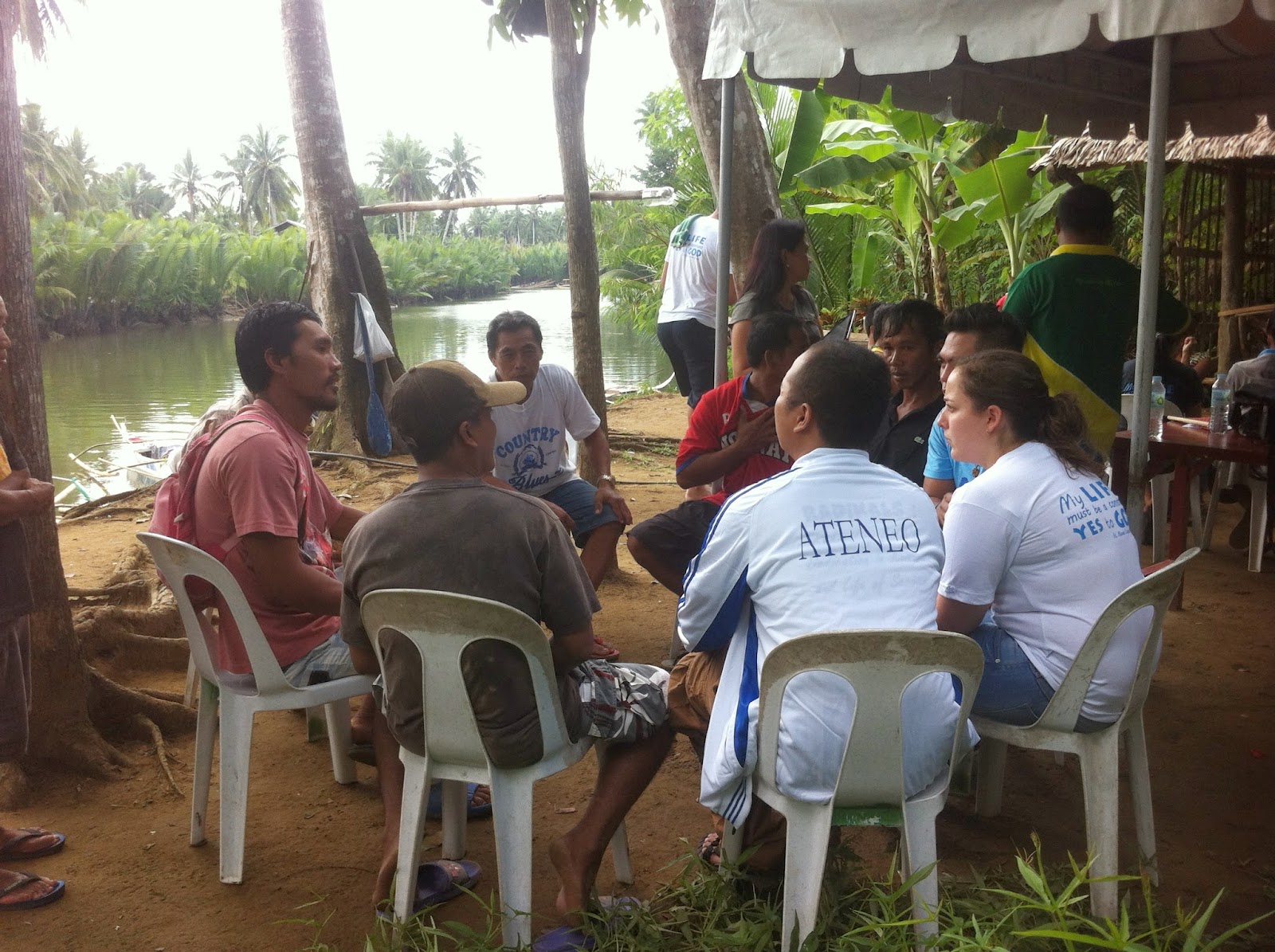
The callers are the volunteers of the Associate Missionaries of the Assumption or AMA for short. I know them not personally, but I met and befriended some of their peers sometime when they rowed down the Jal-o a long time ago--yes, but not that very long time ago. They brought with them their smiles, their friendship, their affirmation, their faith, their hopes, their stories. They came from as far as Europe and the United States (a friend and I found it amusing seeing a French animatedly chatting with a British volunteer), from Mindanao and North Luzon and even from nearby Iloilo, all to break bread with us today as we remember the sad incident of last year. They brought with them some means to help restore the lost livelihood of the fisher folks by the Jal-o. Yes,they brought us the Assisi Development Foundation which in turn capacitated the fisher folks to build boats out of the fallen trees.
Small group sharing: Here I am a year after Yolanda.

On that simple yet grace-filled gathering by the Jal-o today, we were informed that AMA and the Assisi Development Foundation opted to be with us for the occasion to witness the blessings and turn-over of boats (34 for today--and 50 last September 28) as part of the their Tabang Visayas reach-out program. And yet, they admitted that more than helping us process our trauma, they intently chosen to be with us for Balete has a special place in their hearts. One AMA "graduate" confessed that it was in Anao many years ago when she decided to give her yes to serve God through the poor by living the "Simple Life" They looked back at us to say thank you for that grand and wonderful immersion that they experienced while living with the kind people of Sitio Anao, Aranas.

The new batch of AMA volunteers rendered a special song
especially composed by one for Tabang Visayas. 
Today's interaction between those Assumptionistas, with Ms. Viel Aquino Dee and Ms. Vicky Borres, and the marginalized fisher folks by the Jal-o was a living testimony of the truism that the friendship of the rich and the poor is mutually enriching. It was a quiet yet eloquent love story of neighbors electing to carry the cross of one another.

Yolanda may have caused us much damage and even to some, tragedy; but like the Pandora's Box, she brings out with her moments of grace that lift up the human spirit to soar higher to remind one of his lost calling of living simply, kindly and responsibly along with his neighbor by the Jal-o River. A year after, may he finds the courage to echo the words of St. Marie Eugenie of Jesus, "My life must a be constant yes to my God."

Monday, September 16, 2013

Ro Tag-dapit sa Hae-o: A Prologue

Ro pilapil paadto sa Matalinhaga nga Daean

Ano pa ron ha.  

Bago pa man naka-obog rong mga conquestadores sa suba it Hae-o, rong katunggan nga makaron hay kilaea sa tawag nga Anao,  hay dati eon nga katilingban. Kato nga tiempo, ro katunggan hay baeay para sa mga nanari-sari nga tinuga, makita man o di makita it atong tawohanon mata. Para sa ratong mga tinuga, rong katunggan hay bukon eang it andang ueoli-an, bukon eang it andang daeangpan. Ro katunggan hay tawaya, bugana para sa pang-adlaw adlaw nga kinahang-ean, matawhay nga paeahuwayan, bunayag nga katilingban it tanan nga tinuga kung Makaako nga Kagamhanan.

Sa ratong may mga galing—mga pinasahi nga nakig-angot sa Tuburan it Makaako, sayod nanda rong himaya nga nakatago sa katunggan. Naka-intiende sanda ko matalinhaga nga pagsinaeayo ku tanang bagay nga una sa tawaya. Ro tanan, makita man o indi, nagahueag man o nakatanum, tag-lugar man o mortal, sanda ron hay may bugay nga kina-iya para sa padayon nga pagbilog it Kabuhi sa ginsakpan kung tubi it Hae-o.  Responsibilidad ko kada isaea nga patigayunon nana rong anang kina-iya kumo ruyon rong rason kon ham-an miembro imaw kung katilingban it matalinhaga rona sa Katunggan. Kamana ku Tag-dapit nga si Mang-it ag Nana Ambit. Ginbugayan sanda it galing pinasahi sa ibang tinuga, may kataas eabaw pa sa kahoy nga Danguea, mabaeahibo nga panit ag kahilig sa pinilipit nga abano.

Suma ay maaeam rong Makaako ngani nga si Mang-it ag Nana Ambit hay kapas magbulig sa ratong maintok nga mga tinuga sa pagtabok sa madaeum nga Hae-o. Sa andang pag-obog sa masueog nga tubi, natus-on nanda rong istuyuti daea eon rong andang pagkabutang agod indi mabasa o mahalitan ku iba unang tinuga sa suba. Daea man ku andang kabahoe ag pinasahi nga baeahibo ag kahilig sa abano, kargo nanda rong pagbantay sa kagab-ihon ku Daean nga Matalinhaga pasueod ag pagwa sa likod nga tawaya rona sa katunggan. 

Para sa tag-lugar, ro Daean nga Matalinhaga hay ordinaryo gid lang nga daean. Ogaling, para sa mortal, matalinhaga gid man ron ay sa pagbutlak it adlaw, indi ron makita. Sa tawohanong mata, ro puertahan kon tan-awon hay isaeang ka Nonok o puno it Tugop. Sa taglugar nga may kina-iya nga manguryoso sa bagay-bagay nga hamuea-in, ro Daean hay bukon it makakaeangay kumo ordinaryo.  Ideya ra ku Makaako eamang nga maproteheran rong kada isaea, taglugar man o mortal.  Ag para sigurado gid, ana nga gintugyan kay Mang-it ag Nana Ambit rong responsibilidad sa pagbantay kara.

Ugaling may mga bes nga masaku ro daywang ka Tag-dapit kapin pa kon gabaha ro Hae-o ag ru tubi hay eatob eon hasta sa mga katipusuan una sa katunggan. Tiempo ra nga nahueat ku mga Tag-suba nga magpuka-puka ag magminalit sa mga ibang tinuga rona sa katunggan. Kumo angid sa mga tawo, madali sanda makig-impon sa mga mortal nga nahanaeang rona sa suba. Kay Mang-it ag Nana Ambit, nagakinahang-ean ra nga sindihan nana rong andang abano para matabog ro mga malit pa-uli sa andang buho sa idaeum it mga tipuso. Ro napaslawan una sa andang buho, nagapanangison eon lang, ro andang owang bati-on sa katunggan, “Koh!, Koh!, Koh!”

Tiempo man ra ku mausisang Tag-lugar nga magwarang pagwa sa Daean nga Matalinhaga paadto sa hil-o it mga tawo. Masaku ro Tag-dapit. Owa it bantay ro Daean. Libre ro Ma-usisa sa pagdiskobre ku hamuea-in nga kalibutan.

Sa hamuea-ing kalibutan, sa katunggan it Anao, ro dalagitang unga it maninikop nga si Kagiyaw hay nag-apas sa pangpang it suba agud hatdan si tatay na it ihapon. Gasalikaeom eon ro hapon ag ro tubi amat-amat nga nagaawas. Sa daeanon, solohanon si Kahamungaya nga nagpanikangon.
Ro payag ku maninikop nga si Kagiyaw

Sa makarang sitwasyon, ro katalinhagaan hay nabaeay. Sa Daean nga Matalinhaga, sa tanang tinuga, nagsub-eang rong kabuhi it Mausisang Tag-lugar ag Kahamungayang Mortal. Rong tanan sa hinali hay nagbalhin. Naghinugyaw rong mga agagangis, nagsiga rong mga aninipot, nagpahumot rong mga saliyaw.  Dayon, rong sugilanon nahanungod sa paghigugmaanan it Tawo ag Engkanto hay nag-umpisa. 

Ano pa ron ha.


Thursday, January 17, 2013

Song of the Jal-o


KANTA KU JAE-O
Naga-eumpat ako sa bueogsukan kung Aeatubang
Sa ilaya nga akon ginhalinan
Sa kabukiran sa unhan pa it Benitinan
Kun siin may maberde pang kagueangan.
Iba eon ako makaron
Ilig ko bukon eon it masueog
Kon amat matin-aw pero eaban hay maeobog
Bisan pa ako mat a ra sa gihapon.

Naga-ilig ako sa dagasanan sa Kipot
Sub-eangon ku rong sili pati sa kahoy rong siga ku mga aninipot
Iya eon lang sanda mapabilin kumo ginahingabot
Sa ilawod nga anay anda man nga palibot.
Iba eon ako makaron
Ilig ko bukon eon it masueog
Kon amat matin-aw pero eaban hay maeobog
Bisan pa ako mat a ra sa gihapon.

Padayon rong haganas bisan pa sa tig-ilinit
Sa kurbada sa may Takasan ni Ambit
Sa balsa makaron ag ku baroto anay ni ‘lo Pantit
Sa akon nga sueog naga-eupsi ro imo nga panit.

Iba eon ako makaron
Ilig ko bukon eon it masueog
Kon amat matin-aw pero eaban hay maeobog
Bisan pa ako mat a ra sa gihapon.

Dag-onan ku nga ginadagsaan rong siyam nga katilingban
Eay-on ag dagutdot halin sa kalbo nga kabukiran
Pati eon rong rong hilo sa kaeanasan
Nagahangla sa tangke ro sugpo ag pasayan.
Iba eon ako makaron
Ilig ko bukon eon it masueog
Kon amat matin-aw pero eaban hay maeobog
Bisan pa ako mat a ra sa gihapon.

Iba eon ako makaron
Ilig ko bukon eon it masueog
Kon amat matin-aw pero eaban hay maeobog
Bisan pa ako mat a ra sa gihapon.
Manugpatigayon ku bukid ag ku eawod
Eatayan ku taga Ilaya ag ku taga ilawod.
Iba eon ako makaron
Bisan pa ako mat a ra sa gihapon.

SONG OF THE JAL-O
I drop into the Falls of Aeatubang
Upstream where I came from
In the mountain ranges beyond Benitinan
Under lush of green of the last forest I become.
I have changed from what I had been
For my current are no longer that strong
Sometimes I am crystal clear but typically wrong
Even then, I am still who I am.

I flow  along the rapids of Kipot
Where I encounter the freshwater eel and the luminescence of fireflies I reflect
In here they opted to stay so as not to be caught
Away from the downstream where they are checked
I have changed from what I had been
For my current are no longer that strong
Sometimes I am crystal clear but typically wrong
Even then, I am still who I am.

I keep running my course even in arid days
Take along the bend at Takasan ni Ambit
That through my surge your skin turned pale and blasé
Under the bamboo raft of today just as in the wooden boat of Old Pantit.
I have changed from what I had been
For my current are no longer that strong
Sometimes I am crystal clear but typically wrong
Even then, I am still who I am.

Annually I inundate the nine communities
With silt and debris from the balding hills
And even the sticky pesticides from the factories
To maledict in the ponds the prawns and the shrimps to chills
I have changed from what I had been
For my current are no longer that strong
Sometimes I am crystal clear but typically wrong
Even then, I am still who I am.

I have changed from what I had been
For my current are no longer that strong
Sometimes I am crystal clear but typically wrong
Even then, I am still who I am.
Matchmaker of the mountain and the sea
The bridge of the Ilayanhon and the  dweller by the Balete tree
I have changed from what I had been
Even then, I am still who I am.

Wednesday, August 8, 2012

The Three-fold Functions of a Punong Barangay

An elementary pupil was tasked by her teacher of interviewing the chieftain (Punong Barangay) of a barangay (village). Such is a hard tasked for a toddler in primary education, I reckoned.  But the child was adamant to oblige the wishes of her mentor. She asked her parents for help, who in turn, asked for my intervention. So one fine day, I arranged the meeting of the child and the village official. Their conversation went this way (in vernacular):


Q – What is your name, sir?
A – I am Roberto A. Cuare. I am the Punong Barangay of Barangay Morales.

Q – What is the nature of your job, you being the Punong Barangay of Morales?
A – As Punong Barangay, I perform the three-fold functions of the government. First, I am the chief executive of the barangay government. Second, I am the presiding officer of the legislative council, locally known as the Sangguniang Barangay. And third, I sit as the chairman of the Lupong Tapapamayapa, previously known as Barangay Justice, which is tasked of mediating or arbitrating disagreements among the local residents. For that matter, I sit as judge in this quasi-judicial body.

Q – How many households are there in your barangay today?
A – Barangay Morales has a total population of 2,618 or a total household of 573 per the 2007 National Census of Population. Our population growth rate is at 1.3% per annum.

Q – What projects are being implemented today that will benefit the people in our community?
A – There are many projects being undertaken to address the situation in the community. We coded them under the SPECSE paradigm as follows:
a.     S stands for Social Services. Under this area, the Barangay takes active part in implementing the Conditional Cash Transfer (CCT) or the so called 4Ps (Pantawid Pamilyang Pilipino Program) among the poorest families. Also, it assists the DOH in conducting the National Household Targeting System-Poverty Reduction through the organization of Community Health Teams. Through these programs, the poor are made members of the Philippine Health Insurance Corp. Parent-beneficiaries are required to enroll to schools their school-going age children and are enjoined at availing the health services being offered at the Health Center.  The Barangay also maintains a Health Station and a couple of Daycare Center situated in strategic areas in the locality. It actively coordinates with the DepEd and the Local School Board in the maintenance of the Morales Elementary School. It sets up Tanod outposts and established its own Barangay Disaster Risk Reduction Management outpost and linked up with the Balete PNP and the Municipal DRRMO.
b.     P stands for Political maturity. People empowerment is made possible to transparency, accountability and good governance. We make it happen through the conduct of regular Barangay Assembly and afford our people with the correct information and progress report concerning the administration of the barangay. In the implementation of programs and projects, we see to it that community involvement and their active cooperation.
c.      E stands for economic development. To compliment the 4Ps and NHTS-PR programs we encourage micro-financing to facilitate loan windows and the inflow of local investment in the community. In Morales, several lending agencies such as Taytay sa Kauswagan, Microsavers, Uswag, etc., open their windows to those who would want to start backyard hog raising, multi-cropping initiatives, etc. Morales is basically a farming community and most of my people derived their living through the fruits of their harvest.
d.     C stands for cultural identity. The people of Morales are proud of their heritage as part of the Baleten-on people. We hold dear to our hearts things or events that identify us from among the rest. We thus give time and the rest of our resources to upholding and preserving our cultural and heritage through our active participation it the annual Kultura Balete celebration.
e.     S stands for Spirituality. Our barangay officials took time to attend to their spiritual needs. Just of the recent, we underwent a Moral Recovery Program initiated by the DILG. Our SK officials too have their seminar on Ethical Standards for Civil and Public Servants. These are non-sectarian activity that seeks to rejuvenate our noble aspirations for our people. Having humane and God-fearing officials will not be to the disadvantage of the community and to the individuals, much to those sectarian groups in the barangay.
f.          E stands for the Environment. We are what we are primarily due to our environment. Without it, nothing can there be. Precisely that the Barangay is stringent on imposing environmental measures. Its proactive project is on its establishing nurseries for tree saplings, the conduct of regular tree planting and cleaning and greening in the community.

Personal Insights

·        Punong Barangays are tasked of fulfilling the three-fold functions of the government, i.e., as executive officer, as legislator and as judge in a particular community.
·        Punong Barangays, despite the burden their carry on their back are salaried very low as compared to executives, legislators and judges in both the government and private sectors.
·        Punong Barangays are the ones who have direct encounter with the people. They see, hear and feel their sufferings and daily struggles and yet they are paid low. They attend to their problems 24/7 a day and yet they don’t have social security insurance. 

Friday, July 27, 2012

That They May Be One


    So that we may believe that God the Father has sent you to shepherd us, we pray for your oneness in mind and heart. We pray that you lead us away from the encircling gloom with your staff and protect us by your strong arms from the malaise that prowls like a roaring lion looking for someone to devour.

    We pray to Jesus, our Lord, that you parry the confusion out of our tired hearts and that you may win the trust and confidence of those that you pasture.

    We pray that the Holy Spirit inspires you to break bread with your brethren and show us the example of how good and pleasant it is for brothers to live together in unity.

    With Mary, our mother, we pray for all to be sympathetic, to be compassionate and humble in dealing with one another whom we see Jesus in each of them, more so in the poor and the least among us.

    Amen.

Thursday, July 12, 2012

A Prayer for the Christian Community who Journeys into a Better Balete than Yesterdays


        O, Ginuo, amon nga Diyos nga Amay, ano kanami tan-awon ro imong mga tawo nga nagakabuhi sa gugma ag pag-ambitanay. Ano ka sadya pamatian ro andang kanta it pag-iegmanghuran ag pagbueuligan sa oras it pagtilaw!

      Ikaw ro amon nga ginadayaw sa tiempo ngara it pagbag-o. Kabay, nga sa rayang panahon padayon kami nga ibhan ni San Rafael nga Arcangel sa among nga pagpamanawon sa daean it pag-eigmanghuran kay Kristo-Hesus. Ro imong presensya hay magtao kamon it inspirasyon nga panestigusan rong kamatuuran sa pihak kung pagtilaw it kapurilan. Ikaw ro among kaisog sa pagbag-o ku dapat bag-uhon, rong kaaeam nga nagagiya kamon sa paghimo it tama ag matarong nga desisyon.

        Ro Imong Espiritu ro among manuglipay ag kabulig sa pag-abaga ku mga paeas-anon daea ku among responsibilidad bilang mga lideres ag miembro kung Kristianong Katilingban. Kabay, nga padayon imaw nga mag-tao it kaaeam kamon, eabi eon guid sa rayang adlaw it pagbag-o, sa among pagpang-eakaton nga nagapas-an ku krus it pag-eigmanghuran pauli sa baeay nga imong gintigana kamon.

        Guinapasaeamatan namon ikaw sa imong mga manuggiya nga ginpadaea kamon riya sa Katilingban. Kabay kunta nga sanda hay magpanistigos man sa kamatuoran it Gugma nga nagatubod una sa imong pagka-Dios kaibahan si Kristo ag rong Espiritu Santo. Mangin hueuwaran namon sanda sa pagtao it katumanan sa imong Pulong para maibantala ron sa tanan, eabi eon gid sa mga kubos kamon.  

Sa gahum it Imong Espiritu, magpadayon, kami nga magmatutum sa among sinumpaang responsibilidad, magpadayon nga madaea namon sa kauswagan rong amon nga comunidad sa pihak ku mga sab-eag nga among gina-atubang.

     Amon rang ginapangayu, paagi kay Kristo, kaisa ku Espiritu Santo, Dios sa walay katubtuban nga tanan.

       Amen.

       O Maria nga ina it Dios, ig-ampo mo kami. 

Wednesday, June 13, 2012

Si Baeägtingaw ag ro Muwâ it Sapá

Anu pa ron ha.

Si Baeägtingaw hay namunit sa sapa. "Sin-o ro nagapamunit sa a'ng sapa?" Ro Muwa nangutana.
"Ako, si  Baeägtingaw!" sabat ku mamumunit.
"Adtunan ko ag itikon si Inang mo." paandam ku Muwa.
"Adtuni." sabat ni  Baeägtingaw.
Ro bantay it sapa hay tumakas paadto sa baeay ni  Baeägtingaw. Idto sa balkon haabutan na si Inang. Dayon anang gin-itik nga nagahambae, "Itik Inang! Itik Inang!......" Si Inang nagligid sa saeog nga nagahinibayad. Nag-ilihi. "Man-o pa ing pagginhawa, Inang?" pangutana ku Muwa sa ina ni  Baeägtingaw.
"Makitid eon lang kay sa pasok." sabat ni Inang.

Masunod nga adlaw, namunit eon man si  Baeägtingaw. Pero bago pa pumanaw, si Inang anang ginhab-on sa taeägbasan.

"Sin-o ro nagapamunit sa a'ng sapa?" Ro Muwa nangutana.
"Ako, si  Baeägtingaw!" sabat ku mamumunit.
"Adtunan ko ag itikon si Inang mo." paandam ku Muwa.
"Adtuni." sabat ni  Baeägtingaw.

Ro sapat it sapa hay tumakas paadto sa baeay ni  Baeägtingaw. Idto sa balkon owa na hakita si Inang. Owa man imaw sa kwarto, owa man sa kusina. Owa sa sala, owa sa pantaw. Owa sa kasilyas, owa man sa dapog. Ginutom ro Muwa it usoy. "Ah, madu-om eon ako it bugas sa taeägbasan." hambae ku sapat. "Aha, iya ka gali sa taeagbasan ha!" anang hambae pagkakita na' kay Inang nga nakahab-on sa taeägbasan. Dayon anang gin-itik nga nagahambae, "Itik Inang! Itik Inang!......" Si Inang nagligid sa taeägbasan nga nagahinibayad. Nag-ilihi. "Man-o pa ing pagginhawa, Inang?" pangutana ku Muwa sa ina ni  Baeägtingaw.
"Maku binlod eon lang it bahoe." sabat ni Inang.

Masunod nga adlaw, namunit eon mat'a si  Baeägtingaw. Pero bago pa pumanaw, si Inang anang ginhab-on sa sag-ob.

"Sin-o ro nagapamunit sa a'ng sapa?" Ro Muwa nangutana.
"Ako, si  Baeägtingaw!" sabat ku mamumunit.
"Adtunan ko ag itikon si Inang mo." paandam ku Muwa.
"Adtuni." sabat ni  Baeägtingaw.

Ro engkanto it sapa hay tumakas paadto sa baeay ni  Baeägtingaw. Idto sa balkon owa na hakita si Inang. Owa man imaw sa kwarto, owa man sa kusina. Owa sa sala, owa sa pantaw. Owa sa kasilyas, owa man sa dapog. Owa man sa taeägbasan. Inuhaw ro Muwa it usoy. "Ah, mainom eon ako it tubi sa sag-ob." hambae ku engkanto. "Aha, iya ka gali sa sag-ob ha!" anang hambae pagkakita na kay Inang nga nakahab-on sa sag-ob. Dayon anang gin-itik nga nagahambae, "Itik Inang! Itik Inang!......" Si Inang nagligid sa sag-ob nga nagahinibayad. Nag-ilihi. "Man-o pa ing pagginhawa, Inang?" pangutana ku Muwa sa ina ni  Baeägtingaw.
"Maku tueo eon lang it tubi sa naatas nga sag-ob." sabat ni Inang.

Anu baea kara ro madason? Baea hay nag-ungkat si  Baeägtingaw it pamunit sa sapa? Kon owa t'a, hay siin na ginhab-on it uman si Inang? Hakit-an man dayon baea ku Muwa rong ginhab-unan kay Inang?

Anu pa ron ha.

Wednesday, May 30, 2012

Tree Planting and the High Tide

High tide. Debris of all sort float upriver. Pag-asa refuses to declare that the summer ends today. It promises though that maybe next week--the first week of June--summer departs.
The Jal-o at Bag-ot


High tide. And the rain pours shower on the arid land. How I wish it is already weekend and I can transplant those three seedlings given to me by the fair elfin lady. The orchard is still a mess though. The weeds are tall and the black-brown coucals (kokok) are still nesting on the thickets.
Kokok (Photo credit: Alex Loinaz @ birdwatch)
High Tide. I will remember your time this weekend. My old folks believe that fruit trees planted at your heights bear fruits in abundance. My friend's gifts will have to be replaced on a fertile damped ground at your hour that they may yield great in their appointed time. But I want to be sure. Hence, I shall harvest a few vermicast and spread it out around the holes where they shall be planted.
Yes. On high tide this weekend.

Tuesday, May 29, 2012

Rantings Down the Jal-o

The conclusion of the Corona Impeachment Trial reminded me of a couple of stories told down the Jal-o. These stories illustrate two survival techniques espoused by those who refused any of the principles of life being taught by those great minds that have had walked the earth:
Harvesting the produce of the pond

Deny Even if You Got Caught. 

    The fishpond operator is suspicious that some of his harvest are being stolen by an insider. He spoke out his mind in a threatening voice before his turf:
Sin-o kinyo ro kumupit it alimago? (Who among you took interest in my crabs?) 
Knowing that the operator is a mean man, the honest thief volunteered:
Sang saga man lang, Maninoy, ang ginbuoe (I only took about a kilo of them, my dear Godfather.)
The condescending operator thus responded:
Gago! Sayod mong saea, akoon mo! (Stupid! You knew beforehand that it is wrong and you dare admitting it!)
The produced of the brackish Jal-o

 Don't Throw Stones on Your Fellow Thief

The guard reported proudly to his boss. "Sir, I caught a thief tonight."
"What did you do to him?" asked the boss.
"Oh, I shoot him to death, sir."
"Holy cow! We will all be wiped out if you kept doing such thing!" (Gakala-ubos kita sini)

Tuesday, May 1, 2012

THE DECISIONS OF KAGIYAW


My mother used to tell us the legend of how Barrio Lalab got its name during our tender years. The story circles around Kagiyaw, a fisherman who made his living down the brackish portion of the Jal-o during his days. By his days, she meant the time when the Spanish colonizers were still arguing whether the world is round or not.

The story started with a decision. Kagiyaw decided to fish down the Jal-o one morning in summer despite the threat of a dreaded river monster called Kugtong. Soon enough, as he was rowing his boat downstream the river, the giant grouper swallowed him—and perhaps his boat. Wow, that's a really huge fish if it can swallow a boat! But Kagiyaw is the protagonist of the story. So he did not instantly die, otherwise the story would not go further than that. Besides, my mother's story was not a tragedy. It was meant to inspire us despite the apparent tribulations life gives us from time to time.

So, while in the belly of the giant grouper, Kagiyaw heard a voice of a fairy or a bird singing, "Eab-eabi! Eab-eabi!" Was it a kingfisher? The fear and disorientation took flight, and he remembered the knife tied to his hip. He grabbed it and started eab-eab—stabbing the belly of the Kugtong until he got out of it and breathed the fresh, sweet morning air.

His resurrected life.

And the birth of the barrio named Eaeab—Lalab.

Kagiyaw swam with the current and led the dead fish ashore. He salvaged the best part of it and called the attention of other fishermen to help him out with the carcass. Those who joined him scaled the Kugtong in what is now called Sitio Himbis, where, on the bank of the river, one could note the scaled formation of some stones.

Soon enough, the news of the feat of Kagiyaw spread out. People from all over were attracted by the prospect of taking a part of the carcass of the vanquished Kugtong and of meeting the man of the hour. Some of them managed to have a share, which they sun-dried for preservation. Today, the place where they sun-dried the fish is called Sitio Kaeug-a, meaning a place of dried fish.

Some of the meat rotted after long exposure to the elements. The place where some of the carcass decomposed is now called Sitio Ban-os. Residents thus decided to bury the rotten meat to get rid of the foul odor. That place was called Sitio Maeubong, signifying the place where they buried the remains of the Kugtong.

People upstream along the brackish Jal-o waited for their errands to arrive with their prize, only to see them come empty-handed. That place is now known as Sitio Hueaton, or the place where people waited.

Upriver, people grew impatient with the waiting and decided to catch fish for their lunch. They were those from the place called Sitio Pinamunitan, meaning a place where people decided to catch fish through line, hook, and sinker.

The story began with a personal decision on the part of Kagiyaw. It ended with a decision made by a community whose waiting had failed them. They chose to follow the river themselves and go fishing.

And so, along the Jal-o, the story of a fisherman who escaped the belly of a giant grouper lives on in the names of places. The river carries their memories downstream, past Lalab, toward Banga Bay and the Sibuyan Sea.

The people may have long departed, and the Kugtong may have returned to the realm of legend. But the names remain, each preserving a fragment of the story: where the fish was scaled, where its meat was dried, where its remains rotted and were buried, where people waited, and where they finally decided to fish for themselves.

Perhaps that is how a community remembers—not only through the stories passed down by our mothers, but also through the names of places we continue to inhabit.

The river flows on.

The decisions remain.


Monday, April 23, 2012

Rowing Down the Jal-o

The water is silent. Deep. It betrays movement. It hides the strong current that runs underneath the aquamarine surface.

Life sometimes is the water that runs silently. It is a movement; a jibing and tacking of some exiled souls.


Tonight, the angel announces: Be at peace, sojourner. Your boat is approaching a bend. For awhile, your are no longer exiled, rowing alone in the river of life. The dawn is about to break. I got for you a boatman who will journey with you to the next embankment.

While on your own, follow the North Star. She will guide you in the pitch black of the night as you navigate the shoals and the sandbars.

Then on the sixth month of the year, you will be reunited with the boatman of your soul. You shall once again row along with the Katilingban and the boatman will lead you home to your community.

Wednesday, April 18, 2012

Approximating Binakoe


Binakoe is definitely an Akeanon dish popularly known throughout the Philippines as "binakol". The net is rich with information on how it is done but always falls short of its spirit. Most surfers encounter clones which definitely alienate them farther off from its true nature and deprive them of the chance of feasting on this rare delicacy the way Datu Puti had it in his time.

Nemo dat quod non habet. That's the rule. Nature without spirit is ironically unnatural. Factual but not real. Bereft of its true essence. Artificial. An imitation. Preparing 'binakoe' without understanding its philosophy is deception. You cannot cook something which in the first place you do not understand.

Binakoe dates back to the pre-Spanish Panay settlers when cauldron was a very rare commodity. It has been handed to us by the Ilayanons who introduced us to a couple of variety of preparing it. I for myself witnessed and feasted on them during my visits in upstream Jal-o, notably in Dayas and Benitinian years back. When in Dayas or Benitinan, a visitor is asked by the children with this riddle: "What would you make of a fowl when you are tired of eating it grilled but find yourselves in the middle of nowhere with nothing but salt in hand and some wild herbs to collect around?"
Cooking a Binakoe the way our forebears did it.
The answer to that is of course, "Binakoe."


BINAKOE – HOW IT IS DONE 
Ingredients:
       1 dressed native chicken (preferably one year old or younger-talin o sueog) cut into bite-size pieces
       1 big onion, quartered (sibuyas)
       1 piece ginger (about the size of your thumb, peeled and pounded – pinaepag nga euy-a)
       1 teaspoon, black pepper (whole - recado)
       1 piece dried bay leaf (dahon it recado)
       Lemon grass (enough to seal the mouth of young bamboo internodes – tang-ead)
       Salt to taste (asin)
       (You may also mixed some Aeabihig leaves or fruits to give off sourly taste to your viand)
  
Pre-cooking Preparation:
    For Variety One – You will need one or two cleaned young bamboo culms* taken out of a newly felled down bamboo and cut to about ½ meter from each node. The hollow internode is where you put in the meat** already mixed with the rest of the ingredients. Seal each culm with the washed lemon grass. Place it perpendicularly near a fire for about an hour, regularly turning the culm to even up the heat and to avoid burning the inside of the internode.
    *Butong is the better alternative than the kawayan and the rest of the bamboo varieties as it is juicer. 
    **The dressed chicken, prior to cutting it into pieces, is pounded softly as if being beaten down, thus the term, binakoe. The wisdom behind this practice is to make the meat tender but firmer. It helps also in removing those sticky serum-like strands that enveloped certain parts of the muscle structure of the meat.  
Binakoe cooked on a young coconut drupe.

    For  Variety Two – one or two young coconut fruit (also called 'butong' in local dialect). Do not remove the coconut husk. Use a crosscut saw in opening finely the top of the young coconut. Discard the juice but leave the endosperm (the young coconut meat or drupe) untouched. On the hallow space of the fruit put in the mixed ingredients and the meat, capping them with the lemon grass. Replace the top of the young coconut to serve as cover of the lid. Cook it directly on fire for about 1 to 2 hours. 

Feast on it with you bare hand and match it with bisaya (upland rice variety). You won't regret scaling the heights to Benitinan or Dayas. Those are just bonus besides the opportunity of communing with nature at its best. 

Sunday, January 29, 2012

The Unconscious Rowed on the Jal-o River


I SAW myself by the Jal-o River--or was it the Jal-o? I was into a tribal village where the people that populated the area were skeletal. I wondered what became of them for they seemed lifeless. I sensed though that they're all alive and that something evil ruled over them. So sensing the danger, I fled from their place and continued with my rafting into another place.

As I reached my destination, the milieu presented itself as familiar. The place was abandoned for quite a long time. As I surveyed it though, a feeling of déjà vu overwhelmed me. I seemed to recall that I'd been there. Tried as I must, I couldn't figure out when and how.

I was awaken by some noise when I was almost grasping that sense of familiarity.  

Thursday, January 19, 2012

A Directory of Bisaya Rice Grown in Upland Balete


 THERE have been some animated discussions concerning the effect in the biodiversity of our environment vis-a-vis the introduction of genetically altered rice to supplement the staple food in the impoverished and Vitamin-A deficient countries such as the Philippines.  Its repercussion reached the far flung mountainous sitios of Benitinan and Dayas when then parish priest of Balete, the Rev. Msgr. Pedro C. Frac collaborated with Prof. Dr. Klaus Becker of the University of Hohenheim sometime in 2000. The collaboration brought forth some developments that benefited the people of Balete and the academe, among others was a thorough and insightful look into the aspects of nutritional values of indigenous upland rice varieties grown in Balete and Libacao. Several scholars came over to help out the collaboration. One of them was Michael Frie, a German national who managed to come up with his diploma thesis on the subject at hand. The chemical composition of rice grain identified hereunder are based on his work done sometime in April 2002. 


Name

Crude Protein
(% DM)

Crude Lipid
(%DM)


Gross Energy
(kJ/gDM)

Beta-carotene
(ppm/DM)

Phosphorous
(%DM)
Aromatic Brown
8.1
1.9
17.8
0.030
0.41
Bagoean 1
9.9
2.2
18.0
0.028
0.35
Bagoean 2
10.4
2.6
nd
0.040
0.37
Benibi
9.8
2.9
18.2
0.033
0.40
Bihud 1
11.6
2.8
18.1
0.007
nd
Bihud 2
9.2
1.5
17.6
0.019
0.36
Bihud 3
9.9
2.3
nd
0.000
0.28
Binangdan 1
8.6
1.6
17.2
0.023
0.16
Binangdan 2
7.0
2.0
nd
0.000
nd
Buhangin
8.9
2.4
nd
0.009
0.32
Burok
10.4
2.6
17.9
0.000
0.28
Calulay
10.0
2.6
nd
0.000
0.24
Camoros
13.7
2.0
18.3
0.020
0.32
Canato
10.3
2.5
17.8
nd
0.30
Capukao
9.6
2.5
17.8
0.023
0.26
 Dayuyo, Sticky Rice
10.3
2.9
17.8
0.011
0.35
Diamante 1
9.8
2.6
nd
0.000
nd
Diamante 2
8.6
2.4
17.8
0.016
0.22
Di Castilla
10.9
2.7
17.8
0.061
0.43
Dinolores 1
9.0
2.5
17.8
0.035
0.41
Dinolores 2
8.5
2.3
17.9
0.028
0.39
Dinolores 3
10.2
2.1
nd
0.000
0.25
Entang 1
8.2
2.1
17.6
0.016
0.32
Entang 2
10.5
2.1
17.8
0.000
0.30
Guyud
10.0
2.5
nd
0.000
0.22
Inabaka
9.9
2.0
nd
0.000
0.24
Ininyam 1
9.5
2.4
17.6
0.024
0.35
Ininyam 2
9.1
2.6
nd
0.000
0.24
Kabalbag
7.6
2.1
17.6
0.055
0.28
Kabiray 1
9.9
2.5
17.8
0.015
0.38
Kabiray 2
10.0
2.6
17.9
0.018
0.21
Kabiray 3
9.8
2.5
nd
0.013
0.32
Kabiray 4
9.6
2.2
nd
0.013
nd
Kabugna
8.9
3.0
17.7
0.013
0.27
Kabunbun 1
7.6
2.3
17.6
0.029
0.27
Kabunbun 2
9.4
2.3
17.8
0.031
0.26
Kabunbun 3
9.0
2.0
nd
0.000
0.24
Kabunbun 4
9.3
1.9
nd
0.023
nd
Kaburok
10.1
2.1
nd
0.009
0.34
Kalonggo
7.5
2.0
17.4
0.000
0.25
Kalesod
8.4
2.6
17.6
0.018
0.25
Kapino 1
9.5
3.0
18.1
nd
0.35
Kapino 2
11.0
2.5
18.1
0.010
0.29
Kapino 3
10.0
2.8
18.0
0.022
0.45
Karaya
9.9
2.8
nd
0.000
0.30
Karibo
8.4
2.0
nd
0.009
0.25
Kasilag
8.3
2.2
nd
0.125
0.27
Kenaw-Etan 1
11.0
2.5
18.3
0.022
0.25
Kenaw-Etan 2
9.6
2.2
nd
0.013
0.27
Keong -Go
9.0
2.4
17.9
0.022
0.26
Kinabuno 1
9.8
2.3
18.0
0.014
0.21
Kinabuno 2
9.1
2.7
nd
0.000
nd
Kinabuno 3
9.5
2.1
nd
0.000
0.25
Kinaures
11.1
2.4
17.5
0.013
0.19
Kinta
9.9
2.7
nd
0.073
0.33
Kutsiyam 1
9.1
2.4
17.9
0.005
0.28
Kutsiyam 2
10.8
2.2
nd
0.013
0.17
Kuragang
10.7
2.9
18.3
0.021
0.021
Mabilonia 1
9.1
2.2
18.2
0.010
0.24
Mabilonia 2
8.3
2.3
nd
0.000
0.31
Malagkit 1
10.3
2.2
nd
0.032
0.21
Malagkit 2
8.3
2.3
nd
0.000
0.31
Malero
9.9
2.3
nd
0.019
0.20
Manumbaeay 1
10.9
2.3
18.2
0.033
0.34
Manumbaeay 2
9.2
2.6
18.0
0.021
0.27
Manumbaeay 3
10.7
2.6
17.9
0.000
0.22
Manumbaeay 4
10.3
2.4
nd
0.009
0.22
Manumbaeay 5
10.3
2.1
nd
0.023
nd
Milagrosa 1
9.3
2.3
17.8
0.017
0.36
Milagrosa 2
8.5
2.4
nd
0.000
0.33
Milagrosa 3
8.6
2.3
nd
0.000
nd
Milagrosa 4
8.0
1.9
17.2
0.013
nd
Minantika (Malagkit)
9.5
2.9
17.9
0.036
0.37
Munahan Bungduan
8.8
2.1
nd
0.000
0.27
Purple Glutinous
9.6
2.6
17.8
0.042
0.38
Quiaidonse (Bisaya)
10.0
2.1
17.6
0.023
0.36
Tabao
9.7
2.0
nd
0.009
0.28
Tipakla 1
8.7
2.4
17.7
0.016
0.26
Tipalka 2
8.4
2.2
nd
0.000
0.26
Tukhaw
9.1
2.5
17.8

0.26
Vinernal 1
9.4
2.2
17.5
0.009
0.37
Vinernal 2
11.8
2.0
17.6
0.000
0.33
A (no name)
9.1
2.5
17.9
0.019
0.29
B
10.5
0.8
17.7
0.007
0.36
C
7.4
2.4
17.9
0.006
0.17
D
7.5
3.2
18.0
0.015
nd

I do not pretend to fully grasp their impact on the issue of environmental ethics much on its scholarship. My bias however is for the preservation of these varieties and the greater appreciation of their unique nutritional values that makes the taga-ilaya (the highlander) the more resilient as compared to the taga-ilawod (the lowlander).

THE STORIES OF THE RINGS

  I simply want to preserve the humor that resides within the otherwise exacting relationship between the I and the Thou. That is why I am...