Posts

Towards New Evangelization

Image
The Call for a Culture of Encounter    The clergy in the Diocese is responding to the call of Pope Francis to proclaim the Gospel and promote a culture of encounter in their pastoral works. Such call requires a new approach to make all things new. A New Pastoral Orientation A new way of doing pastoral works in the parishes is being proposed by no less than than the chairman on Pastoral Ministry, Msgr. Pedro C. Frac. In a schema above, basic ecclesial communities (BEC) take central prominence suggesting a movement originating from the bottom struggling to live up to the promises of a new heaven and a new earth. The movement is focused on new catechism as a new way of doing evangelization. A New Catechism    The monsignor has pioneered in the Diocese of Kalibo a community-owned school-based catechetical program. The program, like a mustard seed, is silently thriving and gaining strong support among small communities in the whole municipality of Batan. Wit...

Simply Grand: My Life on the Zip Line

Image
Be Forewarned: Ride at Your Own Risk! Diving into a zip line is like getting married. Once you took off, there is no getting back. You have to take the plunge, attend to your fears and leave the rest to the line. Like the married life, the zip line enables you to experience all-in-one, both attraction and dread, the challenge, the excitement, glory, ecstasy, regret, fulfillment. THE ATTRACTION Zip line always attracts, just like a pretty face is. But the zip line in Lake Sebu, South Cotabato is an irresistible elfin lady. It towers the Seven Falls that emptied from the lake at an elevation of almost 600 meters. It consists of two stations, the first extends to 700 meters (from Falls No. 1 to Falls No. 5) while the other is 400 meters (from Falls No. 5 to Falls No. 2). The lush vegetation, the panoramic scenery and the enthusiasms of those who queue to take its challenge are more than enough to enchant a restlesshiker like me to try giving into its seduction. So impulsively I ...

Seduced to be God

Image
This piece is also posted in my other blog, " Our Restless Journey " Pope Francis'  commentary on Mark 9:38-40  last Wednesday, May 22, 2013 during the Feast of St. Rita de Casia, OSA, the patron of impossible things,  draws much attention  in a society that is fast becoming secular. His words were headlines and the next most shared item in social media. Why is that?  Sermo humilis ?  The other day, he was talking about the possibility of all men of goodwill entering the Kingdom of God, and he means, "all" including even those who refuse to believe in the existence of God. Yes, my friend! Even if you're an atheist or an agnostic, you can inherit New Heaven and New Earth. The proviso is simple. Do good works. Be good and shun evil.  Now, this reminds me of a youthful desire brought by an "entanglement" with Sartrean Existentialism. Human reality desires to be God. To Sartre, this is bad faith. Man is deluded to believe that he can be happy in...

The Neighbor I Never Met

Image
We could have talked extensively about Martin Heidegger's  Being and Time over several cups of coffee and later on exhaust ourselves on Sartre's Existentialism is Humanism over glasses of brandies. We could have philosophized about the quiet flow of the Jal-o River and collected common memories of its songs composed throughout the ages. But our roads were not meant to cross--even if our houses were only a few meters apart. I knew my neighbor only from third party. And that knowledge came only later when we were no longer neighbors. I befriended some of his brothers and cousins. I was particularly close to his grandmother, Lola Mabing (Mabina PareƱas Feliciano-Cortes). In my childhood, I had the privilege of turning her orchard into my playground with the perks of having to pick up fallen Rambutan and Chicos--in a time when Rambutan was still an exotic tropical fruit. When she and Lola Pining (Crispina PareƱas Feliciano) died in the 70's, La Mabing's daughter, Nay In...

Those Principales of Balete

Image
By the time Miguel Lopez de Legazpi declared the Philippine islands as a colony of the kingdom of Spain, the barangay  or pockets of kingdom throughout the archipelago were assimilated and their datus and families granted the privilege of continuing to govern their respective   barangays . Those nobles became the   cabezas de barangay  (later called Teniente del Barrios) of the barangays and the gobernadorcillos  (presidente municipales) of the   pueblos   or towns and were known then as the principalia . The principalia were a privilege class as consequence of their nobility. They were exempted from paying tributes (taxes) even as they were allowed to have real property. They were distinguished by the titles they carry, i.e., the Dons and DoƱas of the Spanish Philippines and the only ones who can vote or be voted upon as officials of the pueblos as in the case of a local election in May 8, 1893.  Yet, it can be noted in the later time...

Uninspired

Image
Something inside urges me to write something today. I refused on many occasions. I argued that I am not inclined of writing something worthwhile befitting of this journal--err, blog. I prefer reading these days. Yesterday, I grabbed a label of an olive oil and tried hard reading the minute printouts written therein. Today, I visited this site hoping to read something that would interest me. It failed. So I decided to surf from the list in my dashboard and I managed to engage my mind into the gibberish that my fellow ghostwriters were trying to advertise. Then again, I got tired of tiring myself in indulging into those promotions. What the heck! Why not try Facebook instead, whispered an inner voice. " ¿Para que? ", my rational mind responded readily. I realized later, I was back at square one as if an automaton writing this hallow words with nothing in mind but the desire of tinkering the keyboard of my computer. At the back of my mind, something tells me that I have...

Counting Numbers: Interpreting the SWS Survey on the State of the Roman Catholic Church in the Baleten-on Context

Image
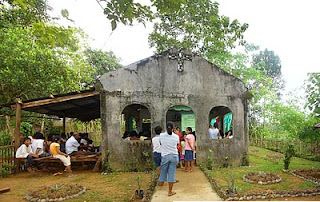
A storm in a tea cup. That's the impression of most of my priest-friends concerning the release of the 2003 SWS Survey about the present state of the Roman Catholic Church in the Philippines as the latter tries to come up with its so called Catholic Vote in time for the May 13, 2013 elections. The good Archbishop emeritus of Lingayen-Dagupan however sees it differently. But then that is his opinion. The Roman Catholic chapel in Sitio Duduemon, Calizo, Balete In my interactions with the clergy, I have maintained that the 37% attendance during Sunday masses is almost realistic and questioned the basis in claiming the 64% turnout recorded in 1991. As we all know, the survey registered among others the following data: 81% of the Philippine Population are Roman Catholics 80% are of majority age (18 years old and above) 29% consider themselves very religious 37% go to church to hear mass at least once a week compared to the 64% in 1991 9.2% think seriously of leaving the...