Tuesday, September 22, 2026

THE LIST


The morning is breaking softly today. The wet blades of grasses mirror the morning light in mythical symmetry. Some roosters still perching on their Indian Mango roost welcome it in solfeggio intervals. The brood of chicks plea on their mothers to hasten their morning rituals to hunt for some prospective worms. A couple of snipes inspect the drying stream winding through the orchard and down into the culverts set up by DPWH. It follows them across the Aklan East Road to join the greater water of the Jal-o yonder several communities in rural Balete. The lanzones and mangosteens spread their leaves quietly exposing proudly the ripening of their abundant fruits. On their branches black ants are already queueing in their endless lines as if they have not taken a respite.

The morning is breaking sweetly today. My wife’s brew is already steaming, a weft of bitter aromatics escapes into the fresh air and mingles with the sweet scent of a ripening eangka. The coffee! My morning ritual. A candle is lit, its flame dancing silently as if a laud, its whitish smoke raising the sigh of praise and longing around the altar in our living room.

The morning is breaking. Vehicles zoom fast the road outside in different directions. People are rushing it for their worries and concerns. The net is buzzing. The radios break in angst.  All are up and about.

All save for one.

In her bed, a barangay official refuses to welcome the day. She puts her pillow over her head. The night had been restless. Morpheus failed again to lull her to slumber. In her mind, no sheep are jumping over some fence. In its stead, a list of names keeps appearing as if phantom haunting her over and over again.

The list. That robbed her of her rest. It was not a very long one. Nor it was a very short one. Nothing special about it. But something in it deprived her of her sleep.  Names she knows quite well. It was like any other, a simple list of names. Names everyone in the small neighborhood know. Names of people whose roofs displays no stars and whose house stands on owned lots. Names of people whose parents get invited in social events and whose family names carry weights in a community that give due regards to men of consequences.

The list is for indigent beneficiaries. And they are there. All of them.

Monday, September 21, 2026

OF NEEDLES AND BLOSSOMS


I remember the morning because of the smell.

The saliyaw was in bloom around the star apple trees near the plaza, and the morning air was fresh and sweet. Across Plaridel Street stood our Gabaldon school building, where something unusual was happening. Health workers had come to vaccinate us, accompanied, as I remember it, by men in uniform.

Even as they were caught by surprise, my classmates were quick to concoct other plans. Some of them scrambled out through its Capiz windows. I watched them from near the Sunny Hillside Arch, amused by their ingenuity and perhaps a little proud of myself. I had nothing to fear. I was already vaccinated. My mother was the midwife.

I was five and was a “visitor” in Grade 1.

I did not know then that I was growing up under Martial Law, or what Presidential Decree No. 996 had to do with the government that had sent the health workers and the soldiers to our school. I knew only that my classmates were escaping a needle, and that I was safe from it. That morning held a strange paradox: laughter and fear, blossoms and needles, health entangled with the heavy hand of command.

Today, that old Gabaldon is gone, and the star apples and saliyaw no longer grace the plaza with their sweet scents. New structures rise, but the Sunny Hillside is still watching, still remembering.

More than half a century later, I found myself sitting in a public hearing in Balete, this time talking about a proposed local measure—the Expanded Balete Mandatory Immunization Ordinance of 2026. The report from the Municipal Health Office was sobering: only 43 percent of infants and children in Balete were considered fully immunized children (FIC) in 2025. That figure is far from the 95 percent coverage that the Department of Health seeks to achieve in every community.

We looked at the numbers on paper, knowing that behind every percentage are children, parents, health workers, and the community's responsibility to protect them.

And suddenly, the Grade 1 boy standing by the Sunny Hillside Arch came back to me.

The circle had closed. But this time, the needle is not a command born of fear or coercion. It is a covenant of care—a community remembering what it owes to its children, and passing that protection down to those waiting in our barangays.


Tuesday, September 1, 2026

THE RITE OF PASSAGE


My father’s errands were small rites of passage. He would press a few coins into my palm and send me down the street to Lola Elvie’s store, just a few houses away from our home at the back of the Puericulture Center. It was a general merchandise shop, typical of the 1970s, where rice stood beside soap, kerosene, and sundry goods—necessities for survival in upland Balete, when the Jal‑o River was still the principal road. By Saturday, Market Day, the place swelled with voices from Ilaya, the upland folk carrying their week’s barter and coins.

There, amid jars of candy lined like jewels and the faint smell of kerosene clinging to the air, I would ask for my father’s brand—Marlboro. Nang Viola, Lola Elvie’s daughter, would smile as I appeared at the counter, her eyes bright with familiarity, and ask what I was after for the day. That simple gesture—half welcome, half ritual—made the errand feel less like contraband and more like belonging. The cowboy’s brand, riding across the television to the brass and drums of The Magnificent Seven. I did not care for the cigarettes themselves; I cared for the music, the gallop of horns that seemed to promise a frontier beyond our town’s center.

            Returning home, I carried the sticks like treasure. I would lift them to my nose, inhaling through the filters, imagining a future where I too would smoke—not Marlboro, but Philip Morris Menthol, cool and green, a boy’s fantasy of adulthood. I told myself, when my time is come, I will be that man.

           Yet wonder of wonders, the years passed, and I never lit a single stick. The cowboy rode on without me, and the menthol dream dissolved into laughter. I laugh now at Ayn Rand’s solemn declaration that smoking is Atlas shrugging—man asserting his mastery, or a capitalist man proclaiming his dominion of Earth’s resources. To the boy I was, however, it was nothing so grand: only a cowboy, a soundtrack, a smile at the counter, and a scent caught in the filter.

          Now I stand grown, lungs unscarred, memory intact. The Marlboro Man remains a phantom of my childhood, his anthem still echoing somewhere in the background. And I, who once thought smoke would crown my adulthood, discovered something else instead: that sometimes manhood is not in the fire one learns to light, but in the fire one learns to leave alone.


Tuesday, April 30, 2024

BUEON-AGAN IN THE SUMMER OF 1980


Weeks before our graduation from Grade Six, the four of us were invited by Samuel, a classmate who lived at the foothill of Bueon-agan.

Bueon-agan is a steep, rocky hill stooping down on the small poblacion in the valley cut by the Jal-o River. It got its name, according to local legend, from a girl or woman dinaguit—abducted from what is now called Dumaguit. From there, her body, abused and dissected, was said to have been sun-dried on the rocky slab atop the hill we now call Bueon-agan.

Old folks claimed that Bueon-agan was mystically connected to the other hills of Balete: Agtawagon, Nasarok, Eumati, and another whose name is on the tip of my tongue but which I can no longer name.

I have long wanted to discover the tales about these hills, but I got distracted every time I went out into the Baleten-on world. Maybe one of these days, when I am no longer preoccupied...

Now, the four of us—Roy, Simeon, Jonard, and I—summoned our courage to hike into that mystical hill. This would be our first adventure outside Poblacion.

We were Boy Scouts. Not just ordinary Scouts. We held the highest ranks in the district organization of Baden-Powell. Perhaps that alone gave us the courage to venture into the unknown.

How were we to find our way? We had no map. No Google Maps back then, no Waze. We relied on instinct and common sense. On strangers we encountered along the way. And on our training as Scouts.

It took us less than half an hour of hiking and then another stretch of steady ascent to reach our destination. But we did not seem exhausted. The lush greenery, the fresher air, the singing of birds, the pristine water flowing melodiously along the creeks, the wonderful scenery, and the privilege of looking down on the poblacion from a vantage point—all these were enchanting.

From there, we could look across at the once-towering hills of Eumati and Agtawagon and wonder at how they seemed to rise to the same height as where we stood.

Add to that the sumptuous meal Samuel’s parents prepared for us: aromatic bisaya rice, binakoe nga manok, and pinayukan nga dahon it balinghoy nga may sinaeay nga batod.

Wow!

Those were the days indeed.


Thursday, November 26, 2015

Echoes: Encountering BEC

I do not want to end like the old mariner grabbing people to listen to his story at the sunset of his life. I want it that at the end of the day I rest assured that I have rowed my river and handed on to my children the lessons I have learned in my journey upstream to the House of the Father. So I made, early on, a solemn vow, that I would immerse my four daughters into situations that allow them to know and love the God of Jesus of Nazareth. Sadly, like most promises, mine was half-heartedly kept.
I can justify why I kept on failing. I was trained and educated to find reasons to the things I do. I have a lot of excuses; all of them are sound and rational. Yet honestly, they are like wicker baskets—they hold stones and boulders but not water. The truth of the matter is although I was raised a Catholic, (I even had seven years of formation in the seminary) I am struggling with my faith given my entanglement with Sartrean Existentialism vis-à-vis the clash of orientations at the local church.  Every day I wake up confronted with the question of meaning and automatically finds myself forcing to pray to the God whose existence I keep on questioning. 
Perhaps, my former parish priest senses the civil war raging inside of me and the growing apathy deep within that he keeps on disturbing me in my complacency. Just the other day, when the family was preparing for the Angelus, the monsignor came knocking at my door. He came bearing what he considered good news. He excitedly related that it appears the Division Office of the Department of Education is now adopting a policy concerning the 90-minute religious instruction per the 1997 Constitution. The move is supportive of his catechetical program in Batan (Aklan). 
The monsignor has pioneered in the Diocese of Kalibo a community-owned school-based catechetical program. The program, like a mustard seed, is silently thriving and gaining strong support among small communities in the whole municipality of Batan. Without wishing to, it is fast becoming part of the mainstream society that policy makers are giving it a second look. It started small. The parish priest and his coadjutors simply and consistently celebrated the Eucharist in the barrio chapels monthly. Then slowly, they encouraged parents and ordinary teachers to hear masses in schools too. Soon enough the team of three priests finds themselves busy saying masses and attending community and PTA meetings.  At present, each of them has more or less 13 masses a week, not to mention funeral and wedding masses and community meetings.
The communities became articulate. They demanded that the local schools afford their children their right to religious instruction as provided for in the Philippine Constitution. Equally, the ordinary government teachers heeded the call and volunteered themselves as instant catechists, despite their lack of training and to most, experience in catechesis. Thus begin the community-initiated school-based catechetical program that the Diocese is now gearing up to replicate in other parishes. Presently, the teachers who responded to the call number to about 200 more or less. They have received specialized trainings from the Institute of Religion of the University of Sto. Tomas (UST-IR) and had been certified by it as professional catechists. They catechized their pupils and students voluntarily as their token of gratitude to the communities that have supported them all along and as a response to the call they heard on the "Road to Damascus." Modules on New Catechism in Akeanon dialect are being developed with the assistance of the Diocesan Catechetical Ministry.
The multiplication of the bread is one ordinary yet wonderful miracle in Batan. One can note such reality in their breaking of bread whenever a communal affair takes place, say a seminar on catecheses or a Sunday Mass in their tiny chapel. A peninsular agro-fishing community harboring Batan Bay and facing the Sibuyan Sea, it prided itself of the richness not only of its natural resources but also of its history, heritage and culture. The Augustinian missionaries who interacted with the locals in 1600’s as narrated in Apuntes Historicos of Fray Juan Fernadez, OSA were impressed of their highly cultured and communitarian manner. He writes of this impression on Batangnons being:
“…the most noble in the Archipelago, a highly-cultured group
                              with well  built  beautiful  houses  and  many  well-organized
                              villages…” (p. 275)

The friars further noted that they were neither wild nor refractory. The memory of the race perhaps remains intact in the consciousness of the present generation that they positively responded to the initiative of their parish priest and readily regarded the program as their own and give it their all-out support.  Personally, I believe God is working wonderfully on the openness and generosity of these people most of whom had long been “unchurched” and marginalized by the mainstream society that typically represented the institutional church.  I had witnessed the transformation from their being indifferent Catholics to what are now budding witnesses and active members of Basic Ecclesial Communities. I am neighbor to them. By parentage, I am Batangnon too. As a child, I used to roam around the fishpond on my grandfather in Sitio Pinamunitan, Barangay Lalab and had known the saga of Kagiyaw along the meandering waters of the Jal-o and the legend of how Lalab got its name.  Precisely that I always take it as an opportunity to be of service—though in my own little way—to the Batangnon communities everytime Msgr. Frac asked me to write something related to his pastoral works. I consider it my role being part of the One Body of Christ made manifest in Batan BECs. To me, I am merely a follower of Christ Jesus and a servant of God. What I have had accomplished are my duties and for that I expect neither a reward nor gratitude.  The outpouring of help coming from the members of the community every time an event takes place either in the Parish or in the schools or chapels are manifestations of this understanding that each faithful is merely doing her/his duty in this brotherhood of ours in Christ Jesus. They are one with the whole Body of Christ. They see themselves as the Church.
            The multiplication of bread in Batan is one miracle that calls on me to reach out my left hand and thrust it on the bleeding wounds of the risen Jesus. But the fact that in Batan there are small communities regarding themselves as the Church despite their poverty is one miracle that tells me that God has pitched his tent in their midst to dwell with them. Indeed, as St. Ireneus used to say, their very existence is joy, A MIRACLE OF GOD!  
            The presence of my former parish priest in my house is an encounter rich with meaning and graces not only for me but most importantly for my family. I pray therefore that he may keep on disturbing us in our complacency that we may always be restless until we rest on the bosom of our Father in a New Heaven and a New Earth.
            

Wednesday, August 5, 2015

A Fisherman's Daily Bread


A man from the Jal-o came up one day to the Rural Health Center to seek the assistance of the midwives. His wife, he reported, was showing signs of giving birth.

He identified himself as a resident of a village downstream and had come by motorboat, then the best means of getting in and out of the place. There was an access road, a dirt road, but it would take hours of hiking, for public transport was rare and the terrain too dangerous to navigate. Besides, he owned the boat. It was his means of living.

He was a fisherman. He maintained a couple of tangab, or fish pens, and made his living from the river. Lately, however, he had failed to make his routine harvest because he had been attending to his expectant wife.

The Rural Health Physician, noting the typically unhurried day at the RHU, permitted the nurses on rural service to accompany the sole midwife in attending to the fisherman’s wife. Soon, the group boarded the motorboat, and off the fisherman went, navigating the quiet river.

The young nurses were loquacious and excited by the experience. They sat on makeshift boards placed at the center of the boat, delighted by their first journey down the river. It was their first call since arriving in town to fulfill the year of rural service required of young health practitioners before they could take their board examinations.

The midwife sat at the rear, where the fisherman had positioned himself to steer the boat. From time to time, she asked him about his wife’s condition since he had left home to fetch them. He readily supplied the answers, though anxiety filled his voice.

The fisherman was indeed frantic. He knew from experience how difficult his wife had labored in the past. They already had seven children, and the youngest had only recently learned to walk. Their eldest was thirteen, and he hoped and prayed that she would manage the household chores while her mother endured the spasms of labor.

Yet even in his anxiety, another concern occupied his mind.

He was calculating the prospect of playing gracious host to these health practitioners aboard his motorboat. He could manage, he assured himself, to trap a couple of hens. He would ask his son to grate some coconut meat so they could have chicken adobo sa payok, cooked in coconut milk. He was already wondering where to get some lemongrass and pepper when he heard a loud thud from underneath the keel.

Something big had struck the boat.

He gaped as a silvery object landed inside the hull, twisting violently before the shocked young nurses.

“Wow! A baeanak!”

A giant broad-mouthed mullet.

The smile on the fisherman’s lips was unmistakable. One of his prayers had been answered. His two hens were saved.

He thanked God silently.

“Padre was right,” he thought. “God really provides when you need it most.”

He returned his attention to the river, faintly hearing the excitement of the nurses over the big fish still twisting inside the boat, now trapped and very much alive.

Soon enough, he reached his destination.

He positioned the boat quite differently from his usual habit. He was particular this time. He wanted to please his passengers, whom he regarded with esteem, and would not want them to get wet while alighting.

When they arrived home, he felt relieved to see his wife waiting for them at the balconaje. She welcomed him and the health personnel with a smile.

He showed her the catch, and she grinned like a Cheshire cat.

But she smiled even more when she saw the kindly midwife accompanied by the vibrant and jolly young nurses. She ushered them inside and reserved the best chair for the midwife.

“Pungko anay, Nay Nela. Mayad man ro inyong pagpanakayon?”

Take a seat, Ma’am Nela. Did you have a comfortable journey?

Saturday, November 8, 2014

Those Assumptionistas Who Looked Back at the Jal-o a Year After Yolanda

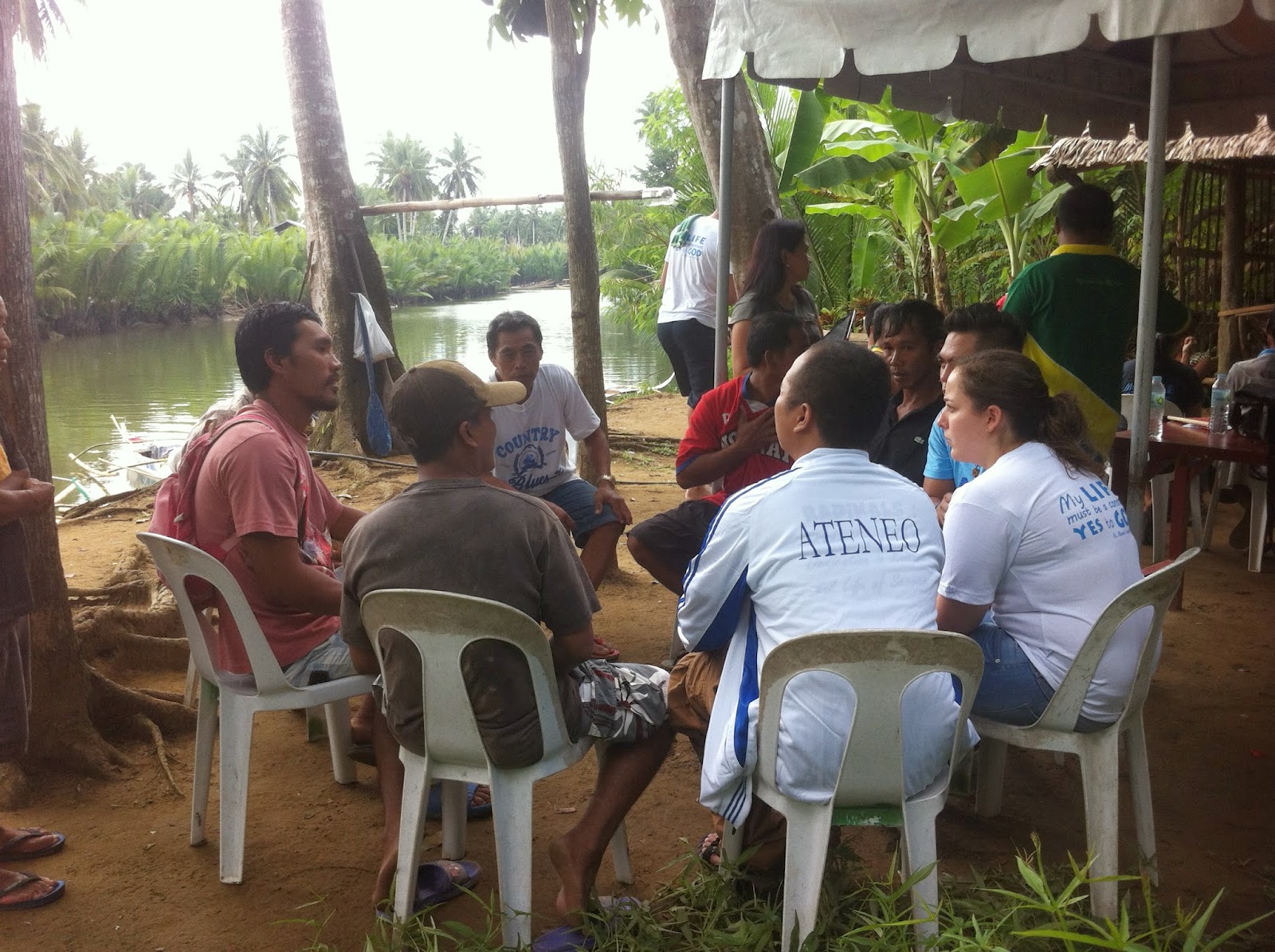
Today is the first anniversary of Yolanda, internationally known as Typhoon Haiyan, which has been regarded as the strongest of those typhoons that ravaged communities all over the world. I intended to let it pass without so much ado, for after all, most of my trees have never recovered when she battered them last years. My neighbor is still without a decent house to live in--despite the reported many humanitarian aids coursed through either the government or the non-government organizations. But there are those who knocked on our doors today, inviting us to see through the bitter experience that we had last year and reflect on the way we chose as we tried to stand up from its havoc.

Ms. Viel Aquino Dee, Vice Chair of Assisi Development Foundation
and Mayor Bobby Calizo of Balete, Aklan surveyed the boats
made by the fisher folks themselves.
The callers are the volunteers of the Associate Missionaries of the Assumption or AMA for short. I know them not personally, but I met and befriended some of their peers sometime when they rowed down the Jal-o a long time ago--yes, but not that very long time ago. They brought with them their smiles, their friendship, their affirmation, their faith, their hopes, their stories. They came from as far as Europe and the United States (a friend and I found it amusing seeing a French animatedly chatting with a British volunteer), from Mindanao and North Luzon and even from nearby Iloilo, all to break bread with us today as we remember the sad incident of last year. They brought with them some means to help restore the lost livelihood of the fisher folks by the Jal-o. Yes,they brought us the Assisi Development Foundation which in turn capacitated the fisher folks to build boats out of the fallen trees.
Small group sharing: Here I am a year after Yolanda.

On that simple yet grace-filled gathering by the Jal-o today, we were informed that AMA and the Assisi Development Foundation opted to be with us for the occasion to witness the blessings and turn-over of boats (34 for today--and 50 last September 28) as part of the their Tabang Visayas reach-out program. And yet, they admitted that more than helping us process our trauma, they intently chosen to be with us for Balete has a special place in their hearts. One AMA "graduate" confessed that it was in Anao many years ago when she decided to give her yes to serve God through the poor by living the "Simple Life" They looked back at us to say thank you for that grand and wonderful immersion that they experienced while living with the kind people of Sitio Anao, Aranas.

The new batch of AMA volunteers rendered a special song
especially composed by one for Tabang Visayas. 
Today's interaction between those Assumptionistas, with Ms. Viel Aquino Dee and Ms. Vicky Borres, and the marginalized fisher folks by the Jal-o was a living testimony of the truism that the friendship of the rich and the poor is mutually enriching. It was a quiet yet eloquent love story of neighbors electing to carry the cross of one another.

Yolanda may have caused us much damage and even to some, tragedy; but like the Pandora's Box, she brings out with her moments of grace that lift up the human spirit to soar higher to remind one of his lost calling of living simply, kindly and responsibly along with his neighbor by the Jal-o River. A year after, may he finds the courage to echo the words of St. Marie Eugenie of Jesus, "My life must a be constant yes to my God."

REMEMBER HER SMILE

  My friends, my family— As you know, my youngest daughter, Aurea Vera, gave up her life at the twilight of October 11, 2026. She was eigh...