Friday, November 6, 2026

SIESTA


I can’t recall the instance when we were taught about cloud formations. Science was taught in English when we were in our elementary years. There was no such thing as mother tongue instruction. Perhaps that is precisely why, to this day, I know cloud formations by their English names. I am ignorant of their Inakeanon counterparts. I have never heard my forebears speak of nimbus or cumulus in my native tongue. Nor have I encountered any specific taxonomy of clouds in Inakeanon, save for the general terms daeaora, the white cloud, and gaeum, the dark cloud.

When I was growing up, my parents made it a rule for everyone to take a siesta. Boys were often the violators of this household rule, particularly my younger brother, Achie, and me. But whenever we were made to observe that mandatory midday rest, I preferred the veranda.

Our home by the old Puericulture Center had a very long window secured by bamboo slats artistically crisscrossed by my father’s Teodosio cousins. The window had a suspended, veranda-like eave with bamboo flooring that could accommodate a small child like me, allowing me to recline on it. Lying there felt like being on a hammock, except that it didn't sway. The air passed through from both sides, and the view offered a panorama of the vast sky, yet I remained sheltered from the direct sunlight.

In that midday haunt of the mind, my eyes feasted on the different formations of clouds drifting by. My mind wandered along with them, riding with the banog and the salimbabatang, and reaching out to touch those cottony clouds. One afternoon, I saw an angel with her wings spread out, riding a unicorn.

Today, I had my siesta in AV’s room. I sought her permission, just as I always did whenever I needed something from her. This time, I simply assumed her nod and enigmatic smile. Her room is now wide open and bathed in sunlight. I chose the divan by her window, and for the first time since those childhood years, I was treated to a feast of clouds drifting by her familiar haunt.

For the first time, I have had a restful siesta since she left us.


Monday, November 2, 2026

THE SILENCE OF THE KUKOK


October 4, 2003. That was the date we moved into the Nameless House by the Baeaeu-an.

The Church observes that day as the memorial of St. Francis of Assisi, the patron saint of animals. The occasion was especially memorable to us, as stray cats, symphonies of maya capra, a snake, several geckos, a couple of bats, and a horde of black ants welcomed us into our new home.

Years later, the Nameless House became home not only to my growing family of five but also to a harem of rabbits, half a dozen pairs of lovebirds, a family of guinea pigs, assorted breeds of dogs, native chickens, turkeys, goats, and Kara—a mixed-breed carabao.

Stray and adopted animals were welcome, too. Even feral ones, like the marae—a small leopard cat—and the singgaeong—a civet cat—which often got run over by passing vehicles at night.

In the nameless creek, sili, freshwater eels, and wild ducks hunted for their favorite meals: crayfish, freshwater clams, and banag.

Uphill, we could always count on the presence of our neighbors, the households of Tay Berting and his son Totog. My wife's grandfather had placed them there as watchmen of the property he had inherited through his wife. They ran errands for us and helped with household chores whenever we needed them. They were the ayam—a Baleten-on label imposed upon the patriarch, Tay Berting. To us, they were our guard dogs.

Right after Yolanda, most of the tree canopies that had miraculously survived the onslaught of the super typhoon provided shelter to endemic birds seldom seen in this part of the country. I enjoyed watching punay—green pigeons and bleeding-heart doves—feasting on the fruits of bili, or marmelos.

Native to the place is the kukok—the Philippine coucal. Not a day passed without our hearing its haunting cry. Tueoy. That is how old people think of it. Some would even label it an aswang. Tueoy is the Inakeanon word for what English speakers might describe as wishing death upon someone or placing a hex on them.

But the kukok has been silent for most of 2026. I have not heard it cry out its haunting call. Not even when Av died on that memorable Sunday in October. It has been silent.

Did it know that Av would die that day? Was its silence a way of warning us that my daughter would no longer sing her songs? That she would no longer strum her guitar or dance her TikTok dances or paint sunsets on her canvas?

Much of the menagerie we once had is gone: the rabbits, lovebirds, guinea pigs, turkeys, goats, and Kara. So are the punay, the marae, the singgaeong, the symphonies of maya capra, and even the kukok. The nameless creek that cuts through our property is now without its sili and wild ducks.

Even the ayam uphill are gone—and the hill itself is no longer what it used to be. Tay Berting and Nay Yuning, his wife, have long been dead. Totog moved out to his wife's property in Lalab. Portions of the hills were leveled off by my wife's uncle. The secondary forest northwest of our place was destroyed in the name of development. It is no longer there.

They are all absent. Just like Av in our Nameless House.


Friday, October 30, 2026

FATHERS AND THEIR GRIEF


I sometimes wonder how parents survive the death of a child.

I remember John Q, the film where Denzel Washington takes an entire emergency room hostage in a desperate attempt to save his critically ill son. I think, too, of Eric Clapton, who famously channeled the tragic loss of his young son into "Tears in Heaven." Yet many others find no song to write, no stage upon which to perform their sorrow. Still, they endure.

I thought of this when Gary Granada arrived in Balete, shortly after the fortieth day of remembrance for his daughter, Kiel. He had come with Luke, his younger daughter, to continue work on a project we had begun more than a year earlier. Alongside Caitlin, Bryan, Mayann and our partners in the Local Government Unit, the Department of Education, and Societrix, he was helping develop contextualized learning materials for Citizenship Education.

What struck me was not simply that Gary came, but that he came while grieving.

During an earlier visit, Gary had quietly mentioned that Teacher Kiel had been instrumental in developing some of the very materials our educators in Balete were refining. To honor her contribution, we intend to publish these as learning handouts for Grade 10 students. In this way, her work will continue to speak to young minds long after her passing.

The months that followed brought a steady rhythm of plans, writeshops, meetings, and curriculum discussions. Schools across the district were introduced to the project. We spoke of books, policy, and ordinances. Life, as it always does, pressed forward.

Yet I refused to believe that Gary had somehow suspended his grief for the occasion.

He had publicly thanked those who offered prayers and condolences, apologizing for limiting his availability in the months ahead. But prior commitments, he maintained, would continue as scheduled. It was not a denial of loss; it was simply his way of carrying it.

Perhaps this is how some fathers grieve.

Their sorrow is not always visible. They do not always speak of it or display it for the world to see. They retreat backstage—sometimes slipping quietly into a dark comfort room—before stepping back out to face the work that awaits them. To a casual observer, they may appear composed, even untouched.

But grief has not left them.

It walks quietly beside them, accompanying them to appointments, conversations, and unfinished work. It waits in the silences between tasks and visits them when no one is watching.

Some fathers write songs. Others return to the work that still needs doing. Both are forms of remembrance. Both are acts of love.

And like the rest of us, they grieve.


October 31, 2026

Wednesday, October 28, 2026

The Nameless Home


I still have not found the appropriate word or phrase to describe my home at Manggaean. My family and I have lived here since October 2003. We were four when we moved in. In 2008, Aurea Vera was given to us as a gift from God, our golden truth. And yet, even when she was taken back last October 11, 2026, the place remained nameless.

Some strangers call ours the haunted house by the bend, as the thick canopy of trees enveloping it keeps the house hidden from passing motorists.  At night, however, passersby wonder at the light spilling through the trees, as though it were bursting out of nowhere. My wife, on the other hand, loved describing her sweet daughters as the Engkantada ni Al sa Likuan—the Fairies of Al by the Bend.

A name would be useful for practical reasons. It would help couriers deliver our parcels, the occasional postal worker finds our address (postage delivery having become something of a rara avis), and public transport operators identify the place. More than that, a name would give the house a distinct identity in the eyes of the public.

Our home stands alone at one of the many bends along Manggaean, now considered part of Sitio Campitan, Barangay Aranas, along the Aklan East Road. This particular bend, however, has acquired a reputation as one of the more menacing places in Balete. The old people called it Baeaeuan—a spooky place where elementals were said to dwell and play tricks on passing motorists.

To the secular mind, it is simply an accident-prone stretch of road. Many motorists have met accidents here, some of them fatal. Human error, intoxication, exhaustion, and sleepiness have all played their part. The road climbs at an incline of about fifteen to twenty degrees, bends one way, turns in the opposite direction, and then bends back again. Its successive curves can play tricks on the reflexes of even a weary driver. Just beside our house, the road crosses a nameless creek.

Our home has served on several occasions as a temporary infirmary for unsuspecting motorists who met misfortune along the way. The girls would readily help us attend to the injured and ease their pain. Our porch became a place of refuge for their battered bodies, offering them a brief respite until rescue arrived. The gated space in front of the house served as a temporary parking area for their damaged vehicles.

In the 1970s, the creek teemed with life. In the 1990s, its water was diverted into a small impounding reservoir to irrigate the vast ricelands of the Calizo family. The creek managed to survive, though it became something like a dagaas-linaw—a body of water that often dries up during long rainless months. A spring near our property continues to feed it, allowing the creek to flow, albeit with less life to sustain. I remember seeing freshwater eels in it on several occasions in the mid-2000s.

The nameless home has now been visited by death. With Aurea Vera's passing this year, it has become no stranger to the pangs and pain that death brings to those who remain. The house and the Baeaeuan seem to speak the same ancient lesson: life is fleeting as creek water in summer, yet abundant while it flows.

Thus, they remind us not only of our mortality but also of our duty to live.


Monday, October 26, 2026

THE STORIES OF THE RINGS


I simply want to preserve the humor that resides within the otherwise exacting relationship between the I and the Thou. That is why I am writing this piece on the Stories of the Rings.

Certain relationships are marked by rings and their curious evolution. Take, for instance, two people who agree to be friends and commemorate the occasion with a Friendship Ring. At a certain point, the ring evolves into an Engagement Ring. And from there, those reckless souls, perhaps armed with nothing more than optimism and a sense of humor, proceed to what they call a Wedding Ring.

But once the honeymoon is over and reality acquires its sharp teeth, the ring often becomes a Suffering. Through these transitions, some emerge stronger, and their rings may rightly be called Enduring. For the weak, however, the story takes a different turn. Their rings become Terering.

In Inakeanon, terering means losing one's sound mind, as though the bolts in one's head have come loose. It is perhaps the final transformation of the ring: from a symbol worn on the finger to a condition endured in the mind.


Tuesday, October 13, 2026

REMEMBER HER SMILE


My friends, my family—

As you know, my youngest daughter, Aurea Vera, gave up her life at the twilight of October 11, 2026. She was eighteen.

She was born on May 13, 2008, at the Balete Birthing Clinic of the Pacita C. Cortes Health Center, once the Balete Puericulture Center. She was the last child my mother, a newly retired Supervising Midwife, helped bring into the world. The nation was then embroiled in the NBN-ZTE scandal, with truth rallies taking to the streets. Amid that clamor for transparency, our family found its own golden truth. We called her Av.

She was our laughter and our tears, our innocence and our scars. She was woven into the fabric of our family, as we were into hers.

Scarred since childhood, she wrestled with her demons. Yet she was strong, as her mother was strong in her love and support. She was sweet, as her sisters showered her with affection. She was kind, and her friends were never far, ready to offer companionship, or the distance she sometimes needed.

She has gone ahead of us.

We will miss her.

It hurts beyond words to look upon her lifeless body. Yet perhaps more painful still is to feel her absence in the ordinary spaces of our lives. For a man who has pretended to be stoic, almost Promethean in his resolve, her death strips away every pretense. It lays bare the vulnerability of one who thought he had mastered composure.

She has gone ahead of us.

And the manner of her going leaves us with questions we may never answer. She took her own life. She left no note.

There was only that Sunday we had shared, an ordinary day now made extraordinary by memory. She massaged her father's aching back. She refilled the empty water jug. She laughed with her sisters, playfully scolding them and their mother for being too boisterous. She spent the afternoon with her boyfriend. Nothing in these recollections explains her going. They are simply the moments we shared, now immeasurably precious.

She has gone ahead of us.

Her absence feels absolute.

Yet I keep returning to that last smile, the sweet smile she gave us before going into her room.

I want to remember her smile.

Not because it explains her going. Not because it eases the pain. But because it was hers. Because she was here. Because, for all the pain she carried and all the questions she left unanswered, she was our Av.

And we loved her.

We thank our Christian community, our relatives, our friends, our fellow Baleten-ons, and all who have come to walk with us in this valley of sorrow. Your presence reminds us that grief need not be borne alone.

Above all, I thank God for lending Av to us for eighteen years. Eighteen years of laughter and tears, of struggles and triumphs, of wounds and healing, of memories that will forever remain part of who we are.

And I thank Av.

For even in her passing, she has awakened many of us to the things that truly matter. In our sorrow, we have been reminded to pray. We have been reminded to forgive. We have been reminded to love. We have been reminded that every moment shared with those entrusted to us is a gift and a grace.

Remember her smile.

Please remember her in your prayers.

May God, in His infinite mercy, grant her eternal rest, and may perpetual light shine upon her.

Amen.


(Updated on October 17, 2026)


Friday, October 9, 2026

Joecab

I saw Joyce from a distance yesterday afternoon. He was at the poultry supply, perhaps buying goods for his game fowls.

Joyce is a friend from my childhood in rural Balete. We grew up together, went to the same school, and were tutored by the same teachers from Grade 1 to 6 at Balete Elementary School. We were playmates, though not exactly the best of friends. We had our share of differences, and when diplomacy failed, we let our fists settle the matter.

 Old Baleten-ons called him Joecab—a monicker he earned for being the grandson of Old Lo Bador, the original “bagoe.” As you already know, Balete is notorious for giving a second baptism to its favored sons and daughters, christening them with monickers apt to capture certain characteristics in their persons. Thus, Joyce became Joecab, a combination of his first name and his grandfather’s “patented” nickname—not to mention that he was always sporting shaven head we used to enjoy rubbing with a chunk of goso.

 I was on my way home yesterday when I saw him standing before the poultry supply along T.F. Calizo Ave. He acknowledged my passing with a nod and a smile. Something in that smile somehow reminded me of a particular event in our lives—not when we were toddlers playing bricks and goso at the plaza, but when we were already grappling with the puzzle of puberty.

 You see, despite the feminine sound of his name, Joecab was a raging bull. He was already brimming with testosterone in his youth. On one occasion, he quipped, addressing the entire barkada:

 “Tao kon sin-o katon kara iya ro mauna makapangasawa?”

 But that’s not what I recalled yesterday upon seeing him. What I remembered was that particular instance in Mapait, one summer night…

 “This song,” Joecab proclaimed in his loud baritone voice, breaking the silence of the night, “is lovingly and heartily dedicated to Miss—Sin-o ngani to, pre?”

Thus began our harana, or serenade, to a young and beauteous vacasionista.

 As you also know, Joecab had a good singing voice and was a self-taught acoustic player. He was one of those few animators in our group of friends who could turn a simple gathering into festive carousing. Just let him strum his guitar to the tune of Tantaloyloyloy.

 Those were the days!

That’s Joecab.

And he was the first among us to get hooked.


Wednesday, October 7, 2026

Owning the Church of the Poor


Msgr. Adolfo Depra used to speak of the Church of Balete as truly the Church of the Poor. He made that remark sometime in the 1990s, after celebrating the High Mass during the Feast of St. Rafael the Archangel, which had been rescheduled to October 23 instead of the traditional October 24.

In those days, the roles of the local Church and the civil government in the fiesta were clearly defined. The Church was not trying to take over what did not belong to her. She was simply claiming what was rightly hers.

The fiesta was a religious event. As such, the Church strove to manifest the truth of Christian life in every facet of its celebration: in the preparation, in the celebration itself—from Day 1 of the novena to its culmination—and even in the evaluation afterward. The fiesta was meant to be a witnessing to the ideals of our brotherhood in Christ Jesus; never merely a festal gathering of frenzy and wild abandon.

Perhaps this was what it meant to be a Church of the Poor: not simply to stand with the poor, but to protect what was sacred to them, even when doing so meant confronting the habits and interests that had gradually taken possession of the fiesta.

To claim the fiesta was therefore not to claim power over the people. It was to reclaim a meaning that belonged to the people in the first place.

And perhaps this is where the Church had to be both pastoral and prophetic. Pastoral, because it knew the people and their lived realities; prophetic, because it could not simply bless whatever had become customary. It had to ask whether our customs still bore witness to what we professed to believe.

The question was never: Who owns the fiesta?

The deeper question was: What has the fiesta become—and what does it say about us?

For a Church of the Poor, that question could not be avoided.


Tuesday, October 6, 2026

BETOK, THE DUMUEUONG THAT HAS TAKEN ROOT AT LAST


MY FATHER was regarded by his peers as an outsider, a newcomer—a dumueuong.

He was a jack of all trades from Sitio Hueaton who married my mother of the Flogio-Perez clan of Sitio Pinamunitan. He built our first home on a parcel of land by a nameless creek in Pinamunitan, Batan, Aklan—a wedding gift from my grandparents, Eli and Curoy.

It was a paradise. Birds sang without fear, and the creek ran clear, sheltering fishes of every kind: puyo, pantat, aeogsok, oeang, sili, and more. It was there that our family began.

In 1973, with our growing family of five, he moved us to Balete and settled in a small hut behind the old puericulture center. The decision was practical, but in retrospect it seems almost providential.

My mother had just been hired as the town's midwife. She worked alongside a lady-doctor from Banga and a nurse who was the mayor's wife, and who would later become an “accidental mayor” herself. Soon after, my father was appointed Sanitary Inspector, serving first with old Tay Jamin Rafol and later with Tay Lende Barrios.

Yet despite his position and authority, the old tumandok—the true Baleten-ons—still regarded him as a dumueuong.

He bore the stigma with a mixture of derision and defiance. When intoxicated, he would sometimes rail against those who called him an outsider.

“Bah! They call me dumueuong—those without roots to boast about. Remember, Al, you are deeply rooted in this land. Your forebears were here long before those hypocrites came around.”

He would then recount the lineage of our clan, naming Dela Cruzes, Gomezes, Marcialeses, Rebenitos, Gallardezes, Teodosios, Tamayos, Redondos, and others.

In adulthood, I went looking for those names in the archives. His boast was not entirely a drunkard's invention. He was indeed descended from families whose roots reached deep into the history of the place. Perhaps that knowledge gave him the courage to ignore the label others had given him. Or perhaps the label itself made him more determined to prove that he belonged.

In the late 1970s, he astonished Balete by building a house out of coco-lumber. “What on earth is coco-lumber?” people scoffed. He answered not with words but with a shining, sturdy, termite-resistant house.

He bought a chainsaw, introducing it to Balete for the first time, and taught his Tamayo cousins, along with others, how to use it. He then made coco-lumber available to Baleten-ons as a cheaper alternative to good lumber. With his Rebenito uncles, he established a furniture shop. Their craftsmanship found its way into homes across Balete and beyond—tables and cabinets made from naga, dao, apitong, kamagong, and other hardwoods.

In 1982, he left for Saudi Arabia as an OFW. Two years later, he returned home and took over the management of our family's fishpond in Pinamunitan. He turned it into a thriving aquaculture venture, raising milkfish, tiger prawns, and mud crabs. To protect its earth dikes from the tides and flood, he planted nipa palm along the river.

By the late 1980s, his Teodosio cousins persuaded him to open what would become Balete's first hardware store. With little capital, he sought help from Fr. Tito, who was skeptical of the venture. But my father's conviction prevailed, and together they founded Balete Mini-Hardware. Through it many sturdy houses sprouted like mushrooms in Balete. The partnership did not last long, but the business prospered. It opened another door for him—this time into small-scale government contracting.

For the first time, perhaps, leisure seemed within reach. But success brings its own temptations. In midlife, pride and desire proved stronger than discipline. The ventures that had once carried him forward gradually slowed, then faded into silence.

Life, however, has a way of bringing us back to where we began. In his final years, my father returned to Pinamunitan. There, on the land where his journey had begun, he built a simple hut. He planted fruit trees, mahogany, acacia, and eucalyptus. I gave him a water pump and had a deep well installed, sparing him the burden of fetching water from the murky creek.

He died quietly on the early morning of January 3, 2024, at the age of eighty-two. His remains are now entombed on the quiet hill of Balete Cemetery. No longer a dumueuong. The land had finally claimed him as its own.

By then, our family had grown from five to eight. Five of his six children had families of their own. His fruit trees bore fruit for children who would never know the man who planted them. His hut was vandalized. His pump was stolen. The land grew forested. And the creek—the same creek that once ran clear and sheltered puyo, pantat, aeogsok, oeang, and sili—now struggled to breathe.

Perhaps that is what remains of a life in the end: not the houses he built, the businesses he started, or the things he accumulated, but the roots he leave behind.

My father was called a dumueuong because others thought he had no roots here. He spent his life proving otherwise.


Monday, October 5, 2026

OF CARPENTERS AND OLD SONGS


Old songs are doorways to yesterdays. On Sundays, I make it a ritual to listen to them—the ballads of the fifties, sixties, and seventies—not merely for their melodies, but for the rhythm they awaken in memory. 

They carry me back to afternoons beside my mother as she repaired a broken bariw mat. Her hands moved with quiet precision, each movement a beat in the rhythm of her day. As the lone midwife to a community of some fifteen thousand souls, perhaps this small act of mending was her way of resting from the heavy demands of her calling. I was told to take my siesta, but I resisted. I hated siestas. Instead, I rolled a pencil across the mat like a toy car while the afternoon stretched lazily around us. The movement of her hands, the rolling of my pencil, the drowsy heat—somehow, they have remained with me. 

The old songs take me there. They take me to the old house by the puericulture center, and later to my father’s furniture shop. There, the local panday worked with the quiet confidence of men who knew their craft. They arrived before seven, their pomaded hair already part of the morning scene. At nine, they paused for breakfast—sinabawan nga sapsap sa kamatis o eba—which they loved enough to sip down to the last drop. Fifteen minutes later, they were back at work. They labored until eleven, broke for lunch, took a strict one-hour siesta, and returned at exactly one. At five, they tidied the site, gathering their waste and leaving the workplace almost as they had found it that morning. 

There was a discipline to their hours, but there was also something gentler in it—a rhythm of work, food, rest, and work again that belonged to the life of the town itself. 

And so the old songs bring all these back: my mother mending the mat, the carpenters shaping wood in the afternoon light, the taste of broth, and the stubborn boy who thought an hour of sleep was an hour stolen from living. They bring back a way of life I did not know I was witnessing. 

I miss them. I miss those Sunday afternoons. 

Last Sunday, I switched on my phone’s Bluetooth to my Marshall. There, The Carpenters began to sing, and it is yesterday once more. 

Songs do not return the past exactly as it was. They return fragments of it—the sounds, textures, tastes, movements, and feelings that somehow survived in us. The old panday built the houses and furniture of my childhood. The Carpenters now help rebuild them in memory.


Tuesday, September 29, 2026

ARBOR DAY MEMORIAL


We observed Arbor Day today.

Early this morning, some of us from the local government unit went up to the foothill of Eumati at Sitio Arcangel Norte to plant trees. I scaled the heights of Eumati when I was a young man, but I had not been there since. Not even at Arcangel Norte. I decided to ditch the motorcycle, being unfamiliar with the terrain, and hitch a ride on the back of one of our 4x4 service pickups, together with the girls.

The road was long, winding, and mostly uphill, with the final ascent stretching more than 300 meters at a sustained incline of almost 45 degrees. Eumati leaned over us, inviting us to discover her again. But our roads diverged. We stopped at the entrance of Arcangel Norte Primary School, an old, solitary building with three classrooms, perched on a plateau facing the crest of Eumati. The school stood on an expanse bordered by a game farm on a rolling hill teeming with rambutan trees heavy with ripening fruits.

There, we planted varieties of endemic trees—narra, taghangin, and another whose name I failed to identify.

We planted them for us later to forget.

Yes. To forget.

We have been planting trees since the late 1990s. At one time, we aimed to plant a million trees across our vast territory. Balete has a total land area of 11,892.78 hectares. Its upland forest cover is pegged at only 2,054.30 hectares, while its mangrove forest covers 179.36 hectares. Our population, according to the 2024 CBMS data, is 30,310. One could imagine how thickly forested our land might have been had those million trees thrived.

But we forget.

We plant, then return to our quotidian worries, forgetting that we have planted trees.

Precisely why there is a need for an annual observance we call Arbor Day. We need it to remind us that we planted trees long before we planted trees today. Perhaps we should call it Memorial Arbor Day, an occasion to remember those trees we planted in the bare thickets of Eapos, at the foothills of Agtawagon, in the shade of Nasunogan, on the hidden hill near Kabuhian, in the heights of Anao, in the wilderness of Cortes, and in some other places I can now barely recall.

I wonder why, but today reminded me of the chocolate pig my daughter Aurea loved when she was just three. Something in them seemed to connect one to the other. I just can't figure out what.


Aurea at 4, guarding her sapling


Monday, September 28, 2026

RUBBING SHOULDERS

There is something valuable about riding public transport in Rural Balete. A jeepney ride offers the commuter perks that enliven his experience of humanity. In it, he is part of the whole. He rubs shoulders and body with the rest. He hears their stories. He smells their histories. He sees them as persons—not just individuals, and neither as statistics.

The jeepney is his public sphere. In it, he interacts with others through his daily commute and their quotidian worries. In it, the exigencies of life are shared. The jeepney is his community. In it, he belongs. He feels the others’ joys and struggles, the others’ victories and defeats, the others’ hopes and angsts, the others’ faith and disbelief.

Yesterday, I had the grand opportunity of commuting to Kalibo. I seldom take public transport these days. I am what others see as a privileged one, being placed on the high seat of power by local standards. I rub shoulders with the power-that-be. In a way, I am alienated from the common tao, from the ultimo, those who have least in life.

I seldom hear their stories and woes firsthand these days. I’m confined in the inner air-conditioned room, guarded by gatekeepers. Only the select can come to see me on a regular basis. My office has been appropriated and allotted to those who sought my advice or those who sought my intervention.

But yesterday, I had the wonderful opportunity of commuting. My travel was personal, not official. And I opted to commute. I don’t want to abuse the perks of a service vehicle. I want to reclaim my experience of rubbing shoulders with my fellowmen. I miss hearing their stories. I miss hearing them utter their unguarded tales, inflected in the sound of their language. There’s something different in their idioms, in the way they exchange words.

Yes. Yesterday, riding on a jeepney bound for Kalibo, I regained that heartwarming experience. As I rubbed shoulders with my fellow commuters, I listened to the tales of a woman behind me. She was addressing someone from her place. She was telling him about someone who was hospitalized and whose bills were now accumulating fast. She wondered where they would get the money to pay the bills. She talked also of a loanshark they happened to know. She said she was soulless. She said that she believed in gaba—karma. But the loanshark, she said, was not affected by it. It was her family that suffered because of her evil ways.

Kaeuoy ta ra mga unga nga nagaantus. She pities her children who suffered in her behalf. Sayod na gid ron. Sayod na gid ron. She emphasized it as if reciting a mantra.

Her words reminded me that the jeepney is not merely transport but a chapel of stories. In its cramped benches, we carry each other’s burdens, and in rubbing shoulders, we rub away the illusion of distance between privilege and struggle.


Tuesday, September 22, 2026

THE LIST


The morning is breaking softly today. The wet blades of grasses mirror the morning light in mythical symmetry. Some roosters still perching on their Indian Mango roost welcome it in solfeggio intervals. The brood of chicks plea on their mothers to hasten their morning rituals to hunt for some prospective worms. A couple of snipes inspect the drying stream winding through the orchard and down into the culverts set up by DPWH. It follows them across the Aklan East Road to join the greater water of the Jal-o yonder several communities in rural Balete. The lanzones and mangosteens spread their leaves quietly exposing proudly the ripening of their abundant fruits. On their branches black ants are already queueing in their endless lines as if they have not taken a respite.

The morning is breaking sweetly today. My wife’s brew is already steaming, a weft of bitter aromatics escapes into the fresh air and mingles with the sweet scent of a ripening eangka. The coffee! My morning ritual. A candle is lit, its flame dancing silently as if a laud, its whitish smoke raising the sigh of praise and longing around the altar in our living room.

The morning is breaking. Vehicles zoom fast the road outside in different directions. People are rushing it for their worries and concerns. The net is buzzing. The radios break in angst.  All are up and about.

All save for one.

In her bed, a barangay official refuses to welcome the day. She puts her pillow over her head. The night had been restless. Morpheus failed again to lull her to slumber. In her mind, no sheep are jumping over some fence. In its stead, a list of names keeps appearing as if phantom haunting her over and over again.

The list. That robbed her of her rest. It was not a very long one. Nor it was a very short one. Nothing special about it. But something in it deprived her of her sleep.  Names she knows quite well. It was like any other, a simple list of names. Names everyone in the small neighborhood know. Names of people whose roofs displays no stars and whose house stands on owned lots. Names of people whose parents get invited in social events and whose family names carry weights in a community that give due regards to men of consequences.

The list is for indigent beneficiaries. And they are there. All of them.

Monday, September 21, 2026

OF NEEDLES AND BLOSSOMS


I remember the morning because of the smell.

The saliyaw was in bloom around the star apple trees near the plaza, and the morning air was fresh and sweet. Across Plaridel Street stood our Gabaldon school building, where something unusual was happening. Health workers had come to vaccinate us, accompanied, as I remember it, by men in uniform.

Even as they were caught by surprise, my classmates were quick to concoct other plans. Some of them scrambled out through its Capiz windows. I watched them from near the Sunny Hillside Arch, amused by their ingenuity and perhaps a little proud of myself. I had nothing to fear. I was already vaccinated. My mother was the midwife.

I was five and was a “visitor” in Grade 1.

I did not know then that I was growing up under Martial Law, or what Presidential Decree No. 996 had to do with the government that had sent the health workers and the soldiers to our school. I knew only that my classmates were escaping a needle, and that I was safe from it. That morning held a strange paradox: laughter and fear, blossoms and needles, health entangled with the heavy hand of command.

Today, that old Gabaldon is gone, and the star apples and saliyaw no longer grace the plaza with their sweet scents. New structures rise, but the Sunny Hillside is still watching, still remembering.

More than half a century later, I found myself sitting in a public hearing in Balete, this time talking about a proposed local measure—the Expanded Balete Mandatory Immunization Ordinance of 2026. The report from the Municipal Health Office was sobering: only 43 percent of infants and children in Balete were considered fully immunized children (FIC) in 2025. That figure is far from the 95 percent coverage that the Department of Health seeks to achieve in every community.

We looked at the numbers on paper, knowing that behind every percentage are children, parents, health workers, and the community's responsibility to protect them.

And suddenly, the Grade 1 boy standing by the Sunny Hillside Arch came back to me.

The circle had closed. But this time, the needle is not a command born of fear or coercion. It is a covenant of care—a community remembering what it owes to its children, and passing that protection down to those waiting in our barangays.


Tuesday, September 1, 2026

THE RITE OF PASSAGE


My father’s errands were small rites of passage. He would press a few coins into my palm and send me down the street to Lola Elvie’s store, just a few houses away from our home at the back of the Puericulture Center. It was a general merchandise shop, typical of the 1970s, where rice stood beside soap, kerosene, and sundry goods—necessities for survival in upland Balete, when the Jal‑o River was still the principal road. By Saturday, Market Day, the place swelled with voices from Ilaya, the upland folk carrying their week’s barter and coins.

There, amid jars of candy lined like jewels and the faint smell of kerosene clinging to the air, I would ask for my father’s brand—Marlboro. Nang Viola, Lola Elvie’s daughter, would smile as I appeared at the counter, her eyes bright with familiarity, and ask what I was after for the day. That simple gesture—half welcome, half ritual—made the errand feel less like contraband and more like belonging. The cowboy’s brand, riding across the television to the brass and drums of The Magnificent Seven. I did not care for the cigarettes themselves; I cared for the music, the gallop of horns that seemed to promise a frontier beyond our town’s center.

            Returning home, I carried the sticks like treasure. I would lift them to my nose, inhaling through the filters, imagining a future where I too would smoke—not Marlboro, but Philip Morris Menthol, cool and green, a boy’s fantasy of adulthood. I told myself, when my time is come, I will be that man.

           Yet wonder of wonders, the years passed, and I never lit a single stick. The cowboy rode on without me, and the menthol dream dissolved into laughter. I laugh now at Ayn Rand’s solemn declaration that smoking is Atlas shrugging—man asserting his mastery, or a capitalist man proclaiming his dominion of Earth’s resources. To the boy I was, however, it was nothing so grand: only a cowboy, a soundtrack, a smile at the counter, and a scent caught in the filter.

          Now I stand grown, lungs unscarred, memory intact. The Marlboro Man remains a phantom of my childhood, his anthem still echoing somewhere in the background. And I, who once thought smoke would crown my adulthood, discovered something else instead: that sometimes manhood is not in the fire one learns to light, but in the fire one learns to leave alone.


Tuesday, April 30, 2024

BUEON-AGAN IN THE SUMMER OF 1980


Weeks before our graduation from Grade Six, the four of us were invited by Samuel, a classmate who lived at the foothill of Bueon-agan.

Bueon-agan is a steep, rocky hill stooping down on the small poblacion in the valley cut by the Jal-o River. It got its name, according to local legend, from a girl or woman dinaguit—abducted from what is now called Dumaguit. From there, her body, abused and dissected, was said to have been sun-dried on the rocky slab atop the hill we now call Bueon-agan.

Old folks claimed that Bueon-agan was mystically connected to the other hills of Balete: Agtawagon, Nasarok, Eumati, and another whose name is on the tip of my tongue but which I can no longer name.

I have long wanted to discover the tales about these hills, but I got distracted every time I went out into the Baleten-on world. Maybe one of these days, when I am no longer preoccupied...

Now, the four of us—Roy, Simeon, Jonard, and I—summoned our courage to hike into that mystical hill. This would be our first adventure outside Poblacion.

We were Boy Scouts. Not just ordinary Scouts. We held the highest ranks in the district organization of Baden-Powell. Perhaps that alone gave us the courage to venture into the unknown.

How were we to find our way? We had no map. No Google Maps back then, no Waze. We relied on instinct and common sense. On strangers we encountered along the way. And on our training as Scouts.

It took us less than half an hour of hiking and then another stretch of steady ascent to reach our destination. But we did not seem exhausted. The lush greenery, the fresher air, the singing of birds, the pristine water flowing melodiously along the creeks, the wonderful scenery, and the privilege of looking down on the poblacion from a vantage point—all these were enchanting.

From there, we could look across at the once-towering hills of Eumati and Agtawagon and wonder at how they seemed to rise to the same height as where we stood.

Add to that the sumptuous meal Samuel’s parents prepared for us: aromatic bisaya rice, binakoe nga manok, and pinayukan nga dahon it balinghoy nga may sinaeay nga batod.

Wow!

Those were the days indeed.


Thursday, November 26, 2015

Echoes: Encountering BEC

I do not want to end like the old mariner grabbing people to listen to his story at the sunset of his life. I want it that at the end of the day I rest assured that I have rowed my river and handed on to my children the lessons I have learned in my journey upstream to the House of the Father. So I made, early on, a solemn vow, that I would immerse my four daughters into situations that allow them to know and love the God of Jesus of Nazareth. Sadly, like most promises, mine was half-heartedly kept.
I can justify why I kept on failing. I was trained and educated to find reasons to the things I do. I have a lot of excuses; all of them are sound and rational. Yet honestly, they are like wicker baskets—they hold stones and boulders but not water. The truth of the matter is although I was raised a Catholic, (I even had seven years of formation in the seminary) I am struggling with my faith given my entanglement with Sartrean Existentialism vis-à-vis the clash of orientations at the local church.  Every day I wake up confronted with the question of meaning and automatically finds myself forcing to pray to the God whose existence I keep on questioning. 
Perhaps, my former parish priest senses the civil war raging inside of me and the growing apathy deep within that he keeps on disturbing me in my complacency. Just the other day, when the family was preparing for the Angelus, the monsignor came knocking at my door. He came bearing what he considered good news. He excitedly related that it appears the Division Office of the Department of Education is now adopting a policy concerning the 90-minute religious instruction per the 1997 Constitution. The move is supportive of his catechetical program in Batan (Aklan). 
The monsignor has pioneered in the Diocese of Kalibo a community-owned school-based catechetical program. The program, like a mustard seed, is silently thriving and gaining strong support among small communities in the whole municipality of Batan. Without wishing to, it is fast becoming part of the mainstream society that policy makers are giving it a second look. It started small. The parish priest and his coadjutors simply and consistently celebrated the Eucharist in the barrio chapels monthly. Then slowly, they encouraged parents and ordinary teachers to hear masses in schools too. Soon enough the team of three priests finds themselves busy saying masses and attending community and PTA meetings.  At present, each of them has more or less 13 masses a week, not to mention funeral and wedding masses and community meetings.
The communities became articulate. They demanded that the local schools afford their children their right to religious instruction as provided for in the Philippine Constitution. Equally, the ordinary government teachers heeded the call and volunteered themselves as instant catechists, despite their lack of training and to most, experience in catechesis. Thus begin the community-initiated school-based catechetical program that the Diocese is now gearing up to replicate in other parishes. Presently, the teachers who responded to the call number to about 200 more or less. They have received specialized trainings from the Institute of Religion of the University of Sto. Tomas (UST-IR) and had been certified by it as professional catechists. They catechized their pupils and students voluntarily as their token of gratitude to the communities that have supported them all along and as a response to the call they heard on the "Road to Damascus." Modules on New Catechism in Akeanon dialect are being developed with the assistance of the Diocesan Catechetical Ministry.
The multiplication of the bread is one ordinary yet wonderful miracle in Batan. One can note such reality in their breaking of bread whenever a communal affair takes place, say a seminar on catecheses or a Sunday Mass in their tiny chapel. A peninsular agro-fishing community harboring Batan Bay and facing the Sibuyan Sea, it prided itself of the richness not only of its natural resources but also of its history, heritage and culture. The Augustinian missionaries who interacted with the locals in 1600’s as narrated in Apuntes Historicos of Fray Juan Fernadez, OSA were impressed of their highly cultured and communitarian manner. He writes of this impression on Batangnons being:
“…the most noble in the Archipelago, a highly-cultured group
                              with well  built  beautiful  houses  and  many  well-organized
                              villages…” (p. 275)

The friars further noted that they were neither wild nor refractory. The memory of the race perhaps remains intact in the consciousness of the present generation that they positively responded to the initiative of their parish priest and readily regarded the program as their own and give it their all-out support.  Personally, I believe God is working wonderfully on the openness and generosity of these people most of whom had long been “unchurched” and marginalized by the mainstream society that typically represented the institutional church.  I had witnessed the transformation from their being indifferent Catholics to what are now budding witnesses and active members of Basic Ecclesial Communities. I am neighbor to them. By parentage, I am Batangnon too. As a child, I used to roam around the fishpond on my grandfather in Sitio Pinamunitan, Barangay Lalab and had known the saga of Kagiyaw along the meandering waters of the Jal-o and the legend of how Lalab got its name.  Precisely that I always take it as an opportunity to be of service—though in my own little way—to the Batangnon communities everytime Msgr. Frac asked me to write something related to his pastoral works. I consider it my role being part of the One Body of Christ made manifest in Batan BECs. To me, I am merely a follower of Christ Jesus and a servant of God. What I have had accomplished are my duties and for that I expect neither a reward nor gratitude.  The outpouring of help coming from the members of the community every time an event takes place either in the Parish or in the schools or chapels are manifestations of this understanding that each faithful is merely doing her/his duty in this brotherhood of ours in Christ Jesus. They are one with the whole Body of Christ. They see themselves as the Church.
            The multiplication of bread in Batan is one miracle that calls on me to reach out my left hand and thrust it on the bleeding wounds of the risen Jesus. But the fact that in Batan there are small communities regarding themselves as the Church despite their poverty is one miracle that tells me that God has pitched his tent in their midst to dwell with them. Indeed, as St. Ireneus used to say, their very existence is joy, A MIRACLE OF GOD!  
            The presence of my former parish priest in my house is an encounter rich with meaning and graces not only for me but most importantly for my family. I pray therefore that he may keep on disturbing us in our complacency that we may always be restless until we rest on the bosom of our Father in a New Heaven and a New Earth.
            

Wednesday, August 5, 2015

A Fisherman's Daily Bread


A man from the Jal-o came up one day to the Rural Health Center to seek the assistance of the midwives. His wife, he reported, was showing signs of giving birth.

He identified himself as a resident of a village downstream and had come by motorboat, then the best means of getting in and out of the place. There was an access road, a dirt road, but it would take hours of hiking, for public transport was rare and the terrain too dangerous to navigate. Besides, he owned the boat. It was his means of living.

He was a fisherman. He maintained a couple of tangab, or fish pens, and made his living from the river. Lately, however, he had failed to make his routine harvest because he had been attending to his expectant wife.

The Rural Health Physician, noting the typically unhurried day at the RHU, permitted the nurses on rural service to accompany the sole midwife in attending to the fisherman’s wife. Soon, the group boarded the motorboat, and off the fisherman went, navigating the quiet river.

The young nurses were loquacious and excited by the experience. They sat on makeshift boards placed at the center of the boat, delighted by their first journey down the river. It was their first call since arriving in town to fulfill the year of rural service required of young health practitioners before they could take their board examinations.

The midwife sat at the rear, where the fisherman had positioned himself to steer the boat. From time to time, she asked him about his wife’s condition since he had left home to fetch them. He readily supplied the answers, though anxiety filled his voice.

The fisherman was indeed frantic. He knew from experience how difficult his wife had labored in the past. They already had seven children, and the youngest had only recently learned to walk. Their eldest was thirteen, and he hoped and prayed that she would manage the household chores while her mother endured the spasms of labor.

Yet even in his anxiety, another concern occupied his mind.

He was calculating the prospect of playing gracious host to these health practitioners aboard his motorboat. He could manage, he assured himself, to trap a couple of hens. He would ask his son to grate some coconut meat so they could have chicken adobo sa payok, cooked in coconut milk. He was already wondering where to get some lemongrass and pepper when he heard a loud thud from underneath the keel.

Something big had struck the boat.

He gaped as a silvery object landed inside the hull, twisting violently before the shocked young nurses.

“Wow! A baeanak!”

A giant broad-mouthed mullet.

The smile on the fisherman’s lips was unmistakable. One of his prayers had been answered. His two hens were saved.

He thanked God silently.

“Padre was right,” he thought. “God really provides when you need it most.”

He returned his attention to the river, faintly hearing the excitement of the nurses over the big fish still twisting inside the boat, now trapped and very much alive.

Soon enough, he reached his destination.

He positioned the boat quite differently from his usual habit. He was particular this time. He wanted to please his passengers, whom he regarded with esteem, and would not want them to get wet while alighting.

When they arrived home, he felt relieved to see his wife waiting for them at the balconaje. She welcomed him and the health personnel with a smile.

He showed her the catch, and she grinned like a Cheshire cat.

But she smiled even more when she saw the kindly midwife accompanied by the vibrant and jolly young nurses. She ushered them inside and reserved the best chair for the midwife.

“Pungko anay, Nay Nela. Mayad man ro inyong pagpanakayon?”

Take a seat, Ma’am Nela. Did you have a comfortable journey?

Saturday, November 8, 2014

Those Assumptionistas Who Looked Back at the Jal-o a Year After Yolanda

Today is the first anniversary of Yolanda, internationally known as Typhoon Haiyan, which has been regarded as the strongest of those typhoons that ravaged communities all over the world. I intended to let it pass without so much ado, for after all, most of my trees have never recovered when she battered them last years. My neighbor is still without a decent house to live in--despite the reported many humanitarian aids coursed through either the government or the non-government organizations. But there are those who knocked on our doors today, inviting us to see through the bitter experience that we had last year and reflect on the way we chose as we tried to stand up from its havoc.

Ms. Viel Aquino Dee, Vice Chair of Assisi Development Foundation
and Mayor Bobby Calizo of Balete, Aklan surveyed the boats
made by the fisher folks themselves.
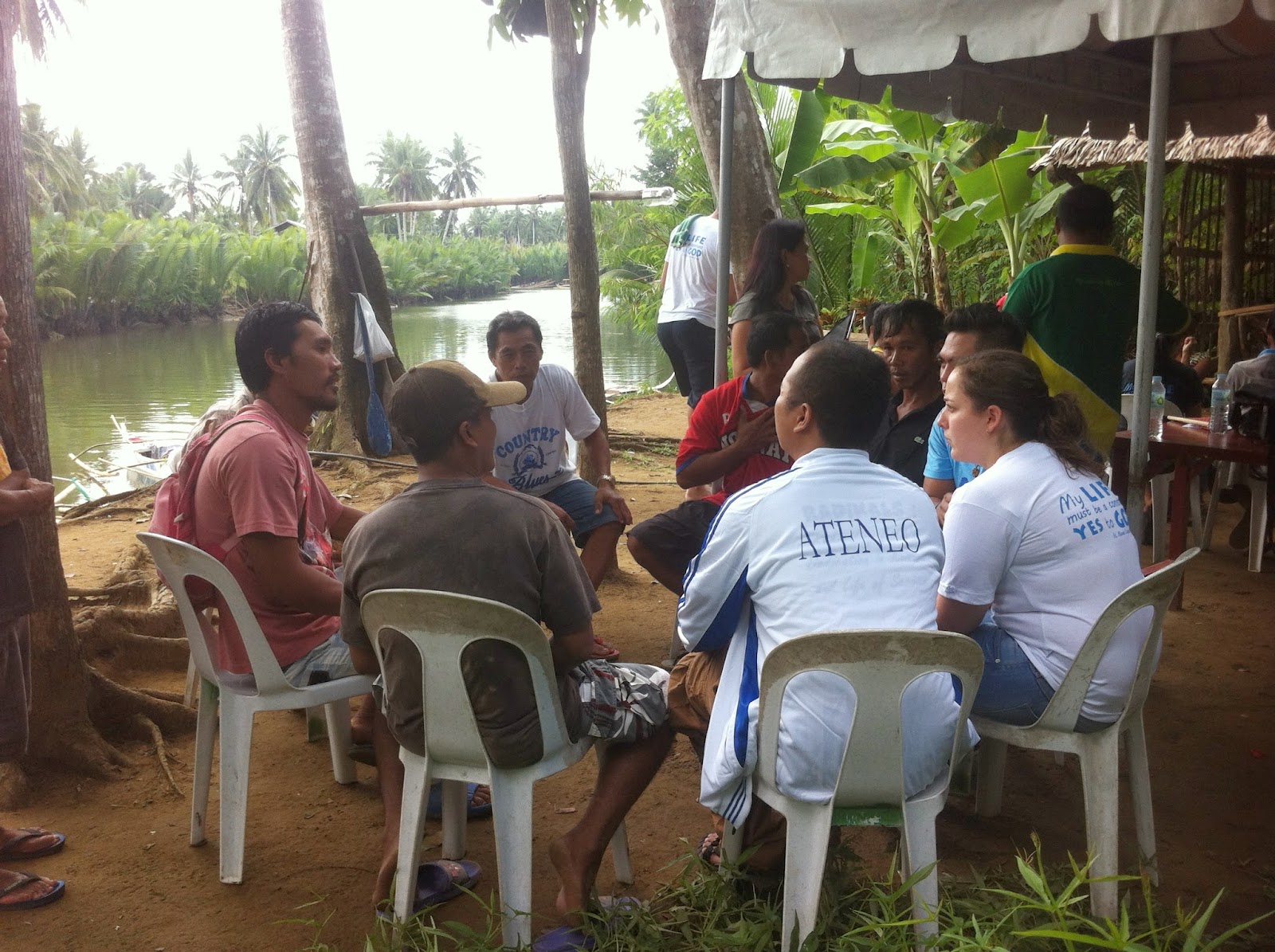
The callers are the volunteers of the Associate Missionaries of the Assumption or AMA for short. I know them not personally, but I met and befriended some of their peers sometime when they rowed down the Jal-o a long time ago--yes, but not that very long time ago. They brought with them their smiles, their friendship, their affirmation, their faith, their hopes, their stories. They came from as far as Europe and the United States (a friend and I found it amusing seeing a French animatedly chatting with a British volunteer), from Mindanao and North Luzon and even from nearby Iloilo, all to break bread with us today as we remember the sad incident of last year. They brought with them some means to help restore the lost livelihood of the fisher folks by the Jal-o. Yes,they brought us the Assisi Development Foundation which in turn capacitated the fisher folks to build boats out of the fallen trees.
Small group sharing: Here I am a year after Yolanda.

On that simple yet grace-filled gathering by the Jal-o today, we were informed that AMA and the Assisi Development Foundation opted to be with us for the occasion to witness the blessings and turn-over of boats (34 for today--and 50 last September 28) as part of the their Tabang Visayas reach-out program. And yet, they admitted that more than helping us process our trauma, they intently chosen to be with us for Balete has a special place in their hearts. One AMA "graduate" confessed that it was in Anao many years ago when she decided to give her yes to serve God through the poor by living the "Simple Life" They looked back at us to say thank you for that grand and wonderful immersion that they experienced while living with the kind people of Sitio Anao, Aranas.

The new batch of AMA volunteers rendered a special song
especially composed by one for Tabang Visayas. 
Today's interaction between those Assumptionistas, with Ms. Viel Aquino Dee and Ms. Vicky Borres, and the marginalized fisher folks by the Jal-o was a living testimony of the truism that the friendship of the rich and the poor is mutually enriching. It was a quiet yet eloquent love story of neighbors electing to carry the cross of one another.

Yolanda may have caused us much damage and even to some, tragedy; but like the Pandora's Box, she brings out with her moments of grace that lift up the human spirit to soar higher to remind one of his lost calling of living simply, kindly and responsibly along with his neighbor by the Jal-o River. A year after, may he finds the courage to echo the words of St. Marie Eugenie of Jesus, "My life must a be constant yes to my God."

Monday, November 3, 2014

The Telos of Life According to Lagumbay

My friend Lagumbay was relaxing with some buddies over a few bottles of Gold Eagle Beer Mucho in a hut by the Jal-o. Thereupon, a local politician noticed their presence and approached them in an animated fashion. As the custom of the place, the bystanders hurriedly offered the caller a glass of beer. They were not turned down and as the candidate held the bottle, he went on with his animated maneuvering. Soon, he managed to grab the attention of everyone and was already dominating the conversation.

The politician was in his element. He took out some bills from his pocket and was ready to order for more beers when Lagumbay interjected. "No sir," he declared. "The beer is on me."

This remark of Lagumbay earned him the ridicule of his peers. In rural Balete, politicians are perceived as patrons who call on the bills—be it a hospital bill or a bar chit. Thus, calling onto himself the burden of paying for the beer when there is a politician present is bordering on ridiculous. Lagumbay appears the fool, but he has the last laugh. He asserted his conviction that in a democratic society such as ours, the citizen is not a supplicant before the politician, nor is the politician a benefactor dispensing favors from his own pocket. The politician is, in the end, a public servant, and the citizen remains a citizen—with a dignity that does not have to be purchased by another man's generosity.

Perhaps this is what Lagumbay's life has been quietly witnessing: that the telos of life is not simply to survive, to prosper, or even to be remembered. It is to become, however imperfectly, what one believes a human being ought to be. Sometimes that conviction reveals itself in no grander gesture than refusing to let another man pay for one's beer.

And perhaps that is why I remember Lagumbay.  

SIESTA

  I can’t recall the instance when we were taught about cloud formations. Science was taught in English when we were in our elementary yea...