Saturday, December 31, 2011

My One Attachment to 2011

A screen copy of my entry at WCJ

I received a notice from the publisher of my other personal blog informing me of the following:
Dear author,    After nearly 5 years and more than 7 million words written,WcJ is ceasing service. In order to give you a chanceto retrieve your writings if you so desire, WCJ is nowavailable again until the end of 2011.
To retrieve the contents of your journal(s), you should visit thesite and login and then select the journal you'd like to retrieve.Then click the Print button, and a new page will be shown with allyour journal entries, in "New to old" order. If you'd prefer to seethem in the order you wrote them, just click "Old to new" at the topof the page.
When you're happy with how that looks, you can use your web browser tosave the contents of the page, or you can click Print to print it, orto save it as a PDF if you have that functionality available.

Kindest regards,
The Team
Reading it, something inside stirred and I felt my heart is being gently stabbed once again. Really, saying goodbye is a hard thing to do. But goodbyes are meant to be said, no matter how and even if it caused so much pain.

Sunday, December 25, 2011

Firecrackers in 1950's

A police officer came over my office the other day to ask if the Sanggunian has any relevant legislation regulating the selling or display of firecrackers especially during the Christmas season. I responded in the negative.

Balete ranks among the few municipalities in Aklan to have the "luxury" of  having a firetruck and more importantly, the presence of personnel from the Bureau of Fire Protection. Armed with a Comprehensive Land Use Plan and Zoning Ordinance, and the mandate of the BFP to implement and enforce the provisions of the Fire Code, the Sanggunian is spared from legislating "more" ordinances concerning the regulation of those firecrackers that stray into our quiet town in this time of the year. It may of archival interest however to mention that the Municipal Council has an ordinance on the matter as early as 1956.

On February 1, 1956, the Municipal Council of Balete, then part of the Province of Capiz, and composed of the following:
Mr. Apolinario Cleope, Municipal Mayor; Mr. Patrocinio Lachica, Vice Mayor; Mr. Roberto Sabla-on, Councilor; Mr. Blas Cortes, Councilor, Mr. Ludovico Yasa, Councilor; Mr. Agaton Recidoro, Councilor; Mr. Hernan Cuyong, Councilor
passed and approved Ordinance No. 1, entitled, "An ordinance prohibiting the storag, sale, display, carrying and/or exploding of big firecrackers classified as dynamites or explosives."  Absent during the session was Mr. Ludovico Villanueva, also a Municipal Councilor.

What about those big firecrackers? The council identified them as "Bawang", "Atomic Bomb", "Atomic Bomb Jr." etc. The penalty for violating this ordinance involves a fine of not less than Php. 50 but not to exceed Php. 200 and the imprisonment of not less than 10 days and a maximum of 6 months at the discretion of the court.

I am having a hard time appreciating those "big firecrackers" but some "old friends" intimated that they were indeed "nasty ones" that our delinquent youths of today should be prevented from laying a hand on lest they cease to be "the hope of our fatherland."


Thursday, December 22, 2011

Please Don't Postpone Your Christmas


A lot of people have decided to postpone their long planned Christmas parties and in lieu thereof, donated their entire budget to augment the rehabilitation fund/relief of those victimized by the shocking flashflood that washed out Cagayan de Oro and Iligan City. Apart from the shock is the seemingly lost of appetite to celebrate the season. "How could you have Christmas party when your countrymen down south are grieving for their lost?", they rhetorically asked. The President got lambasted in the process for going out of his way to attend such a party at the height of the tragedy (for how one could refuse if you have a Valerie Concepcion as guest performer?)

Often times, we fall into the assumption that Christmas is Christmas party, or garish decorations, lavish food and exotic gifts. Christmas has to be merry and bright otherwise it is not Christmas. Then when we find ourselves in such unfavorable situation, we qualify ours as "bleak Christmas"," mamaeamaea nga Paskwa", "sad Christmas". We failed to apprehend the meaning of the event in its facticity. We could not blame ourselves for we are bombarded daily in our tubes and other mass media by the propaganda of commercialism. The meaning is lost. Christmas is something that appeal to the senses and the perceptions of men.

But more than 2000 years ago, in an obscure town, a child was born, a son was given birth by a virgin. He was said to be the one long promised to proclaim good news to the poor, freedom for the prisoners, to set the oppressed free, sights to the blind and to proclaim the year of the Lord’s favor (cf. Lk.4:18ff; Is. 58:6). He is Wonderful Counselor, Mighty God, Eternal Father, Prince of Peace (cf. Is. 9:6). He is Immanuel--which means, "God is with us." (cf. Mat. 1:23) 

More than 2000 years ago, in that obscure town, this child was born poor and in exile, homeless and a stranger. Each Christmas is his birthday and he is knocking on each door seeking for anybody to give him a room. Will you be kind enough not to forego such an observance? Will you be considerate enough to give up your comfort to let him in into your house this Christmas?

Tuesday, December 20, 2011

Christmas Stories


Merry Christmas. Bleak Christmas. Are there such a thing? 


Last week, I asked my friend, Lagumbay, if he can spare me sometime to a bottle of Emperador. He profusely excused himself for the moment, disclosing in the process that he has to attend a retreat at Sibaguan, Capiz. 


The invitation was meant to process his traumatic experience. Lagumbay and his family have barely recovered from the flood of November 15. His house was one of the eight houses washed out by the raging waters off the Jal-o. I was entertaining to sense some tinge of resentment on his voice. But his was placid. He promised me in a placating tone to make out some time of talking out some things over a bottle of brandy after the retreat. It is a priority: to confront his Creator of the miseries and trials of his life. He wanted to give his God the benefit of doubt. Like the prophet Job, my friend fight on to keep the faith: "Naked I came forth from my mother's womb and naked shall I die. The Lord gives and the Lord takes away. Blessed be the name of the Lord." (Job 1:21)


Tonight, I watched on TV a man frantically cleaning his damaged house off the City of Cagayan de Oro. There were mud everywhere. His daughter is still missing, washed off by the flash flood which came like a thief in the night of December 17. He is cleaning the mud out of his abode that he and his wife can "celebrate" Christmas even without the presence of his beloved child. He is struggling to make things normal. Life has to go on amid the defined evil that cause so much chaos and death on his community. Christmas is something that cannot be postponed, no matter what. After all, it is not about partying or blinking lights or garish Christmas trees. 


As I reclined on my bed, I gave those encounters some thought and asked myself a question: Can we qualify Christmas as either merry or bleak? 


I really do not know. But what comes to mind is these words from St. John, "This is real love--not that we loved God, but that he loved us and sent his Son as a sacrifice to take away our sins." (1 John 4:10) It sends me to sleep deep and sound despite the evils that haunt my mind and heart these days. 


Monday, December 5, 2011

St. Nick and Paskwa sa Banwa's Christian Paradigm

Today is the feast of St. Nicolas of Myra (December 6). Of course, only a handful know about it. Less even cared about it. Saints are no longer popular these days. Much more their feast days.

What people cared is that Piolo Pascual, their idol set upon a pedestal, remains true to the image he let his fans made of him all these years. As for old St. Nick, well, (pardon the word) he stinks--unless we reinvent him and call him by his popular name. And of course, by presenting him as the one who makes dreams and wishes come true, especially this Yuletide season.
Balete LGU employees sing Christmas carols for the poor

Take for instance our Paskwa sa Banwa. Considering that Balete was the first in the Aklan to stage a grand Christmas decoration by lighting trees within the Municipal Park and Plaza, we deemed it proper that the Baleten-on constituencies have a responsibility in sustaining this laudable pageantry through collaboration with the local government and the various civil society organizations as well as the private sector. Christmas is however not just about pageantry. It is more about sharing and caring. As a matter of fact, it is about the birth of hope in an otherwise hopeless situation. Hence, we reinvented it by introducing certain variation by doing away with glamour and at times scandalous display of lights and introducing the Christian paradigm of sharing and caring. We have encouraged participating agencies to go out of their way and reach out to the underprivileged instead of spending their monies on Christmas lights and decors. We facilitated their meeting at the town plaza where these agencies, CSO's and PO's impart the spirit of Christmas to the poor through Christmas carols and gift-giving. 


To put it simply, we tried to celebrate Paskwa sa Banwa in a manner old St. Nick did it many, many years ago.  He went out of his way just to reach out--even risk his safety by climbing chimney just to help. Not for his own glory but for that of his God. Incognito and especially during nighttime, he carries bags of goods and discreetly threw them into the abodes of the poor.


One particular story, I love to tell my kids about is St. Nick's encounter with a poor widower who raised singlehandedly his three daughters. He was particularly concerned about their plight that when its was time that the poor man's daughter are to be wed, he slipped into the nights an threw in bags of money to enable the father to pay for the dowry of his daughters. It was said that the poor man was so keen at knowing the persona of his unknown benefactor that he labored staying at night locking the windows and watching the only entrance. He was outwitted by Bishop Nick who made his entrance at the chimney just to avoid being recognized.  


So today is the feast of St. Nicholas, Bishop of Myra. He won't mind if we failed to remember though. But he would mind if we endeavored to live out the spirit of Christmas--not just about sending cards, giving gifts and singing carols to our loved ones during this season; not just about completing the dawn masses and giving alms to the poor. Old St. Nick would really mind if we make room for the homeless Jesus in our lives day by day. Can we make it happen? 


By the way, St. Nick is popularly called in other countries as Kriss Kringle, Pere Noel, Santa Claus. 

Monday, November 28, 2011

Hibiscus is Katueanga and Ylang-ylang is Daeanghilang

Behold, the Katueanga!

"Tay, sueanga ako makaron", my daughter requested me. What she meant to say is that I send her off and in my tongue, it should be put, "Tay, hatdan ako hu." The other day, she inquired when I asked her to cook rice, "Hay sin-o ma-obra it kaeayo?" Her mind is constructing the question in English and literally translated it, unaware of the idioms, "Who will make fire?"

It is sad to note that the younger generation is becoming alienated from our native tongue. It is sadder to discover that their minds work and construct images in weltanschauung far different from our own. Even then, I got some opportunity especially when there are power interruptions and the kids are forced to huddle together on my lap asking for stories or some old folk songs to sing. From my point of view, brownouts are blessings in disguise, freeing us from our dependence of electronic gadgets that otherwise steal us our attention. For instance, the other night, we celebrated the blackness with a song I heard sung by my lola several decades ago. I improvised though to keep the kids interested:
"Si AV nga maitom-itom, angay gid sa baeay nga butong. Tumindog, yumuhom-yuhom matsa bueak it Katsubong. 
"Si Vida nga maputi-puti, angay gid sa baeay nga tapi. Tumindog, kumiri-kiri, matsa bueak it Kamantigue.
"Si Vita nga mapuea-puea, angay gid sa baeay nga tabla. Tumindog, humiya-hiya, matsa bueak it Katueanga." 
And sure enough, there were series of questions raised by the curious girls. "Anu, Tay, do Katueanga?"  Of course, most of us Aklanon seldom heard of that word for we've gotten used to call that flower, "Gumamela" or Hibiscus. In olden times, Katueanga is almost synonymous with red for there was no other varieties then. Today, one could feast on the many colors of hibiscus.
A seafood pakbit with Anaea-taea herb

In my interactions with older people in the Ilaya (the mountainous region of Balete) I've managed to document some words we seldom used today. Let me list down some of them here:

  • Anaea-taea - n., refers to a seasonal herb that thrives along moistened ground; tastes like mint and smells like anise
  • Daeanghilan - n., Ylang-ylang
  • Deawidaw - n., a variety of humming bird (Antuyamis) thriving in upper and cooler region. With prominent royal blue feather on its chest. Sighted in Agtawagon.
  • Oeangkas - n., a minuscule mountain crab boring on moistened ground; most attractive for its bright red pigmentation; There are a lot of it along the trail to Benitinan. 
  • Sum-ean - n., a dry wood with an ember in it and kept in every house's hearth in mountainous region
  • Taeagbasan - n., a tin can where clean rice is kept; rice canister   
  • Tagwatihot - n., another variety of humming bird in mountainous region. Often seen near abaca plantation; Notable for its red crested feathers and a very acrobatic flights. 


Wednesday, November 16, 2011

By the River Jal-o Damulot Wept Over a Wet Blanket


A historic high, however one might take it, is what the inundation of the Jal-o River yesterday morning is all about (by Balete's standard). Here are some of the factors to consider this assertion:
   a. No storm was forecasted by the PAG-ASA; a night before, only an inter-tropical convergence zone was reported to have been spotted off the Surigao provinces;
   b. A sustained downpour for the entire morning of November 15 and sporadic rains in the afternoon;
   c. Flashflood soaked the low lying portions of the Poblacion and the floodplains of the contiguous barangays along the Jal-o in a matter of time;
   d. Fatal landslides took place in several barangays, notably in Barangay Feliciano (God bless the soul of Herminia Cuales);
   e. The raging waters washed out several houses abutting the banks of the Jal-o, forcing more than a hundred souls to seek refuge at the Uphill, my friend Lagumbay and his entire household included;
   f. Hundreds of motorists (and perhaps, a thousand commuters or more) were stranded on both sides of the winding Jal-o and its tribuaries, causing historic monstrous traffic from midday until nighttime--in Feliciano, Calizo, Morales, Poblacion and Aranas;
   g. My neighbor, Benjie, reported to have cooked several layers of eggs and sold them out with hot coffees to hungry stranded motorists. Other enterprising souls found myriad of ways helping out the commuters;
  h. The Sangguniang Bayan in a special session today declared based on the recommendation of the Municipal Disaster Risk Reduction Development Council the entire municipality under a state of calamity.

      As I surveyed my neighborhood yesterday, a weary farmer named Damulot approached me pleading, "You gotta take a photograph of my submerged house. You ought to have proof to show to Mayor that I'm a victim of this calamity." "Ok," I assured him, "I'll take a photo of it". After having attended to his request, I moved about to inspect other areas but he followed me up and went about lamenting. "Oh, my clothings and blankets are all wet. Where shall I rest my head and that of my family tonight? Alas, my TV is soaked with flood water. I've seen to it that the water won't reached it. I was busy attending to other chores and I did'nt notice that the water level rose so fast.  Also, see, my chickens are all dead. They were a stubborn lot. I've already helped them find some branches to rest, but they opted for the barn. Now, they join innumerable lots floating lifeless down the Jal-o."


Hayra, Damulot, ro ing baeay. Sa Facebook eot a. Hambae ni Engr kaina pagkatapos na it ocular inspection hay sangkiri man land a damage. Ag hambae pa gid ku ing unga hay sambilog man lang kuno ing manok nga alaga. Pero bisan pa, may bulig man gihapon kimong ma-abot. (Here is your house, Damulot. It is already posted in Facebook. The municipal engineer in his ocular inspection noted that it is not totally damaged. Also, your son revealed that you only have one hen, no more no less. Even then, the local government will help you out recover from your sad plight.) 

Wednesday, November 9, 2011

Balete 8. de Mayo de 1893

      Besides me today are some photocopied manuscripts culled from a bundle called "Elecciones de Gobernadorcillos de Capiz". With it is my handy magnifying glass and a newly sharpened Mongol. I've just read the whole bulk of it and now am appreciating their relevance.

    When I discovered their existence at the National Archives, I just can't believe my eyes. But the truth of the matter is, in my hands are the official ballots of the May 8, 1893 elections of gobernadorcillo. I read and I quote one:
"D. Ambrocio Aranas, gobernadorcillo actual de este pueblo, propone para succederle on el bienio de 1893 al 95. a.
D. Toribio Oquendo
D. Eulalio Feliciano
      Balete 8. de Mayo de 1893
     (the signature of the voter)" 
   In my possession are some 15 ballots duly signed by the voters--all officials of the pueblo in their capacities as either "cabeza actuales" (there were 11 barangays in 1893) or "capitan pasado".  Don Ambrocio Aranas, happened to be the outgoing gobernadorcillo and as his ballot shows, he opted to name Toribio Oquendo as his first choice and Eulalio Feliciano as his second. I am still deciphering who won the election that day.

   Maybe one day, when we have exhausted all the relevant manuscripts at the National Archives...we shall know. But what for. Ah, to paraphrase Beowulf, "Make a memory of me. Not as a king or a hero, but as a man--fallible and flawed."


Tuesday, November 1, 2011

Requescat in Pace


Right after the priest gave the final blessing, the throng of faithful rushed into the street that leads to the public cemetery. It was already nine o’ clock in the morning of November 1, 2000 and the crowded graveyard was, as it has always been on All Saints’ Day, venue to the festive mood.

The juxtaposition of women lighting candles as they murmured verses of prayers for their dearly departed relatives and the carousing of Tanduay by men were common scenes on this time of the year.  But what was unusual on that fateful Wednesday morning was Ray, armed with a .45 automatic, half-naked, shouting to the top of his voice: “INAWAY!”

The tradition of drinking intoxicating liquor in the cemetery every All Saints’ Day is not unique of Balete alone. Almost everywhere throughout the country, All Saints’ Day celebration has been observed to include unrestrained drinking. The Sanggunian Bayan of the Municipality of Balete, Aklan, notwithstanding its respect for the tradition of celebrating the feast of all the saints, deemed it proper to come up with something to make such an event wholesome and fitting of a Christian celebration. Hence, seven days after the incidence, the local council deliberated on the possibility of enacting an ordinance that would eventually prohibit the drinking of liquor in public places.

The prohibition of drinking liquor in public places would not necessarily eliminate the commission of violence. What the Municipal Officials have in mind was that its thorough and consistent implementation would contribute to the awareness that unrestrained consumption of intoxicating liquor often leads to violence—domestic or otherwise. Besides, the imposition of such ordinance, says Councilor Villanueva would “further instill in the mind of our people a sense of decency and respect for the sensitivity of others” while in public places.

Members of the Catholic Women’s League noted that many mothers were appreciative of the moved made by the Councilors. “That’s also good for the policemen. It would keep them busy moving around,” they quipped with knowing grins.

For a number of reasons, deliberation on the proposed ordinance dragged on for several months. Eventually, it was enacted on May 31, 2001 by a unanimous vote. The Mayor affixed his signature on it the day after thus sealing its immediate implementation a week before the opening of classes.

On August 30, 2002, the Sangguniang Bayan invited various civil society organizations in the municipality to an evaluation meeting. It was particularly called to monitor and solicit feedbacks regarding the impact of the imposition of the ordinance prohibiting the consumption of liquor in public places.  Their sentiment was undivided. Imposition of the ordinance should be continued to give birth to a culture that is respectful of the sensitivity of others and uphold a sense of decency among our people.

Ray was shot to death on April of 2001.  It turned out that the incident involving him on November 1, 2000 at the Public Cemetery was his farewell party. With the strict imposition of Ordinance No. 2001-01, he and the rest of the faithful departed in Balete can now rest in peace.  

Sunday, September 11, 2011

Senator Jose Cortes Altavas, Baleten-on Par Excellence


The following entry was originally written sometime in January 11, 2008 as a press release during the Higante Parade in Kalibo, Aklan to inform the public of the Baleten-on senator. Madyaas Pen later decided to publish it on its own initiative. 
In 1998, the Sangguniang Bayan of the Municipality of Balete, Aklan adopted Resolution No. 98-37 requesting the National Historical Institute to set up a historical marker in memory of the late Senator Jose Cortes Altavas. Ten years after, the NHI has yet to act on such request.

The LGU though would not be dithered by the intricacies of the bureaucracy. Somehow, it finds the occasion to provide it the opportunity to communicate to its constituency the richness of its history and its contribution to national and local politics. That is why, when it was invited to participate in the Higante Contest and Aklan Festivals Parade 2008 on January 16, 2008 in Kalibo, Aklan, it readily commissioned the fabrication of a higante figure of its imminent son, the late Jose Cortes Altavas.

            But many among us would ask, “Who the heck is Senator Altavas?” “Why would the Municipal Officials bother to have him remembered by the Baleten-on constituents?”  

            Mr. Bingo Altavas, the Director of Jose Cortes Altavas Memorial Foundation Inc., provides the information for us to reconstruct the biography to the Baleten-on Senator.  Supplementary information can be culled from the senator’s Mi Diaro, his 236-volume journal written in perfect Spanish since January of 1905 until the day of his death in August 21, 1952.
             
            Jose Cortes Altavas is best known as a Capizeño. But he was deeply Baleten-on, intensely Akeanon. He was born in Sitio Mapait, Barrio Aranas, Balete, Capiz on September 11, 1877. His father was true blue Hispanic from Val de Algorfa, Turuel City in the region of Aragon, Spain. His mother, Andrea Cortes y Rafoll, was a native of Balete and whose parentage is of Akeanon and Cebuano origin.

            All through his life’s journey, Sen. Altavas carries within him vivid memories of his childhood—a plunge into the cool pristine depth of the Jal-o River; a day’s quest for spiders in the wilderness of Mapait; the aroma of sweet smelling Saliyaw atop Star Apple trees; the struggle of his classmates in mastering the cartillas at the Escuela del Rey beside the San Rafael Church…

            By the age of 10, the young Jose, having mastered his primary education, left Balete to farther his education at the Colegio de San Jose de Calazans in the capital town of Capiz.  In 1894, his road was already well-paved in Manila. He just finished his Bachelor of Arts with honor (sobresaliente) at Colegio del Ateneo Municipal de Manila under the Jesuits. A year after, the Dominicans of the Royal and Pontifical University of Sto. Tomas, Manila honed him further for his law studies.

            Jose at 19 was however forming in his heart a desire for change, not only for himself but more so for the native land and his people. He left his studies and went to the hill. Together with Perdo Advincula and Jose Andrada, Jose took charge of the organization of the resistance in the western part of Capiz (Aklan). With the signing of the Treaty of Paris and the capture of Aguinaldo by the American forces, he gave up the armed struggle and concentrated himself into completing his studies.

            Eventually, by 1901 Jose Cortes Altavas was admitted to the Philippine Bar and thereafter set up a law office in Capiz, Capiz. At 26, he married Socorro Barrios Laserna of Calivo (Kalibo) and with the conduct of the first municipal elections in 1903, he was elected Municipal Councilor of the town of Capiz.  From then on, he devoted his life to Capiz politics and rose to become Provincial Board Member, Governor, Congressman, Senator and Constitutional Delegate.

            It is well established that the politics of Jose Cortes Altavas created many advantages for Capiz—Aklan included. Developments rushed into the land he so deeply loved which seen dramatic and greater impact on his people. Jose Cortes Altavas is “the man who made Roxas” for he primarily launched the candidacy for gubernatorial seat of a promising young lawyer Manuel Acuña Roxas in 1919. He was then the Senator for the 7th District comprising the provinces of Capiz and Iloilo. History will tell us the rest of that story.

            As a two-term Governor of Capiz from 1910 and 1916, he facilitated the construction of the Capiz to Iloilo and Capiz to Kalibo provincial highways thereby improving the transportation, the commerce and the economic situation of both the Capizeños and the Akeanons alike. He was likewise instrumental in the construction of the Panay Railroad System in 1910; labored as a Senator to re-establish Romblon as a province and the separation of Jemino from New Washington as the 32nd municipality of Capiz eventually renaming it as Altavas per executive order by then Governor General Francis Burton Harrison.

            As a delegate to the 1934 Constitutional Convention, Jose Cortes Altavas was the chairman of the Committee on Suffrage which sponsored Article V of the 1935 Constitution, and which provision formally recognized the right of Filipino women to vote.

            The time of Jose Cortes Altavas was far different from ours. It was a time where there was no dichotomy between Capizeños and Akeanons; it was a time when Aklan was Capiz and Capiz was Aklan. And Jose Cortes Altavas personified this wholeness. He was the androgynous of the Akeanon’s spirit and the Capizeño’s soul.  His consciousness was undivided; his memory encompassed his routine of sailing from Panay River into the Sibuyan Sea to Batan Bay and of horseback riding from Batan to Balete or to Kalibo.  

            Yet it cannot be denied that the western part of Capiz (today’s Second District of Capiz including five municipalities of the present day Aklan, i.e., Altavas, Balete, Banga, Batan and New Washington) had been his political bailiwick. He served as its Representative when Capiz was divided into three Congressional Districts in time for the First Philippine Assembly of 1907. Although most in his adult life, Jose Altavas resided in the capital town of Capiz, deep in his heart, he is an Akeanon and that the memories of his childhood always bring him home to his little town of Balete.

            The gist of the 1998 Sangguniang Bayan Resolution of the Municipality of Balete expressed deeply its collective understanding that it is “proper and necessary to construct a monument of the late Sen. Jose Cortes Altavas at the very place of his birth to remind the people of Balete of the greatness of the human spirit to soar beyond the ordinary to become an epitome of valor and magnanimity.”


Monday, May 9, 2011

Thank You

As I busied myself planting seeds of hope in the garden
My elemental neighbor let off out of her verdant abode
An aroma of freshly brewed coffee and a rich scent of cheese bread
To remind the farmer of taking time off
To attend to the needs of watering life for life's growth
Of cultivating hope for hope's fruition
That she may remain as always
The stewardess of Ea
Patroness of nature's bounty
Mythic sign of the unseen works of the Great Artisan
Whose Word she echoes through the sunbird's chirping
Among the guava grooves.

Her faint song soothed the gardener's weary heart
Now grateful that hope resurrects amidst the ruins and haunting sighs
Though the tombstones are juxtaposed closed to each other.

Friday, May 6, 2011

Good Night, My God


Psalm 91

You who dwell in the shelter of the Most High
and abide in the shade of the Almighty
Say to the Lord: "My refuge,
my stronghold, my God in whom I trust!"
It is he who will free you from the snare
of the fowler who seeks to destroy you;
He will conceal you with His pinions
and under his wings you will find refuge.
You will not fear the terror of the night
nor the arrow that flies by day,
Nor the plague that prowls in the darkness
nor the scourge that lays waste at noon.
A thousand may fall at your side,
ten thousand fall at your right,
You, it will never approach;
his faithfulness is buckler and shield.
Your eyes have only to look
to see how the wicked are repaid.
You who have said: "Lord, my refuge!"
and have made the Most High your dwelling.
Upon you no evil shall fall,
no plague approach where you dwell.
For you has he commanded his angels,
to keep you in all your ways.
They shall bear you upon their hands
lest you strike your foot against a stone.
On the lion and the viper you will tread
and trample the young lion and the dragon.
Since you cling to me in love, I will free you;
protect you for you know my name.
When you call I shall answer: "I am with you."
I will save you in distress and give you glory.
With length of life I will content you;
I shall let you see my saving power.

Doxology (bow)

Praise the Father, the Son and Holy Spirit
both now and forever,
The God who is, who was, and is to come
at the end of the ages.

Tuesday, May 3, 2011

Defining Becoming as Being

How one defines something which is in flux? Has anyone tried?

What is the sound of the clap of one hand?, a disciple was asked by his master. He got slap when he failed to answer and that was it. He had an awakening. He just knew what is the sound of the clap of one hand.

But what about becoming? Well, let me define it today--It is a motorcycle parking by the road. I am however afraid that it might be different tomorrow.

The Meaning of Life and the Constancy of the Jal-o

A philosopher opted to spend seven years by the Jal-o with a hook, a line and a sinker to contemplate on the meaning of life. On his seventh year, he chanced upon a beautiful lass doing laundry by the bank of the river who asked him what he's been doing all those years.
"Oh, fishing." he answered, and added to keep the conversation going. "I wanted to know what life really is."
"And have you got the answer?"
"Yes," he answered. "Life is like the Jal-o."
"That's nice," she responded. "But can you explain it to me more clearly how is that that life is like the Jal-o?"
"Ah," he finally replied after some thought. "I really don't want to argue with you. And maybe you're right. Perhaps, life is not like the Jal-o after all."


Monday, May 2, 2011

Zen and the Art of Motorcycle Maintenance: The Book that I Should Have Finished but Failed

I love books. I love books that delve on values most especially. Thirteen of my favorites, i.e., something that I've read more than three times and cared enough to hand out as gifts or lend to my friends are as follows:
  1. First You Have to Row a Little Boat: Reflections on Life and Living
  2. by Richard Bode;
  3. Availability: The Problem and the Gift by Robert J. Wicks
  4. The Road Less Traveled: A New Psychology of Love, Traditional Values and Spiritual Growth by M. Scott Peck
  5. Conjectures of a Guilty Bystander by Thomas Merton
  6. The Little Prince by Antoine de Saint Exupery
  7. Hope for the Flowers by Trina Paulus
  8. The Alchemist by Paolo Coelho
  9. Small is Beautiful: Economics as if People Mattered by E.F. Schumacher 
  10. Myth of Sisyphus, and Other Essays by Albert Camus
  11. Jesus Before Christianity by Albert Nolan
  12. Tuesdays with Morrie: An Old Man, A Young Man and Life's Greatest Lesson by Mitch Albom
  13. Voices of Silence: The Lives of Trappists Today by Frank Bianco
  14. All I Really Need to Know I Learned in Kindergarten by Robert Fulghum 
There should be number 14 but I am undecided what title and whose authorship I want to include. But one thing I am certain about and something that keeps on pestering even my subconscious mind--that I should have collected, cared to finish reading and to reread again and again Robert Pirsig's Zen and the Art of Motorcycle Maintenance. I first encountered a copy of it while perusing Sartre's works as I attempted to posit that human fulfillment is possible (or tacit) in a Sartrean weltanschuung. I was engrossed of finding my way down the nauseatic lane that I did not pursue the experience of asking myself the question of what is good and what is not. I was dismissive that such rhetorical questions are just nuisance to finding at the end of the road the answers to the great questions of life. So now though late it might be, I set myself to be asked after Pheadrus:
    "And what is good, Phaedrus, and what is not good--Need we ask anyone to tell us these things?" 

    Friday, April 29, 2011

    In a Distance: Lolek was Sent to UST one Sunny Morning Telling the World of God's Love

    Photo courtesy of Catholic Online
    I have been hunting down my old notes, photo albums and journals these past few days. I was particularly interested on those memorabilia associated with the last visit of the late Pope John Paul II who is due to be beatified on May 1 to coincide the celebration of the Divine Mercy Sunday. I was unlucky finding my journal of 1995 though. Nanay helped me out digging up the dusty bulks of photo albums in a nook behind the altar of our house. The activity though had her sent back through those captured moments into some bygone years when life was simple and quiet. 

    Pope John II addressing the faithful at the
    UST ground in 1995 on the occasion
    of the 10th World Youth Day.
    But I was a single-minded mule, determined at finding just anything that is associated with Blessed Lolek. I take anything by that degree as something worthwhile to pan on the dying embers in the hearts of men, mine primarily.

    After a while and a few sneeze, I got my price: a couple of photos of the Pope which I took in January of 1995 when he came to the University of Sto. Tomas, that Royal and Pontifical University in España, Manila--the oldest in Asia which had just celebrated its 400 years anniversary last January 2011.  I took many photos of him though for I was carrying 3 cameras at that time, the two of which were by some friends who were not lucky enough to have a pass--the proximate areas were exclusive of the Dominicans and for some select faculty members, student-leaders and a few seminarians. (A friend-seminarian gave up his privilege and lent me his pass just to give me the leeway to frame the Pope) Yet I can't find all of them saved the two.

    The Pope as he descended from the
    stage after delivering his message at
    the UST ground. 
    I have always believed that ours is a special time. Our contemporaries are saints and martyrs and yet we failed to recognize them. They have been calling us out in their quiet and simple lifestyle and yet our attention are drawn to the spectacularism and the grandstanding of men. They have given witness to Truth and have kept the Word alive not only in their hearts but in their day-to-day dealings. They keep on telling us in their very lives of the unconditional love of God for each and all of us.

    Ora pro nobis, Blessed Lolek!

    _______
    P.S.
     What a nice gift to your kids as they take their summer break: Lolek-The Boy who Become Pope John Paul II


    Thursday, April 28, 2011

    Tik, Pak, Bong, Binuno, Inaswang and the Quest of Understanding Dystonia Panayensis

    Balete's unique Rizal Monument after Rodin's The Thinker (Distorted in Photoshop)

    We used to hear it often said. Children sing-song among their peers: "Tik, pak, bong, binuno, inaswang!" And the children would scamper to find a safe place to hide as the "aswang" (the "it") hunts them down in the shadows of pasaw, lumboy and the bandstand. The game is called Bong, a variation of Paeanagu-an (Hide and Seek). The home base is an empty tin can that the players have to kick to save their ass from the "hungry witch" whose attention is diverted to retrieving the misplaced tin can.

    But I missed playing it in my "brief" childhood. We were not allowed to stay late outside of our house. Orasyon, aside from being a moment of prayer, was meant to mark the start of our curfew. Tatay never explained why and we dared not question his policy. Perhaps, he was afraid of the aswang prowling in the dark. Old people believe in its existence. Even a friend who came home from abroad believes its existence as she avers that she saw the transformation of an animagus into a huge albino German shepherd-like dog scouting her. I pray she won't start off bathing her daughter with an orasyon, "Pwera sigbin, pwera aswang." 


    In my neighborhood (Aranas) in the 70's, there live a family whose members were said to have been victim of black magic. The victims were mostly boys who at a certain age would show off signs of the malaise. Inaswang kuno. Ginpaamulitan, hambae man ko iba. (They claimed that they are victims of witchcraft). But my mother* did not believe. She felt it that it was her duty to advise the family to see a neurologist (Aklan had none and Roxas was the most proximate place to see one). She did also report the matter to proper authority. She sent out fillers to experts, giving them clue of the symptoms of body distortions (naga-eubag) and the doctors of Roxas City referred the complicated case to Manila prompting a couple of neurologists** to visit the family. The visit in turn became periodic as the experts noted that the patients were suffering from a very rare genetic disorder: sex linked recessive dystonia--dystonia panayensis***, my mother told me. She described it as something unique of Panay Island and that it predominantly affects adult male.

    We no longer hear the children chorus the sing-song, "Tik, pak, bong, binuno, inaswang" today. They are too busy playing the computers or watching TVs at nighttime that they never bother learning the art of playing Bong in the plaza. They get the feel of the thrill in playing Plants vs. Zombies instead of scampering behind the bush of pasaw. Yet they still believe in aswang and the experts are still without treatment to offer in dealing with the unique genetic disorder affecting the men of Panay.

    _____________
    *My mother was midwife of Balete from 1971 to 1992. She was promoted as the Supervising Midwife and was assigned at the Integrated Provincial Health Office after Balete. Around 1991, she was designated as the Provincial Coordinator on Dystonia Parkinsonism and was collaborating closely with Dr. Lilian V. Lee's aide, Dr. Rivera (I can't recall her first name)

    **First Filipina honors Dr. Lilian V. Lee as the one who discovered the causes of the brain disorder called Recessive Dystonia Parkinsonism

    ***The Journal of Clinical Pathology has an interesting article about Sex-linked Recessive Dystonia Parkinsonism of Panay at this link:
         http://www.ncbi.nlm.nih.gov/pmc/articles/PMC1187125/
    Other reviews are at:
         http://www.ncbi.nlm.nih.gov/pubmed/2030641,
         http://www.ncbi.nlm.nih.gov/pubmed/12217620 (On Natural History of XDP)
         http://www.ncbi.nlm.nih.gov/pubmed/1672807 (On Genetic Mapping of "Lubag") in a Filipino Kindred
         http://www.ncbi.nlm.nih.gov/pubmed/11724910 (On Sex-Linked XDP)

    Wednesday, April 27, 2011

    Balete District Bids Sir Raul Au Revoir

    Entrance to the "Uphill" (Balete Elementary School)

    The program cum invitation proclaims, "Au revoir!" and then subtitled by a quote:
    "The mediocre teachers tells (sic). The good teacher explains. The superior teacher demonstrates. The great teacher inspires."

    The Department of Education in the District of Balete is honoring Mr. Raul M. Jimera, its District Supervisor for more than a decade who is due to retire today. All of the school heads, principals and those who were close to him have been asked to deliver their "reflections" while the schools, both elementary and secondary are expected to come up with some presentations. I was invited to witness the event but is still undecided.

    Mr. Jimera was one of the "effective" mentors during my elementary years. He taught Industrial Education to us boys and was our worthy Scout Master. My batch and my contemporaries were proud that in our time, the District of Balete won the most awards for two consecutive years during the Provincial Jamboree held in the towns of Altavas and Lezo respectively. And Sir Raul was the acknowledged brain in getting all those feathers in our caps.

    But whatever be the others have to say of the man, I for myself will always be grateful to have been under his tutelage and quote unabashedly, "A teacher affects eternity; he can never tell where his influence stops."

    Tuesday, April 26, 2011

    The Conversation of Leticia and Tikboy

            The Asylum story of Kahlil Gibran at Paolo Coelho's Blog reminded me of the "classic" encounter of Leticia and Tikboy years back.

            Leticia is a well known character in rural Balete. She is one of those "itinerant" mentally sick people roaming about the town's small urban area. What made her standout from among the rest is her genial and engaging personality. Tikboy on the other hand was an organic member of the community's peacekeeping force. He was equally popular for being a huge man with a small soprano voice. He is now retired and has devoted his life to farming.

    A view of the town of Balete from the Municipal Cemetery. (A sketch done in 4 January 1999)
            Now, about the so called "classic" conversation these two characters had when Tikboy was still on active duty. He was manning the station one summer afternoon when there and about came Leticia with her characteristic grin flashing her yellow brownish teeth in full glory.

            "Hi there!", she addressed Tikboy. The policeman just ignored her and continued with his preoccupations.
            "Oi, he's grumpy today!", added Leticia, still smiling.
            "Hey, why just go home and leave me in peace? Iya ka't ing magpaepakaumangon! (Stop fooling around, would you!)
            "Heh, huo ay maeumo magpaepakaumangon!" (Bah, what make you think fooling around is easy business?), she rebutted and left the place in a victorious mood.

    Monday, April 25, 2011

    For a Cause: Laure Favre-Kahn Does Concert in Iloilo, Manila and Paris


    A friend sends invite to a concert featuring multi-awarded French pianist Laure Favre-Kahn. She says that it is for the girls of Chameleon Association in Passi, Iloilo, Philippines. A piano interpretation on the ouvre of Chopin and Schumann by the association's ambassadress to raise fund for the abused and the marginalized children being housed and cared for in the 600-square meter compound in Passi City. The concert is set on 27 April 2011 at the auditorium of the University of the Philippines Iloilo City campus. Then on the next day, Ms. Favre-Kahn will do another at the PhilAm Life Theater at UN Avenue, Ermita, Manila. A similar concert was held earlier at Abracadabar, Paris.

    The concert is a collective efforts by French and Filipino friends of Laurence Ligier and by the members and supporters of the Chameleon Association, notably by the French Alliance in Manila, Ros Music Center and the French Embassy. Some years back, Ms. Favre-Kahn's concert for the association was filmed and featured on a French television for the "Samaritans'" awareness. The effort needs a refresher though, thus the reprise.

    Ticket prices are available at Php. 500, Php 1,000 and Php. 1,500. You may contact Claire Renaud-Arce at Chameleon Association Inc: (033) 311 55 75 or 0999 748 01 29 or chameleon_phils@yahoo.com

    Ms. Favre-Kahn is shown on the piano on a video by Paskalita75 at YouTube on this link: http://www.youtube.com/watch?v=eXEyyFRxK1E&feature=related

    Friday, April 15, 2011

    Our Gethsemane Way


    Apart from the crowd but perfectly in communion with all.


    "What a waste of time and talent", a French economist once remarked after his brief stay in Anao years back. He was reacting to the way things were going on where he perceived that a lot of brilliant minds were available most especially in civil society and church-based organizations but in the government. The reaction was raised after somebody "local" handed him a copy of E.F. Schumacher's Small is Beautiful. Apparently, he has not heard of it. Reading it in two setting while reclining on a hammock hanging under the shades of coconut palms, he stood up and paced back and forth like a Peripatetic and suddenly blurted out loud,"You Filipinos have great minds but you are not in the government! You are indifferent to your government. You waste your time on your religiosity and outlandish preoccupation.There is too much heaven than earth on your mind."

    The Filipinos he was referring to were lowly workers, mostly volunteers who elected, opted to work with the poor. There may be heavens in their minds but they remain grounded on earth working side by side with the marginalized and the least in society. For sure, their solitary lives may be perceived as a waste of time and talent, but theirs is not necessarily a separate ones meant as protest and silent critical remarks to the going on in society at large. By their lives, they just strive to give witness to the passion and death of Jesus, who in Spirit and Truth, eventually blessed, raised and broken as an oblation for the world's unfaithfulness. Theirs may be detached from the local community, but theirs is always integrated to it in Spirit and in Truth, perfectly in communion and broken as well, as a bread is broken that all might partake.

    Thursday, April 14, 2011

    Setting Apart A Quiet Week Ahead

    _


    To come to the quiet in search for the Beloved, let us set a week apart from the rest. A holy week to reflect on the Paschal mysteries of the Beloved. A holy week of gathering the broken pieces to reform them into whole. A holy week for renewal.

    Come, exiles, come to the quiet to witness the first full moon of springtime. Come to sing, "Hosannas" in the wilderness as we are not welcome in the urban caves because we are Samaritans. Come let us pursue the Beloved in the mountains of Benitinan and the hills of Agtawagon and Eumati. Come, let us wash each others feet by the Jal-o River in the spirit of brotherhood and break bread with the least amongst us.

    Stay with us even for one hour in the Garden. Let us pray unceasingly even for an hour that we may not succumb to betraying the Beloved. The moon is waning but let our hearts be waxing in vigilance for the hour is come.

    And when they caught up with us, be at peace. Be not afraid. Come to the quiet and trust in the Beloved's faithfulness. Be ready to give the other cheek and walk extra miles. Give them the only bread that you have even if they throw stones at you. And embrace your cross lovingly as you carry it along life's road. Come to the quiet carrying the cross of our Christian brotherhood.

    Don't give up just yet when they nailed you. Keep your peace. Mary and John are following closely. And like them, we are the Beloved's pursuers. We will never share his resurrection if we refuse to undergo our respective dying on the cross. So come to the quiet. Be still. Be at peace. Know that the Beloved is our Way, our Truth and our Life.

    Come, set apart from the rest. Be still. Be quiet. Come to the quiet.
    ____________

    The background music of the video on Portiuncula Hermitage by FraGilesMary is by John Michael Talbot, Where Have You Hidden Beloved (from the Dark Night of the Soul of St. John of the Cross)

    Tuesday, April 12, 2011

    Pamilin-biling Ku Uean (The Rain's Farewell Song)

    Madueom ro agahon. Halin pa kabii hasta makaron, sige rong tangis ku eangit. Hambae abi kung PAG-ASA hay umpisa eon it tigsieilak. Hapan-uhan man ngani ni Totog nga madasig maatas rong tubi sa sapa daea ku tayuyon nga silak ku pilang adlaw eon nga nagtaliwan. Nagakaeangkag eon ngani imaw nga hisug-an na ro anang ginahitan ku Pebrero pat a ngato. Rong binhi it mais halin sa opisina kung Municipal Agriculturist hay owa ta gihapon hadapog. Abi na tayuyon eon rong silak. Pero hara, sige eo mat-a rong uean.

    Madueom ro agahon. Halin pa kabii hasta makaron, sige rong tangis ku eangit. Owa kasaot it mayad rong mga daeaga ag meron sa Baylihan. Besperas it Fiesta kabii idto sa Arcangel. May reyna nga ginkoronahan si Konsehal. Matawhay mat-a pero hay nagamueomueo ro sambilog nga meron ay kuno hay owa nat-a hisaoti ro anang crush ay sige 'ta ro asaw-asaw. Kanugon.

    Madueom gid a ro agahon. Halin pa abi kabii rong uean. Naghueaw man lang it madali kainang aga-aga pero tumangis eo mat a ro eangit kat nagamisa eon ro pari sa kadungganan ni San Vicente Ferrer, rong patron it mga panday, rong patron ku mga taga-Arcangel.

    Madueom gid man ron agahon. Owa ka abi kuno riya, kanta ni Gary Granada. Abu kuno ro kolor ku eangit ay owa ka riya. Abstract 'ta ro palibot kon owa ka riya. Pero saeamat ay bisan paalin hay kadumdum ka. Matam-is nga salad ro imong panumduman. Hakit-an ko rong silak it adlaw sa likod it panganod, maku hibayag nimo nga nagadaea it dupoy-dupoy nga fresco. Mako kanta ni Gary nga bisan masubo hay may masadya nga tunog. Nagahibayag imaw bisan masubo. Nagahibayag man ako sa pamilin-bilin ku uean...

    Monday, April 11, 2011

    Pitiw 101 for the Curious and the Kids at Heart


    So you want to know the art of playing pitiw. That you are reading this piece tells me so. Pitiw, my friend, is my old folks' version of the western world's baseball or softball, only that we don't use a ball but a stick. The knowledgeable will surely react at my simile (for it is actually a "snake game"), but let me finish. Let me describe it by laying down the materials and rules.

    First, the materials:
    • 1 stick, 2 cm diameter x 50 cm long - Kamagon is preferred but Coffee or Guava stem will do--they don't easily crack (This one serves as your bat)
    • 1 stick, 2 cm diameter x 16 cm long - of the same wood with the bat (This serves as the ball or originally, the snake)
    Second, the venue:
    Find an open field to play--we used to play on the streets when the traffic was almost zero during our bygone years. Today, the Ceres Bus and the "Ro-Ro" are making a lot of cracks on the newly paved road which are ideal for playing Pitiw but the busy traffic won't allow.
    Third, the players:
    There are two teams to contend the game. Each team is composed of 1 up to 5 players, depending on the willingness of participants and it can be played "CoEd", i.e., girls and boys can play indiscriminately.
    Fourth, the objective:
    The objective of the game is to be the first team to complete the three stages/challenges of Pitiw depending on the agreed number of times they have to complete.
    Fifth, the game:
    • Find a crack or dig a hole at least 4 cm wide, 20 cm long and 6 cm deep. This will serve as the "homebase" and "batting station"
    • To determine the first batter, each team has to have a representative--ideally, the "captain ball" or team captain-- to strike the "ball" positioned perpendicularly on the crack (hole) with the "bat". The team that hit the ball farthest from the base will be the first to play the offensive.
    • Each player has to complete the 3 stages/challenges of pitiw.
    1. The 1st stage is to throw out the "sleeping snake" or "ball" lying horizontally over the crack using the bat. The defensive team will try to catch the ball to put out the player. Otherwise, the player will place down the bat over the crack and the defenders' captain ball or whom ever the team elects will try to hit it using the ball. The station where the hitter will place himself in hitting the bat is at the point where the ball landed when it was thrown out by the batter. Precisely that the batter will exert all his strength throwing out the ball farthest so to make it difficult for the defensive players to hit his bat back.
    2. If the defensive team failed in both attempts, the player will proceed to the next stage. The 2nd stage is to bat the flying snake held at arms length by the batter himself (Or if he prefers, he could toss it up and hit it hard. As in the first and on the third stages, the defensive players will attempt to catch the flying "ball" to make for an instant out. Otherwise they will resort to hitting the bat from as afar as where the ball landed which is difficult.
    3. The 3rd stage is a tricky stage where the batter often failed to make a hit. This is called tapping the angry snake. He is required to place the "ball" inside the crack perpendicularly (about 45 degrees angle), tapped it lightly to toss upward and then hit it hard again into the field. The defensive team will respond as in the first two stages.
    • Three put outs will make the defensive team to play the offensive.
    And finally, the penalty:

    The losing team will be penalized by the winning team in the following manner, viz.:
    • The team captain of the winning team will do the 3rd step without the losing team preventing the thrust of the ball. From where it landed, he will do the 2nd stage, again without the losing team's opposition.
    • Then from where the ball landed, the team captain of the losing team will sound off a cow's moo as he run as fast as he can towards to base. His mooing has to be done in single breath otherwise it will give his counterpart another chance of batting the ball back and he will moo again from where it landed back to the homebase.
    • All of the members of the losing team will follow likewise with their respective counterparts doing the batting.
    Playing pitiw is a sure fun. Aside from giving your child a chance to develop his/her motor skills, it will enhance his/her relationship with his/her peers and in the process help him/her develop teamwork and camaraderie with his/her playmates. Besides, his appreciation and awareness of his environment will be enhanced and save you of the soaring electric bill --and disposed you of potential rival in playing Farmville on your personal computer the entire summer break.


    The Palatable Scent of the Lowly Anaea-taea


    Of course you don't know what it is. Anaea-taea, my old neighbor called it. A seasonal plant thriving along the banks of nameless creek passing my place, I discovered it accidentally one Sunday afternoon while exploring my orchard. I stepped on it and it defused a sweet palatable scent akin to the aroma of star anise and some other menthol herbs. To my amusement and curiosity, I collected a handful, washed them and courageously diced and sprinkled them on a pansit. Wow, my wife loved it!

    Thursday, April 7, 2011

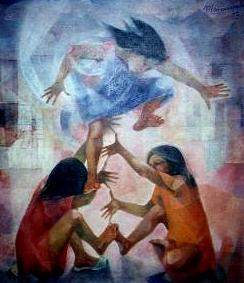
    Summer Games Children Used to Play

    Vicente Manansala's Luksong Tinik (1973) 

    Summer indeed is come. All the schools at all levels in Balete are done with their respective culminating activities for the SY 2010-2011. Congratulatory speeches and valedictions had been delivered. Gifts were given and enjoyed by the recipients. The binakoe and inubaran and pansit were feasted upon. Tanduay and Ginebra were emptied and talks of brawls of the intoxicated were repeated to the amusement of those "honorable drunks".

    Summer indeed is come. Nowhere are the typical boisterous loiterers hanging around the plaza. Suddenly its emptiness and the silence permeating the streets paint a desolate town. But not entirely. The Narra trees are abloom, their fallen yellow flowers adorning the streets and the birds are nesting.

    Cloudless sky and the once soaked ground dried up fast. Despite the sunny days, children preferred staying at home watching tv or at Juris playing CounterStrike or Plants vs. Zombies. So unlike yesterdays...

    ...where kids basked under the summer sun foraying the drying creeks (gapanag-a) for haeo-an (snakehead murrel), puyo (climbing perch), pantat (broadhead catfish) and guorami.

    ...when the heroes and foot soldiers of Ilaya and Ilawod all armed with their creative bamboo "shotguns" and "submachine guns" met at the "center" to start off a week-long mock battles (baearilan--long before they invented the paintball guns and the virtual CounterStrike) and in the process depriving the birds of wild berries (baho-baho, anueogtueog, bili, etc.).

    ...when toddlers played jumping spine, pitiw (bati-cobra) and games (patintero) until dusk, only to take a break when the church bell called the community to Angelus and then to resume afterward to play bong and panaeagu-an (hide-and-seek).

    ...where the girls patiently handpicked on bunch of Huya-huya (minosa pudica) leaves to make out of it a Sipa "ball" and boys innovated on empty Johnson's Baby powder container transforming it into toy car...

    For sure, I miss all those games of our carefree years.

    ______________
    Filipino Traditional Games are described in the following sites:

    Photo: Vicente Manansala's Luksong Tinik in Oil on canvas (1973) at http://iloko.tripod.com/Manansala/artwork.htm

    REMEMBER HER SMILE

      My friends, my family— As you know, my youngest daughter, Aurea Vera, gave up her life at the twilight of October 11, 2026. She was eigh...