Sunday, February 27, 2011

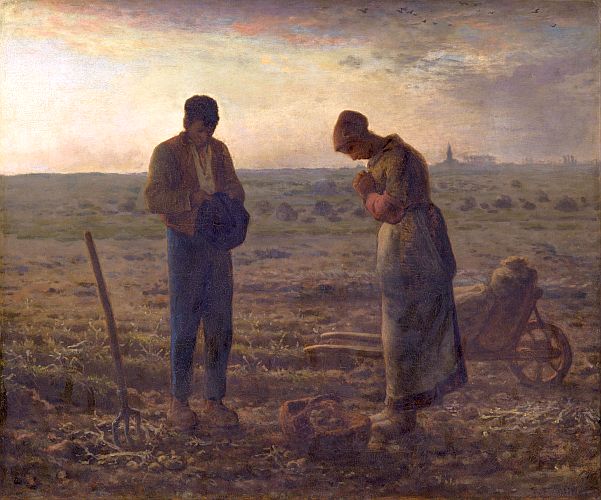
Angelus Domini: Echo of Bygone Years


Angelus in Balete

Secularization. That's one of the main reasons why less and less people in Balete notice the bell tolling at dusk. The young ones seem unaware of that practice. I remember well how we abruptly ceased from going to the hook or dribbling the ball when suddenly, Kulas, the sacristan, hidden in his comfort zone at the belfry, started tolling the bells to mark the end of the day. I remember how each of us impatiently prayed that he hurriedly go for the finale, (Common, show off your campanology, Kulas!), so that we could continue to play. Personally, Angelus (read, the silence in between the tolling) reminded me of my other undone obligations (house chores) that each clang sounded like "patay, owa pat ang kasag-ob", "patay, owa ko pat a hisaburi ro manok" (what a pity that I failed to fetch water...what a pity that I failed to feed the chicken)....Then as Kulas went off pealing those bells, my mind would rush home even as my body stood immobile and expect for the twigs and the one hour forced meditation before the altar. Knelling in front of the image of the Sacred Heart, my mind wandered off back to the children still playing "games" and "bong" in the plaza. Intermittently, silhouette of men in single file amidst the reddening sky flashed into my mental DVD. They seemed humming some haunting sighs as they carried their heaves into the setting sun.

Angelus in Guadalupe, Makati

Signs of secularism is best manifested in Guadalupe though. Judy, the hunchbacked sacristan had refrained from going up to the steeple (for there was none) and in calling the faithful to Angelus he would just play a recorded music on a public address of some distant bells tolling from some far-off monastery. Even then, only a handful laymen paused in silence as most noticed only the building up of traffic along the historic EDSA. Yet the men of the robes sat quietly on the pews. At a signal, they rose up for the vespers and in a melancholic chant addressed their hidden God: The Lord's revelation to my master:Sit on my right...(Ps. 109 [110])

Angelus at the Trappist Monastery in Guimaras

In Guimaras, the Trappists hear the signs in the growing neighborhood of what used to be an isolated monastery surrounded only by thickets of trees and shrubs. The tolling of bells at Angelus is now competing with the sound boxes of some merchants in the developing San Miguel community. But the hooded monks never complained. Instead, in the silence of their hearts, they sung: "O blest Creator of the light/who mak'st the day with radiant bright...Night comes with all its darkling fears/Regard thy people's prayers and tears..."

Yet Asin intimated what a good example of Filipino custom this Angelus was. Listening to its single, Orasyon, one is brought back into bygone years when we led simple, honest and quiet lives in the rural Philippines of our lolos and lolas. Above, Jean-Francois Millet managed to depict it in his famous ouvre of the same title.

(The photo of Jean-Francois Millet's The Angelus is taken from http://www.fisheaters.com/angelus.html Below it is the facade of Our Lady of the Philippines Abbey taken sometime in March 2008 when I was having my two-day retreat there)

See the complete works of Jean-Francois Millet at http://www.jeanmillet.org/

Thursday, February 24, 2011

When Faust Killed Valentine and Those Spirits Wandering About When the Bells Toll at 8


Emotion. I'm writing or rather trying to write a critical analysis on the theories of emotion by a number of leading psychologists from James to Lange, to Cannon, Freud and Jung and the rest of the behaviorists. Only that even as I tried to start, my mind seemed rusty and allergic to venture into this kind of discipline. Me thinks that I read Faust again. I just wanted to explore the scene when Valentine attempted killing Faust for having taken advantage of his sister. I just want to refresh my mind of the descriptions used by Goethe of the heightened emotions between the two characters that resulted to Faust killing Valentine in the process.

These stuffs really put me in reverie of the past events in my life beginning from my early childhood when Balete seemed to be filled with bizarre, if not mysterious phenomena. I remember how the old folks told me stories of aswang and other bad spirits going out of their lair once the bell tolls at 8 in the evening. Fr. Tito subtly discontinued the practice to erase in every child psyche the association of such practice to evil spirit lurking around the town. The original intention when priests of old had the 8 o'clock tolling of bells done was to call the faithful to recite the Nunc Dimittis (Lord, now let your servant go in peace...) during the Compline (or Night Prayer). As years went by, the practice is forgotten and in its stead, the ignorants concocted such stories of the "enemies, prowling like a roaring lion looking for unsuspecting souls to devour..." once the bells are tolled at 8.

Such emotions. Such memories. Are they existentially real?

Wednesday, February 23, 2011

Shooting Your Heart by Your Mother's Grave


A friend caught me off guard when he asked for my opinion concerning the suicide of former Philippine Armed Forces Chief Angelo Reyes. I did not have one. My hectic schedule was my apparent excuse for that indifference and the seeming lack of opinion about the matter.

Deeply, I fear death. I fear anything that is associated with death. Yet, some friends wonder out loud my breakneck habit of fulling my throttle. They say it's bordering to suicidal--which reminds me of Albert Camus and anxiously, of Ernest Hemingway and Vincent Van Gogh. I am really uncomfortable dealing with this kind of theme. I like to imagine myself as Sisyphus carrying my stone uphill again and again despite the seeming absence of meaning of the task. But then again, as Sartre puts it, there is no excuse, there is no exit. Yet Angie Reyes just gave up the freedom of defining himself. Now, he let others define him to their liking.

Even then, I refuse to define him myself other than the fact that he gave up his freedom. Other than that I refuse giving any other opinion however great of humble of his surrender or defiance, whichever you prefer to use.

I refuse too to take suicide by its horn even as I want to admit that I am amused by G. K. Chesterton's description of it. He had it considered, but not today, so as he put it in A Ballad of Suicide, viz:

The gallows in my garden, people say,

Is new and neat and adequately tall;
I tie the noose on in a knowing way

As one that knots his necktie for a ball;
But just as all the neighbours—on the wall—
Are drawing a long breath to shout "Hurray!"

The strangest whim has seized me. . . . After all
I think I will not hang myself to-day.
To-morrow is the time I get my pay—

My uncle's sword is hanging in the hall—
I see a little cloud all pink and grey—

Perhaps the rector's mother will not call— I fancy that I heard from Mr. Gall
That mushrooms could be cooked another way—

I never read the works of Juvenal—
I think I will not hang myself to-day.
The world will have another washing-day;

The decadents decay; the pedants pall;
And H.G. Wells has found that children play,

And Bernard Shaw discovered that they squall,
Rationalists are growing rational—
And through thick woods one finds a stream astray

So secret that the very sky seems small—
I think I will not hang myself to-day.

ENVOI
Prince, I can hear the trumpet of Germinal,
The tumbrils toiling up the terrible way;

Even to-day your royal head may fall,
I think I will not hang myself to-day
Let me however point out this fact that Angie Reyes (Angel of Kings--that's what his name means) did shoot his heart by his mother's grave when he has the spotlight focused to himself. Some say it was noble and heroic; others say otherwise. But how about you? What's your take? Was it a hara-kiri (seppuku) of a valiant soldier or an easy way out of a coward heart?


Thursday, February 17, 2011

Pamaeaybay ni Ensik (The Poem of Ensik)


I loved the way he did it one Sunday morning. The occasion was solemn as he was addressing a throng of faithful. He was addressing them in English and then all of a sudden, my attention was called when he shifted in perfect Aklanon. Oh, he knows Aklanon! so my mind was being rough at by questions. Who is this man? Sure, he's a popular one, a prominent one at that. But I didn't knew him. I was flattered to hear him use my dialect so perfectly. Oh, dear, he was good. Really good and seemed has the better grasp of my language. He inspired and amused the hearers:

Gin-eangoy ko rong suba
Gintak-ead ro bukid
.....
Leon, tigre akon gin-away
Eamang ro imong nawong
Makita ko, Inday.
.....
I failed to have it memorized perfectly. Ensik's pamaeaybay was quite long and that's all what I can recall. I wonder if somebody has got a copy of the complete poem.

As years went by, I got to know him better. In fact, I was lucky to be one of his pontifical servers during the ordination of now Frs. Jonas Mijares and Adam Bede Lasmarias, all of the Augustinian Order way back in the late 80's or early 90's at the Guadalupe Monastery in Makati. Ensik was the Archbishop of Manila that time and was one of the heroes of the EDSA revolt--that progenitor of all non-violent revolution that are now taking place all over the globe.

But few knew that during his younger years, when he was yet a young priest, he was doing missionary works in Balete. He'd done scaling the rugged hills of Cortes up to Oquendo through Guanko to announce the Good News; he'd forded the Jal-o to reach out to the anawim in Morales and Calizo. Ensik had hiked the paths to Arcangel and Aranas, to Feliciano and Fulgencio, eamang ng Inday ikaw anang mabunyagan.

When the mass was about to close that one Sunday morning in St. John Cathedral early in the 80's and after he gave the final blessings, Ensik intoned his favorite song: No mas amor que el tuyo... As he sung, something glowed in his eyes....
O corazon divino,
El pueblo Filipino,
Te da su corazon.
En templos y en hogares,
Te invoque nuestra lengua,
Tu reinaras sin mengua
De Aparri hasta Jolo.
By the time the faithful came to the chorus, "Ha tiempo que esperamos
Tu imperio en el Oriente", I was certain that Ensik was tearful. Oh, how he loved this people, so I thought.

The Book of Baptismal Records in the Parish of St. Rafael the Archangel would show that Fr. Jaime L. Sin (a.k.a., Ensik) was the priest who administered the Sacrament of Baptism to a number of persons between May 16, 1955 to June 2, 1955. He passed by our place that summer of 1955 and brought with him our stories and perhaps inspired him to coin that Pamaeaybay it Nobyo.


More of Cardinal Jaime L. Sin at the following links:

http://www.catholic-pages.com/hierarchy/cardinal_sin.asp
http://www.cardinalrating.com/cardinal_105.htm
http://www.catholic-hierarchy.org/bishop/bsin.html

Wednesday, February 16, 2011

Getting In Touch with Our Roots: Kultura Balete 2011


All roads lead to Balete on Monday, February 21. The Municipal Tourism and Development Council is presenting to Baleten-ons of all ages Kultura Balete 2011. It is a simple event to observe the Culture and Arts Awareness Month. It showcases our heritage as a people with our own distinct identity and history. It is an invitation to highlight the memory of our race through various media: Sotis, composo, pamalaybay, crafts--just to name a few.


Sotis is kind of folk dance still being practiced by the Benitinanons and the Ilahaynon (those that reside in the upstreams of the Jal-o). It is much like the street dances of the contemporary world that the pair who takes part in it has to be agile, athletic and acrobatic while without compromising grace and artistry. In its factuality, it is not a street dance but a "house dance". Yes, a house dance. It is performed by several couples to test the structural strength on a newly constructed house. Originally, it is part of the pagpangagad and pabagti ritual where the suitor, having shown to the father of his beloved his capacity to construct a hut or a house, will now show to the public that it is well-built abode for starting off a family. But just like other dances, it becomes part of the communal celebration and anybody of sound body can dance sotis to the rhythmic, festive and frenzy beating of anything the Ilayhanon's hands can hold on to. One should hear how they improvised on bamboo poles and empty tin can of Fita and Skyflakes and turn invective phrases into joyous composo (composition).

But you need to take a grueling hike or endure sitting on bamboo craft for hours to get to see and hear those. Otherwise, just take time out and join us at the Mayor Teodoro F. Calizo, Sr. Memorial Civic Center on Monday to get a glimpse of them.

Tuesday, February 15, 2011

How Balete Got its Name: A Legend


A Baleten-on OFW based in Vancouver, Canada contacted me through Facebook with the report that the Philippine Consulate there was adamant despite her representation of using an incorrect way of spelling Balete. The DFA employee could not be faulted as she was just basing her action on the available databank entry. My kasimanwa was however worried as it will create discrepancies not only on her portfolio but on other Baleten-on overseas foreign workers and expatriates as well.

The Sangguniang Bayan therefore acted with haste when its attention was called on the matter. Readily and on a unanimous move, it adopted a resolution addressed to the National Historical Institute to inform the Department of Foreign Affairs of the correct way of spelling the name of our town. Copies of the resolution were also sent to the Philippine Consulate in Vancouver, Canada through proper channel. Then, specifically, it was resolved that such resolution shall also be uploaded in any Baleten-on sites in the web for the information of all.

This incident called to mind an old story I read about how Balete got its name. I can't precisely pinpoint where, my thought keep on picturing out a painting hanging on the wall of the Balete Rural Bank during my childhood days. But the story tells of some conquestadores conducting reconnaissance along the valleys and plains by the banks of the Jal-o during the early years of Spanish colonization. They chanced upon a village where outstanding number of ficus trees thrived. Thereupon, someone from the group approached some villagers standing or working under one of those huge trees and proceeded to inquire,?Cual es el nombre este sitio?

That baffled the villagers. Somebody however noted the inquirer's hand pointing to the tree behind them and so readily responded, assuming that they were being asked of the name of the tree: Balete. So it is told that from henceforth, that village by the Jal-o was named, Balete.

One would however wonder why the villagers answered in Tagalog when they were from this place. "Balete" is a Tagalog word and a variation of "Balite". The Aklanon equivalent would be "Nonok" to mean a singular ficus tree while "Kau-i", if it is referred to a forest or batch of ficus trees. More importantly, the name is not unique of Balete, Aklan as there are other municipalities and barangays in Luzon and Mindanao by that name.

So did I succeed in satisfying your curiosity? Questions lead to answers that raise more questions. But don't worry. That's what historicity is all about.

(Full text of the resolution can be downloaded in my Scribd account at this link: http://www.scribd.com/doc/48940840/Res-069-sb2013

Monday, February 14, 2011

Goethe Found It in the Shade


I'm inclined to believe that Johann Wolfgang von Goethe wrote this poem entitled, Found, although I've not seen it in its printed form. The style and the theme verging on nature and the incidents of life typical of Goethe's works are well manifested in its verses. But I'm not an expert when it comes to Goethe. As a matter of fact, I just stumbled upon the poem one summer afternoon early in my youth as I ventured to trespass into my sister's room. That was the first time I heard of him then. The poem was set on the headboard of her bed, as if enthroned like my mother's Bible on our altar. The poem, handwritten on a piece of board paper by her future husband as a gift for the Valentine's day, had my usual forgetful mind remembers it vividly:

FOUND

I walked in the woods all by myself
to seek nothing, that was on my mind.
I saw in the shade
a little flower stand,
bright like the stars
like beautiful eyes.
I wanted to pluck it
but it said sweetly:
Is is to wilt that I must be broken?
I took it out
with all its roots
carried it to the garden
at the pretty house.
And planted it again
in a quiet place.
Now it spreads and blossoms forth.


My sister lost her poem when Undang wrecked havoc on our house and the rest of Panay one fateful day in November of 1984 (or was it 1983?). The inundated Jal-o followed it up as if adding insult to injury. Yet, somehow, my usually forgetful heart remembers and I wonder why.

And just in case you are interested in Goethe's other poems, just follow this link: http://www.poetryintranslation.com/PITBR/German/Goethepoems.htm
Faust and some other plays can be readcast at http://www.imagi-nation.com/moonstruck/clsc20p.html

Sunday, February 13, 2011

In Search for the Beloved: Communicating Juan dela Cruz to Ordinary Folks


Juan dela Cruz is popularly known to us Filipinos as a farmer wearing salakot (native hat made of bamboo thatches), tsinelas (slippers, not Havaianas, of course), barong tagalog and pantalon. A patient and unassuming man, he stands as epitome of the ordinary Filipino. Yes, Juan dela Cruz is the typical Filipino. And many mothers and fathers named their sons after his namesake. Wally Gonzales and Pepe Smith even called their band, Juan dela Cruz Band, to give it a tone of patriotism and to identify with everything that the personification of Juan carries with.

But many Filipinos know not that indeed there was a great man and a lover at that by the name of Juan dela Cruz. The young ones are really ignorant and the old oblivious that there was a time when mothers and fathers wished their sons emulate the virtues of that man. He was a small man by stature yet his love for the Beloved is great. Hereunder, let me share one of his great poems for the young and restless to appreciate:

SONG OF THE LOVER AND THE BRIDEGROOM

I

THE BRIDE

Where have You hidden Yourself,

And abandoned me in my groaning, O my Beloved?

You have fled like the hart,

Having wounded me.

I ran after You, crying; but You were gone.

II

O shepherds, you who go

Through the sheepcots up the hill,

If you shall see Him

Whom I love the most,

Tell Him I languish, suffer, and die.

III

In search of my Love

I will go over mountains and strands;

I will gather no flowers,

I will fear no wild beasts;

And pass by the mighty and the frontiers.

IV

O groves and thickets

Planted by the hand of the Beloved;

O verdant meads

Enameled with flowers,

Tell me, has He passed by you?


The ordinary folks would want that translated in our dialect. But I deemed it proper to be faithful to the intent of St. John while at the same time make a connection with the contemporary Filipino. Thus my "contextualized" translation:


GUINA-USOY KO IKAW
(nabasi sa obra ni San Juan de la Cruz)

Siin ka nag-adto, akong Pinalangga?
Ham-an nga guinapaantos mo ro akong kaeag?
Nagguwa eon ngani ako sa akong banawang
Sa pag-usoy kimo, pero pumanaw ka eo’t ing.

O kamo nga mga bakero nga nagapahang-eab
Ku inyong mga anwang una sa tagodtod,
Kung manabo abi nga hipan-uhan ninyo
ro akong Hinigugma,
suguri imaw nga maemae ro akong pagpangasubo,
nagamasakit ag madali eon lang mamatay.

Guin-usoy ko ro akong Mahae sa kabukiran,
Guin-usoy ko imaw sa kadatagan ag kaeanasan.
Ana ron tanan sanda nga guinbugayan it grasya
Eamang agod nga ro akong taguipusoon
Hay magmayad.
Pero owa’t a magmayad ro akong taguipusoon ngara.

Wednesday, February 9, 2011

Augustine's Scarred, Restless and Flaming Heart


"You have wounded my heart with your Word, and from that moment on, I love you."

Augustine is just as ordinary as we are. He was a parochial boy who made his way into the metropolis and grabbed certain popularity as a rhetorician and a teacher in some respected institution. As a farm boy, he was notorious for raiding fruit trees in the neighborhood--not for want of food to eat though but for the fun of it and the excitement of watching swines gobbled those pears.

As a young man, he was unabashed in expressing his appreciation for beauty and admiration of great curves. He was almost trapped when he sired a son, but he lacked a sense of humor to enter into a one-way contract. His heart was restless--too restless to be caged into such carnal relationship. But he did not ran. He faced the consequences of his lust and set himself to be a good father to his Adeodatus (god-given). And of course, as a bonus, he continued to indulge himself to bodily pleasures.

Yet his heart was restless and in his mind, questions rebutted answers. He envied the drunk who though out of tune, kept on singing to the top of his voice in his improvised karaoke. The drunk appeared to be happy and contented and he was not. There must be more to life, he deduced, than just having sex and indulging oneself to worldly possessions, than being popular, powerful and relevant, than satisfying oneself to sophistic and conventional wisdom and having access to information.

I know a couple of friends who keep on asking questions about the MORE to life, the MORE in life, the MORE of life. These friends seek answers in logic and facts. Like Augustine, they want to contain everything within their consciousness. They pretend that they are supermen but the wounds in their hearts and the doubts in their minds humiliate them. No doubt, they too, are restless, sleepless, nursing hearts that are wounded and bearing minds that are too tired ferreting half-truths and fabricated facts.

Augustine has now the ANSWER to the questions and his once wounded and restless heart is now healed (scarred, of course) and at rest. Yes, indeed, his heart is at rest yet still aflame with the Love that had carried him home to his BELOVED.


"My love is my weight: it is what carries me whenever I am borne." (Conf. XIII, 9,10)


Tuesday, February 8, 2011

John Boyle O'Reilly and His White Rose with a Flush on its Petal Tips


John Boyle O'Reilly was having a dilemma which rose to choose, much like those Don Juans and Cassanovas wishing of having two or more hearts to have. But O'Reilley's dilemma is not about having extras. He was trying to grasp an idea that was regarded as almost outlandish in his time. He may have heard of an Austrian (some says he's of a German-Czech race) Augustinian Friar experimenting on plant hybridization in some monastery in Brunn. However he may have arrived at the idea, he was subtle enough to convey a lover's passion tempered by pure love in his poem, A White Rose.

A White Rose

The red rose whispers of passion
And the white rose breathes of love,
O, the red rose is a falcon,
And the white rose is a dove.
But I send you a cream-white rosebud
With a flush on its petal tips,
For the love that is purest and sweetest
Has a kiss of desire on the lips.

Today's rose lovers enjoy not only the luxury of thought but are endowed with having on their gardens those fancy roses of various colors. They prided themselves of collecting types and varieties of them. They know their names by heart. But they are oblivious as to who engineered their possibilities.

Thursday, February 3, 2011

Visualizing Yanni's Almost a Whisper


I find it easy associating this pen&ink study of a nude and that poem, Your Grief, as well as that watercolor study of a rosebud in handmade paper with Yanni's Almost A Whisper piano arrangement. 
 Logic has defied me of the reasons why. Perhaps the gaps can be bridged if I take the leap from rationality into the realm of the unknowing.


YOUR GRIEF

Your bulging eyelids
Tell me that your pillow was again atop
your face last night
providing a perfect cover
suppressing the sobs
absorbing the tears
concealing the pains of life
lest your sister-roommate suspects

As you went about
the business of the day
you face the world with a Mona Lisa smile
more than a perfect cover
an enigmatic faƧade
of a young beauteous professional
concealing the scarred and confused heart
lest those green-eyed officemates find out.

But your grief is a story
a silent ear can hear.
It is a song a loving heart can echo
or a picture a caring hand can paint.
Your sad eyes
Tell me that it is indeed darkness
But isn’t it that in darkest night
where stars shine most brightly?


Wednesday, February 2, 2011

When Legends Become History: The Case of the Battle of Agtawagon Hill


(The following is an excerpts from my study on local history entitled, Understanding Balete, an unpublished material, which I'm currently updating due to recent findings.)


The later decades of the 19th century saw the rise of nationalism in the whole archipelago. Historians (Constantino and Zaide for instance) claimed that the martyrdom of Catholic priests Frs. Mariano Gomez, Jose Burgos and Jacinto Zamora served to awaken the dormant spirit of Filipino nationalism. Rizal himself a martyr, recognized the significance of this tragic event and thereby dedicated his second novel El Filibusterismo to those illustrious priests.

This growing consciousness for a Filipino nation is best exemplified when Bonifacio together with his friends organized the Katipunan on July 7, 1892. The manner of growth and the rapid spread of this secret society are but indications of this collective desire for freedom.

In the Aklan region, Iban and Del Castillo met no difficulty in recruiting for members to join the Revolution. In a very short span of time since they arrived from Manila (February 1897) they managed to organize the Katipunan in both sides of the Akean river highlighting it with the staging of the symbolic Pacto de Sangre on March 3, 1897 under a Dangkaean tree at Kungtang (Ochando). John Barrios (1998) related that more than 100 men had attended the event. He further claimed that in the three months long leadership of Iban and del Castillo they were able to enlist 1,000 members more or less for the Katipunan.

Although the leadership of Iban and Del Castillo was short-lived (Iban died as one of the 19 martyrs of Calivo on March 23, 1897 while Del Castillo was shot to death on March 17, 1897) the rural masses were able to maintain the struggle where they took it to the hills. This is a valid strategy considering the superior weapons of the guardia civiles and the arrival of casadores (Tagalogs) and Spanish soldiers led by Comandante Ricardo Monet from Manila through Batan.

Nicolas Prado (1952) noted that the seat of power of the remnants of the group of del Castillo in the eastern side of the Akean River during the later part of 1897 was at the hill of Makawiwili where Rafael Maraingan acted as General en jefe. Together with him were Manuel Bernaldo Almanas, the general en Brigada and Eustaquio Gallardo as General en divicion. They called their station Hipatora Central or Central Headquarters. This group was responsible for the ambush of the troops of Comandante Monet at Tinuptupan.

When Aguinaldo declared the Philippine Independence on June 12, 1898 at Kawit, Cavite, the struggle for independence in Aklan raged on. Eugenio Fulgencio, et al. (1971) referred to a manuscript Actas by Julian PeƱalosa, when they related of the raid by several groups of “insurrectos” led by Macario Lacson, Superiano Felizardo together with Rafael Maraingan and Cabibes (perhaps Commandante Macabebe which culminated with the burning of most of Batang on August 21, 1898 and the death of many casadores and 11 innocent people. It was said that many people fled following the defeat of Batang for fear of retribution from the Katipuneros.

Jose Parcon (1977) wrote in his unpublished Masteral Thesis of the arrival of Tagalog Katipuneros headed by Gen. Ananias Diocno at Navas sometime after the declaration of the Philippine Independence. Constantino (1975) however related that Visayan revolutionaries had already vanquished the Spanish forces in Antique and Capiz (Aklan included) before the expedition sent by Aguinaldo arrived.

The Tagalog Katipuneros arrived in Batan in 1899 and established a Revolutionary Government under the Philippine Republic. They were driven out by the joint forces of US Army, the newly organized Constabulary and Philippine Scouts nearing end of the Filipino-American War in 1902. Diocno and his men might have joined forces with that of Maraingan and Gallardo making his stronghold at Manaway, Dalipdip where he was earlier (March 17, 1901) cornered due a treachery.

In Balete, it was said that the remote and ragged hill of Oquendo was made into an evacuation site during the American campaign. It was also used by the Pulahanes coming from Lambunao and Passi as well as by the Maraingan and Gallardo group as route towards the hill of Agtawagon. It was said that the cannons displayed in front of the police station in Balete and that at Camp Pastor Martelino in Kalibo were relics taken from that hill – that it was used during a skirmish or battle against the Americans. Other old folks would assert though that it was used against the Spaniards. The saga of Agtawagon as a battle site where many guardia civiles and cassadores died was once related in a composo by Manuel Cortes.

On the other hand, Jose Dandoy claimed that there was no battle whatsoever that took place at Agtawagon. He narrated that it was only made into a station of the group led by Maraingan to while the moment but more so to draw power from hill that they believed to be enchanted. He related that this group upon notice proceeded to Mauebong where they staged an ambush against a band of casadores coming from Batan. Other than that the old folks in Balete seemed to have memory lapses as to what really took place in that majestic hill overlooking the town proper.

In Gama, an American captain (although popularly known as a general) C.E. Morton was hiding under the protection of Mariano Cortes for fear of getting caught by the insurrectos. Elkanah Babcock however did not mention such story in her A War History of the Sixth U.S. Infantry. Instead, she narrated that on February 9, 1901, seventy enlisted men of Company K of the 6th US Infantry under Lieutenants Nesbitt and Awl destroyed the town of Balete (misspelled as Balet) and had a skirmish with "insurgents" on the road. Then on June 17 of the same year, Nesbitt led thirteen men and went up the mountains capturing in the process one "ladrone."

During the World War II, the hill of Agtawagon did serve as the headquarters of the remnants of the 64th Infantry Regiment under the command of Maj. Jesus Jismundo. However, no battle took place in it this time.

In the late 1960's to early 1970's, a local transport operator painted the headboard of his minibus with the label, El Tiroteo de Agtawagon. His son intimated that his father had asked his elder sisters to construct in Spanish the phrase, "The Battle of Agtawagon", and did in turn came up with the now locally renown phrase. Such was its popularity then that unsuspecting callers easily assume that the noun "tiroteo" (from the verb tirotrear, meaning, to shoot at and from which the Visayan and Tagalog word Tiro is derived) means "battle" in English (Batalla is the Spanish word for Battle, while Guerra is for War) . Balete then commemorates it annually as its civil justification for sanctioning a religious fiesta in honor of St. Rafael the Archangel. Always shown in covers of souvenir programs, in streamers set up on arches or in stages during coronation programs is the phrase, "In commemoration of the _th anniversary of the Battle of Agtawagon" running vis-a-vis with the asseveration, "In honor of St. Rafael the Archangel." By 1996, all were frantic of preparing for its centenary comes the following year. The planners were envisioning a grand celebration but somebody reminded of revisiting the past so as to tell the next generation of the heroisms of their forebears.

So we revisited the past. We tried to hear the stories of old people (the oral history so to speak) while at the same time dug into the dusty bundles of manuscripts in some archives as there was no written history aside from those unsupported and unvalidated narratives found in souvenir programs. Having done, with some stories and manuscripts gathered, we ceased from pursuing that grandiose plan of celebrating the centennial of some alleged battle which supposedly took place at Agtawagon Hill.

So hard was this going back into the past that I've warned those who consider tracing this path that they ought to have the patience of Job, the persistence of Sisyphus and the dexterity of a Benitinanon. Nevertheless, we take heed of Socrates's advice that the unreflected life is not worth living and thus, no matter how hard the going, we keep on tracing our steps among the footprints of the fallen and the brave.

REMEMBER HER SMILE

  My friends, my family— As you know, my youngest daughter, Aurea Vera, gave up her life at the twilight of October 11, 2026. She was eigh...