Showing posts with label values. Show all posts

Thursday, November 26, 2015

Echoes: Encountering BEC

I do not want to end like the old mariner grabbing people to listen to his story at the sunset of his life. I want it that at the end of the day I rest assured that I have rowed my river and handed on to my children the lessons I have learned in my journey upstream to the House of the Father. So I made, early on, a solemn vow, that I would immerse my four daughters into situations that allow them to know and love the God of Jesus of Nazareth. Sadly, like most promises, mine was half-heartedly kept.
I can justify why I kept on failing. I was trained and educated to find reasons to the things I do. I have a lot of excuses; all of them are sound and rational. Yet honestly, they are like wicker baskets—they hold stones and boulders but not water. The truth of the matter is although I was raised a Catholic, (I even had seven years of formation in the seminary) I am struggling with my faith given my entanglement with Sartrean Existentialism vis-à-vis the clash of orientations at the local church.  Every day I wake up confronted with the question of meaning and automatically finds myself forcing to pray to the God whose existence I keep on questioning. 
Perhaps, my former parish priest senses the civil war raging inside of me and the growing apathy deep within that he keeps on disturbing me in my complacency. Just the other day, when the family was preparing for the Angelus, the monsignor came knocking at my door. He came bearing what he considered good news. He excitedly related that it appears the Division Office of the Department of Education is now adopting a policy concerning the 90-minute religious instruction per the 1997 Constitution. The move is supportive of his catechetical program in Batan (Aklan). 
The monsignor has pioneered in the Diocese of Kalibo a community-owned school-based catechetical program. The program, like a mustard seed, is silently thriving and gaining strong support among small communities in the whole municipality of Batan. Without wishing to, it is fast becoming part of the mainstream society that policy makers are giving it a second look. It started small. The parish priest and his coadjutors simply and consistently celebrated the Eucharist in the barrio chapels monthly. Then slowly, they encouraged parents and ordinary teachers to hear masses in schools too. Soon enough the team of three priests finds themselves busy saying masses and attending community and PTA meetings.  At present, each of them has more or less 13 masses a week, not to mention funeral and wedding masses and community meetings.
The communities became articulate. They demanded that the local schools afford their children their right to religious instruction as provided for in the Philippine Constitution. Equally, the ordinary government teachers heeded the call and volunteered themselves as instant catechists, despite their lack of training and to most, experience in catechesis. Thus begin the community-initiated school-based catechetical program that the Diocese is now gearing up to replicate in other parishes. Presently, the teachers who responded to the call number to about 200 more or less. They have received specialized trainings from the Institute of Religion of the University of Sto. Tomas (UST-IR) and had been certified by it as professional catechists. They catechized their pupils and students voluntarily as their token of gratitude to the communities that have supported them all along and as a response to the call they heard on the "Road to Damascus." Modules on New Catechism in Akeanon dialect are being developed with the assistance of the Diocesan Catechetical Ministry.
The multiplication of the bread is one ordinary yet wonderful miracle in Batan. One can note such reality in their breaking of bread whenever a communal affair takes place, say a seminar on catecheses or a Sunday Mass in their tiny chapel. A peninsular agro-fishing community harboring Batan Bay and facing the Sibuyan Sea, it prided itself of the richness not only of its natural resources but also of its history, heritage and culture. The Augustinian missionaries who interacted with the locals in 1600’s as narrated in Apuntes Historicos of Fray Juan Fernadez, OSA were impressed of their highly cultured and communitarian manner. He writes of this impression on Batangnons being:
“…the most noble in the Archipelago, a highly-cultured group
                              with well  built  beautiful  houses  and  many  well-organized
                              villages…” (p. 275)

The friars further noted that they were neither wild nor refractory. The memory of the race perhaps remains intact in the consciousness of the present generation that they positively responded to the initiative of their parish priest and readily regarded the program as their own and give it their all-out support.  Personally, I believe God is working wonderfully on the openness and generosity of these people most of whom had long been “unchurched” and marginalized by the mainstream society that typically represented the institutional church.  I had witnessed the transformation from their being indifferent Catholics to what are now budding witnesses and active members of Basic Ecclesial Communities. I am neighbor to them. By parentage, I am Batangnon too. As a child, I used to roam around the fishpond on my grandfather in Sitio Pinamunitan, Barangay Lalab and had known the saga of Kagiyaw along the meandering waters of the Jal-o and the legend of how Lalab got its name.  Precisely that I always take it as an opportunity to be of service—though in my own little way—to the Batangnon communities everytime Msgr. Frac asked me to write something related to his pastoral works. I consider it my role being part of the One Body of Christ made manifest in Batan BECs. To me, I am merely a follower of Christ Jesus and a servant of God. What I have had accomplished are my duties and for that I expect neither a reward nor gratitude.  The outpouring of help coming from the members of the community every time an event takes place either in the Parish or in the schools or chapels are manifestations of this understanding that each faithful is merely doing her/his duty in this brotherhood of ours in Christ Jesus. They are one with the whole Body of Christ. They see themselves as the Church.
            The multiplication of bread in Batan is one miracle that calls on me to reach out my left hand and thrust it on the bleeding wounds of the risen Jesus. But the fact that in Batan there are small communities regarding themselves as the Church despite their poverty is one miracle that tells me that God has pitched his tent in their midst to dwell with them. Indeed, as St. Ireneus used to say, their very existence is joy, A MIRACLE OF GOD!  
            The presence of my former parish priest in my house is an encounter rich with meaning and graces not only for me but most importantly for my family. I pray therefore that he may keep on disturbing us in our complacency that we may always be restless until we rest on the bosom of our Father in a New Heaven and a New Earth.
            

Saturday, November 8, 2014

Those Assumptionistas Who Looked Back at the Jal-o a Year After Yolanda

Today is the first anniversary of Yolanda, internationally known as Typhoon Haiyan, which has been regarded as the strongest of those typhoons that ravaged communities all over the world. I intended to let it pass without so much ado, for after all, most of my trees have never recovered when she battered them last years. My neighbor is still without a decent house to live in--despite the reported many humanitarian aids coursed through either the government or the non-government organizations. But there are those who knocked on our doors today, inviting us to see through the bitter experience that we had last year and reflect on the way we chose as we tried to stand up from its havoc.

Ms. Viel Aquino Dee, Vice Chair of Assisi Development Foundation
and Mayor Bobby Calizo of Balete, Aklan surveyed the boats
made by the fisher folks themselves.
The callers are the volunteers of the Associate Missionaries of the Assumption or AMA for short. I know them not personally, but I met and befriended some of their peers sometime when they rowed down the Jal-o a long time ago--yes, but not that very long time ago. They brought with them their smiles, their friendship, their affirmation, their faith, their hopes, their stories. They came from as far as Europe and the United States (a friend and I found it amusing seeing a French animatedly chatting with a British volunteer), from Mindanao and North Luzon and even from nearby Iloilo, all to break bread with us today as we remember the sad incident of last year. They brought with them some means to help restore the lost livelihood of the fisher folks by the Jal-o. Yes,they brought us the Assisi Development Foundation which in turn capacitated the fisher folks to build boats out of the fallen trees.
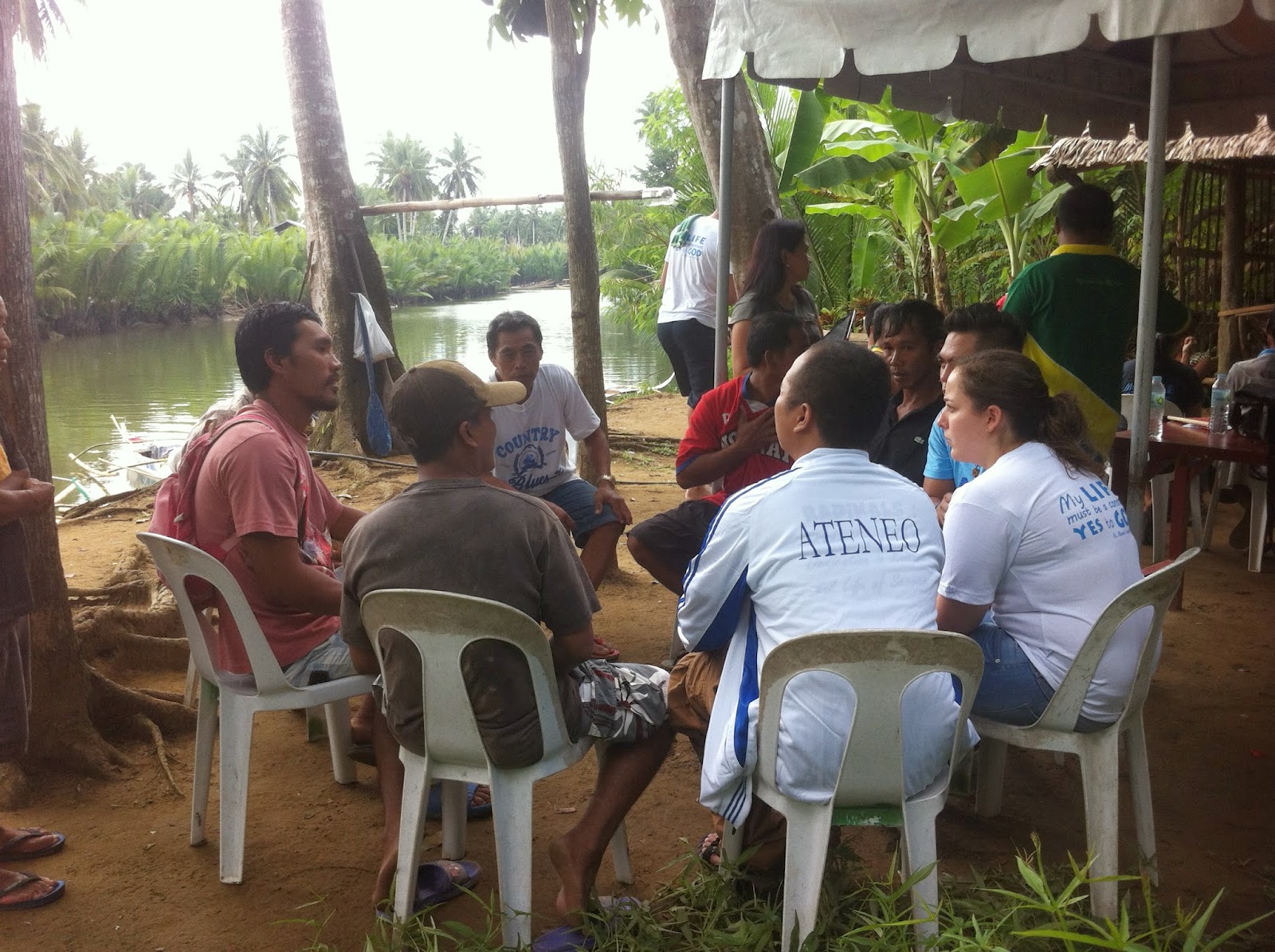
Small group sharing: Here I am a year after Yolanda.

On that simple yet grace-filled gathering by the Jal-o today, we were informed that AMA and the Assisi Development Foundation opted to be with us for the occasion to witness the blessings and turn-over of boats (34 for today--and 50 last September 28) as part of the their Tabang Visayas reach-out program. And yet, they admitted that more than helping us process our trauma, they intently chosen to be with us for Balete has a special place in their hearts. One AMA "graduate" confessed that it was in Anao many years ago when she decided to give her yes to serve God through the poor by living the "Simple Life" They looked back at us to say thank you for that grand and wonderful immersion that they experienced while living with the kind people of Sitio Anao, Aranas.

The new batch of AMA volunteers rendered a special song
especially composed by one for Tabang Visayas. 
Today's interaction between those Assumptionistas, with Ms. Viel Aquino Dee and Ms. Vicky Borres, and the marginalized fisher folks by the Jal-o was a living testimony of the truism that the friendship of the rich and the poor is mutually enriching. It was a quiet yet eloquent love story of neighbors electing to carry the cross of one another.

Yolanda may have caused us much damage and even to some, tragedy; but like the Pandora's Box, she brings out with her moments of grace that lift up the human spirit to soar higher to remind one of his lost calling of living simply, kindly and responsibly along with his neighbor by the Jal-o River. A year after, may he finds the courage to echo the words of St. Marie Eugenie of Jesus, "My life must a be constant yes to my God."

Monday, August 18, 2014

Inspirations and Motivations


I am writing again. I discovered that I am discovering my poetry. A sign along the lonely road I thread.  
Kalipay kung Taguipusoon

Pananglitan nga rong aton nga daean
Indi eon magsub-eang sa unhan
Sa tindahan rong isda nga mub-ead
Magapadumdum kimo
Nga ikaw ro matuod nga mahae
Owa eon it iba pa.

Pananglitan nga rong aton nga eandong
Indi eon makatao it handong sa hilamon
Sa simbahan rong siga it kandila
Magapadumdum kimo
Ikaw man lang rong kasadya it taguipusoon
Owa eon it iba pa.

Ag pananglitan nga hilipatan mo
Sa madueom, matapo-tapo nga kwarto
Ro binaeaybay it kahapon magapadumdum kimo
Ikaw ratong ginatumod ko, hinigugma nga engkantada
Kalipay ag baeay ku baeatyagon nga nagapadayon
Halin pa kato hasta sa gihapon.
I write poems to express what is happening inside my heart. I write poems when the emotion is strong and wanting release. I write poems to convey my feelings of love and admiration. I write poems to tell you that you are special and I love you.

I write essays and narratives to express what is going on around. I write essays and journal to document the things as they happen that I may remember. I write journal whenever I need to process my coming to be -- a sort of psycho-analyses of the reality as it manifests itself in my consciousness.


I write when I am problematic. I write when the enchantress is nice to me. I write when I am troubled by the events as they unfold. I write to earn a living. I write from time to time to compose a book someday.

 I used to write as a form of prayer. I used to write in lieu of meditating. I used to write to contemplate on the nature of the subject matter of my thought. I used to write as a form of introspection with the hope of reconciling my brokenness and recollecting my shattered self. 

Friday, May 16, 2014

Balete Community College's Humble Beginnings

Balete Community College earns the title as the first and foremost tertiary institution in rural Balete. It stands as one of the only four community colleges in the Province of Aklan. Its becoming is a story worth telling.

 Its Humble Beginning


While it is not mandated of a 4th class municipality like Balete, Aklan to operate and afford tertiary education for its people, the circumstances it finds itself in are indicative that it carries the load towards its desired end despite its poverty and capacity gaps. These circumstances were offshoots of an extension program introduced in 1998 by then Roxas Memorial College of Arts and Trade (RMCAT) that paved the way for the birth of the community college in 2004.

Late in 1998, officials of RMCAT in their attempt of preserving the college’s independence from the impending integration with Aklan State College of Agriculture parleyed with Mayor Teodoro V. Calizo, Jr. to allow it to utilize makeshift huts (remnants of an agricultural fair during the Civic Fiesta) located in a property owned by the local government as its classrooms for its extension program offerings by SY 1999-2000.  With the promulgation of Republic Act 9055 in April of 2001, RMCAT was eventually absorbed by the newly converted Aklan State University (ASU) (formerly Aklan State College of Agriculture) thus making its extension program under the auspices of the latter. For reasons unknown to the local government unit of Balete, ASU despite the increasing number of enrollees in the extension program and its vast and richer resources sent feelers that it is turning over to the LGU the operations of the program otherwise it will just close it by SY 2004-2005. Hostage to take the bull by its horns and bite the bullet, the LGU released ASU from its obligations by assuming full control of the program with this Sanggunian enacting the Balete Community College Charter in November of 2003, hence its humble beginnings.

 Our Centerpiece Programs and Feathers in Our Cap


The time when the LGU assumed full control of the community college, it was already committed to prioritizing education as one of its centerpiece programs down from Daycare up to high school level that aside from the mandatory Special Education Fund (SEF), it funded other development projects to advance basic education in the municipality. It secured a sizeable grant/loan (14.4 Million Pesos) from the World Bank through the LOGOFIND project to modernize three ill-equipped National High Schools in Balete thus affording them with several classrooms, laboratories complete with devices and equipment, other state-of-art information communication technology equipment, books and other school facilities. Such loan is still being paid for by the LGU up to this time.

Through its pioneering utilization of its joint Executive-Legislative Agenda in 2004 and later of its Comprehensive Development Plan, it managed to make much of the little fund that it had for which it prosecuted various sustainable programs and projects to approximate its vision-mission statement. Its consistency and sustained programs coupled by adhering to the principles of good governance, transparency and accountability has won for itself the distinction of being primus inter pares in the field of local governance for 4th to 6th class municipalities throughout the entire country when it was conferred with the Seal of Good Housekeeping Award in 2010 along with nine (9) other municipalities by no less than the late Secretary Jesse Robredo of DILG. Such feat was doubled in 2011 prior to the demise of the secretary. In 2012, it was conferred again with the same seal, this time categorized as Silver Grade.

Gaps


It is sad to say however that time and again, the LGU’s hands are tied to limit only to a certain percentage (2% at the most) in its meager budget appropriations for BCC as pertinent laws set the utilization of SEF only to elementary and secondary education while under the Local Poverty Reduction Action Plan/Bottom-up Budgeting (BUB and now known as Grassroots Participatory Budgeting Program) program, projects for the development of the college is prohibited. The LGU was earlier inhibited at allocating certain portion of the grant/loan from the LOGOFIND subprojects for BCC’s development as World Bank was stringent at sticking to the original proposal for which the LGU was screened through the eye of a needle prior to its approval.

The LGU has also to comply with the Personal Services limitation (55% ceiling cap) prescribed by the Local Government Code. As if adding insult to the injury, Local Budget Memorandum No. 67 released by the Department of Budget and Management last June 28, 2013 mandated LGU’s that by 2014, annual budget shall include among others counterpart funds for projects considered in the budgets of implementing national government agencies under the BUB while directing the reversion of losing local economic enterprises departments back under the general fund appropriations.

            The local officials are not blind to the fact that even in this era of ‘Daang Matuwid’ and before Yolanda wrought havoc in the area, most of the educational institutions run by the government at all levels fall short of the standards where teachers in far-off Guanko, in the mountainous Sitio of Benitinan and Sitio Centro of Barangay Oquendo or even in the nearby Morales Elementary School, to mention but a few, are forced to conduct classes inside dilapidated classrooms or even makeshift ones constructed voluntarily by parents and barangay officials as in the case of Cortes Integrated School; where for lack of elementary and secondary teachers employed by the Department of Education, the local government hires additional teachers on contractual basis (at a rate of three thousand pesos per month) to augment the teaching staff in all the four (4) national high schools and one (1) integrated school; where for lack of reading materials, it has used its connections with private individuals for them to donate modest books to some of the elementary schools.

  The Threat of CHED


A couple of team of Higher Education Development Specialists of the Commission on Higher Education  from Central Office, Manila and from its Regional Office based in Iloilo City were strongly recommending the immediate phase out of three (3) out of the four (4) degree programs being offered by the Balete Community College, Balete, Aklan. In their respective reports dated December 12, 2012 and July 4, 2013 respectively, each team noted/reiterated that ‘(w)ith all the major noted deficiencies, the Bachelor of Science in Hotel and Restaurant Management (BSHRM), Bachelor of Elementary Education (BEED) and Bachelor of Science in Industrial Education (BSIE) programs of the Balete Community College, Balete, Aklan are recommended to comply with the noted deficiencies on or before the end of the Second Semester, Academic Year 2012-2013, otherwise, an IMMEDIATE CLOSURE ORDER shall be issued effective First Semester, Academic Year 2013-2014.’ Both reports were endorsed to the Presidential Action Center, Malacañang, Manila, a copy of the latest of which was furnished the Local Government Unit of Balete, Aklan on July 29, 2013.

 Balete’s Proactive Response


The concerned local officials interposed no objection to the recommendation made by the CHED monitoring teams as they understand that being Higher Education Development Specialists they are trained and stipulated by the book to fit in pitiable tertiary institutions into the molds of policies, standards and guidelines set by the Commission. They understand fully well that BCC is no Ivy Leaguer and that with its cheap tuition fees and subsidized income, no erudite doctors or master degree holders in their right mind would seek employment thereto and rub elbows with the lowly and the naïve, let alone lend their names for it to meet the minimum requirement set by the commission.  All of the members of the Sangguniang Bayan as well as the Municipal Mayor are however wondering why Balete Community College is being singled out when its only bias is to provide its poor constituents their rightful piece of pie to higher education in an affordable and contextual manner that they may not end up being tuba gatherers.  Thus, in a couple of resolutions, they expressed their sentiments and their course of actions taken being responsible officials. The same resolutions were furnished the Office of the President, the CHED officials, the Committee on Higher Education at both the upper and lower houses, and the Congressional District Office of the Lone District of Aklan for the information and consideration of the concerned offices.

Given the opportunity, before the start of the 2nd Semester of SY 2013-2014, good natured, qualified and well-intentioned educators accepted key positions to satisfy the wishes of CHED. With the help of the community, local officials, faculty and students, the gaps noted by the commission were slowly being filled up.

 A Spring of Hope


Presently, CHED has amended its reactive ways and the BCC remains operative under the stewardship of a doctor of education as its College Dean (Dr. Arturo I. Zonio, who is working almost on a voluntary basis as the College cannot afford paying him even a modest amount for his kind), a program head and some 22 other contractual instructors. It has produced thirty-three graduates for the SY 2013-2014 for its four program offerings, namely BSIE, BSIT, BSHRM and BEED. Its tuition fee per semester is pegged at most at Php. 4,350 for BEED and BSHRM and at least at Php. 1,350 and Php. 3,150 respectively while for BSIT and BSIE the average tuition is at Php. 3,120 per semester.  The college has a working budget of Php. 1,170,114.40 as against an annual expenditure of Php. 1,194,083.25 and an income of Php. 1,319,466 for the FY 2013.

It remains bullish at providing affordable yet quality education to barriofolks who otherwise cannot afford tertiary education given the exigencies of life they have to contend with. The presence of BCC is a blessing, a spring of hope to nourish the dream of the poor and marginalized.  

Monday, April 7, 2014

The Richness of the Jal-o (Manggad kung Hae-o)

The words used by a community in describing certain reality or experience are indicative to their rich awareness of the things around them. They also serve as clues to the richness and diversity of the environment where they are situated at a certain time. Conversely, the cessation or death of certain words point to a fact that the things they described have ceased to be. These realities are happening down by the Jal-o River. The words in Inakeanon hereunder are clues to the dynamism of culture and the generations that have had used them, not to mention the vibrant environment:

a. Fishes

  1. Bagtis (goby)
  2. Obog (dusky sleeper)
  3. Bae-a (goby)
  4. Sugi (river garfish)
  5. Puyo (climbing perch) 
  6. Pantat (broadhead catfish)
  7. Haeo-an (true murrel)
  8. Aeogsuk (snakehead murrel)
  9. Kilo (spotted scat)
  10. Mub-ead (scat) 
  11. Danggit (scat)
  12. Mangagat (snapper)
  13. Bugok (yellow snapper)
  14. Inid (white dotted grouper)
  15. Paeangan (long-spined glass perchlet)
  16. Aliso (mangrove red snapper)
  17. Baeanak (broad mouthed mullet) 
  18. Gusaw (blue mullet)
  19. Sili (freshwater eel)
  20. Ogdok (giant moray)
  21. Poyoy (finger eel)
  22. Nipa-nipa (brackish water eel)
  23. Sap-sap (pugnose ponyfish)
  24. Eawayan (common ponyfish)
  25. Tambasakan 
  26. Bang-eos (milkfish)
  27. Tilapia (blue tilapia) 
  28. Amuean-buean (tarpon)
  29. Awa (ladyfish)
  30. Lap-lap 
  31. Tabagak (freshwater sardinella) 
  32. Tamban (freshwater sardinella)
  33. Tabyos
  34. Bueogwas (white small fish, like tabyos)
  35. Paead (speckled tonguesole)
b. Shrimps
  1. Mayos (krill or small shrimp)
  2. Oeang (downstream freshwater prawn)
  3. Patuyaw (upland freshwater shrimp)
  4. Paye (upland giant freshwater prawn)
  5. Bueok (downstream giant freshwater prawn)
  6. Batod (brackish water shrimp)
  7. Pasayan (whitish brackish water shrimp)
  8. Saksog (brackish water prawn)
  9. Sugpo (tiger prawn)
  10. kamantaha (ghost shrimp)
  11. pitik-pitik (mantis shrimp)
c. Other Crustaceans, Shellfish
  1. Alimango (mud crab)
  2. Kalampai (river crab)
  3. Kasag (blue crab)
  4. Umang (hermit crab)
  5. Karag (mangrove crab)
  6. Uson (hermit crab)
  7. Kagang (freshwater crab)
  8. Oeangkas (minuscule land crab)
  9. Diwae (Angel wing)
  10. Litob (blood clam)
  11. Litob-litob (blood clam)
  12. Tahong (green mussel)
  13. Sisi (mussel)
  14. Abahong (brown mussel) 
  15. Taeaba (oyster)
  16. Kukod kabayo
  17. Bebe (freshwater clam)
  18. Tuway (mud clam)
  19. Bagungon (telescope shell)
  20. Igi 
  21. Imbaw (mangrove clam)
  22. Banag 
  23. Kaguko (small freshwater clam)
  24. Hungkay-hungkay 
The list of Akeanon words for the rich marine life in the Jal-o and the Tinagong Dagat (Batan Bay) is a long one. And yet, there are signs that the young generations are becoming alienated from most of those words and the very realities they represent. I remember a proposal from scholars of regulating the fishing activities therein which attracted vehement reactions. The proposal was based on several researches and more particularly on a study detailing the overfishing activities in Batan Estuary that eventually threatened marine life in the area. The proposal is for the fisher folks to observe off season for fishing at a certain period when molting is observed among crustaceans. It was rejected outright. 

So I sing in the silence of my restless heart the song of Asin lamenting the dying of the once beautiful ecosystem I was privilege of interacting with. 


Tuesday, March 25, 2014

Timeline II - Balete During the American Pacification

Answering questions leads to more questions. That is a fact. A fact that only proves that man is a rational being. No other animate being on Earth is capable of that. A few creatures shows retention. But they are not historical being for historicity is not one of their endowed faculties. Only man is capable of retrospection and of getting in touch with his past. Aided by his tools, he can easily go back into yesterdays, at least for the time being, in virtuality. Einstein's Special Theory of Relativity though is a tease for him to attempt at going back into time in his existential form. Be that as it may, let us be content with delving into the Baleten-on's historic past, perhaps to get insights in approximating that better Balete than yesterdays.

Herewith then is my additional entry, a follow up to my initial timeline for those who want an airplane grasp of Balete's historic past. My other entries on local history are spread out in the pages of this blog indexed as "local history", "historicity", "characters", "Balete", "Aklan", culture/heritage", "Jal-o". You can find some of them also in my Scribd account as well as that of Balete Association International's Tripod account (although that was not updated).


1897 – Early in March, Candido Iban and Francisco del Castillo organized the Katipunan at Kuntang (now Ochando) with some 100 men coming from all over the Aklan Valley. New Washington celebrates it as the Pacto de Sangre (The Blood Compact). Later in the same month both leaders were executed together with some other compatriots. The rest had gone to the hills.
1898 – In August, the pueblo of Batang fell to the hands of local Katipuneros based in Makawili Hill, near Sitio Himbis, Barrio Lalab, barely a couple of months after Aguinaldo declared in Kawit, Cavite the Independence of the Philippines from the Spanish colonizers.
1898 – Late in 1898, Aguinaldo sent to Navas an expedition led by Gen. Diocno. They entered Batang in August of 1899 after pacifying Calivo and therewith established a revolutionary government.  
1899 – In September, the war against the American broke out.
1900 – Proclamation of Amnesty by the American colonial government and the organization of the Philippine Scouts with 8 companies assigned in Panay Island.
1900 – Late in October, the War Department of colonial government decided to put up a sustain military campaign in the three provinces of Panay Island. Captain Morton operated in the Aclan valley.
1901 – the Philippine Commission adopted the Municipal Code and Provincial Laws.
1901 – Balete was destroyed by the American forces composed 70 enlisted men on February 9. In the same day they had a skirmished with the Katipuneros along the way. In June, elements of the same forces went up the mountains capturing an insurgent in the process. Later, Gen. Diocno was wounded and captured at Makawili in March 17.
1903 – Census of Population. Balete had 5,529.
1903 - Gov. Gen. William H. Taft sent out his representative to reorganize the local governments throughout the country. In the province of Capiz, he commissioned Benito Luzzurriaga to reorganize the municipal government. When Luzzuriaga and his companion arrived in Dominguez (Lagatic), a barrio of Batan, they found the place suitable for the establishment of a good port.
1904 – the Americans fused Batang, Balete and Jimeno into one municipality with its seat of government at Lagatic.  But to make it more symbolic they renamed the place New Washington.
1904- The first Presidente Municipal of the newly created New Washington town was from Balete in the person of Mr. Juan Oquendo who was to serve for one year (1904-1905). Those who served after him were as follows:
Mr. Florencio Melecoton, 1906; (other texts either have Melocoto   or
      Melecoton)
                                    Mr. Ananias Mariano, 1907;
                                    Mr. Blas Feliciano, 1908-1909; (Baleten-on)
                                    Mr. Pedro Cortes[1], 1910-1916;
                                    Mr. Eulalio Feliciano, 1916-1919; (the last Baleten-on to be
                                            Elected as Presidente Municipal of New Washington)
                                    Mr. Rufino Sucgang, 1920-1922.

1917 - Executive Order No. 88 was signed by Gov. Gen. Francis Burton Harrison creating the Municipality of Altavas (formerly Jimeno) as the 32nd Municipality of Capiz. The sponsor for the creation was a Baleten-on in the person of Sen. Jose Cortes Altavas.

1920 - Balete was reestablished as the 33rd Municipality of Capiz. (all pertinent documents of that time points to 1920 although we do not have at our hand a copy of the Executive Order issued by the governor general. We also do not have a iota of idea who sponsored its separation from New Washington)  

As I have stated earlier, answers lead to more questions. For the time being, let us live with questions for they are the ones that are existentially real. Perhaps, in some distant future, we will be living with the answers.


[1] The Research Committee of Altavas however recorded that Mr. Juan Oquendo was reelected in 1910. He was supposed to serve until 1916 as the term of office of local officials were made into five years.  He failed even to complete a year as he resigned for unknown reason. In Lieu, his vice-presidente, Mr. Pedro Cortes acted as the chief executive of New Washington until 1916.


Wednesday, March 19, 2014

Asking the Obvious: Breaking the Ice

I found it difficult to decide which is the appropriate title of this article. Initially, I jot down, "Five Stupid Questions a Baleten-on Asks". My better judgment however suggested that it should be in Inakeanon, "Mga Pangutana Nga Masami Naton Habati-an sa Daeanon". However one takes it, the gist of this entry is the culling of some of the funny bordering to irritating questions we raised up just to strike up a conversation with an acquaintance.
  1.   Pa-Kalibo ka? You strike up a conversation with your fellow commuters riding a Kalibo bound jeepney by raising the obvious.
  2.  Nanindahan ka? On my way out of the public market one Saturday morning, already burdened by the load of goods I just purchased, an acquaintance approached me with the question, “Nanindahan ka?” Automatically, which is equally stupid, out of the lips come the reply, “Huo.”
  3.   ¼ ma’am? A teacher commanded her students to produce ¼ piece of paper for the day’s test. The students chorus the question, “1/4 ma’am?”
  4.  Ha pa siin ing motor ay? Whenever the day starts with a downpour and progressed later into prolonged shower, a bike owner like me has only one option and that is to commute the locally available tricycle. While seated on the sidecar contemplating the rain, I always got asked by the driver and the other commuters, “Ha pa siin ing motor ay?” Hey dude, if you were me, would you brave the storm to drive to your office in your motocycle?
  5.  Pa-Boracay ra? You approached to inquire a barker of a terminal calling passengers to inform that a van heading for Boracay is about to leave. On the backdrop, you can also read in bold capital letters that words, “L300 Van Terminal for Boracay”. And yet you ask him, Pa-Boracay ra? for you always hear the eager response, “Huo, pa-Boracay ra”. 

Akeanons are friendly by nature. They won't hesitate breaking the ice even to the extent of appearing or sounding the fool. Raising the obvious is their way of reaching out to a stranger or an acquaintance 

Tuesday, March 18, 2014

Pag-tuo ag Talimad-on: Isaeang ka Pamaeandong sa Panahon it Kwaresma


May haeambaeon ro mga katigueangan—nga na-anaran man naton—nga kuno hay owa man kimo it maduea kon magpati ka. Masami ta ra nga hababati-an sa mga higayon kon siin ro pila katon hay guina-pangutana ro rason ku atong pagbinatasan kapin pa ro mga talimad-on.

  Guinahambae naton ra masami kon ro isaea katon hay indi magpati sa mga karan-on pareho abi ku pagpatay it manok kon siin ro anang dugo hay atong ipalhit sa bag-ong obra nga baeay. Guinapatihan ta nga ro dugo ngara hay magaserbe nga haead sa mga engkanto o kon sa ano pa rona nga espiritu agod sa rato hay indi nanda pagmalitan ro atong baeay o agod indi mahalitan ro kabuhi it atong mga pinalangga. Guinapatihan ta man nga dugang pa sa dugo nga guinahaead, dapat man nga may atong pangontra sa rayang mga elemento. Ngani nga nagadumog kita kaibahan sa iba agod makabu-oe it bisan sangka dahon it harden nga guin-dekorar sa Santo Intierro. Suma ay de-buenas kuno ron sa panguma, panagat ag negosyo. Magamayad ka man sa amulit kon may imo karon sa inyong baeay.
    Pero, igmanghod, mangutana anay ako. Owa guid baea it may maduea katon kon magpati kita kara nga mga butang? Pamaeandungi it mayad kon ano ro guw-an ku haeambaeon ngara.  Ag dumduma ro imong saad nga magatuo ka sa Dios, Amay nga makagagahum sa tanan, sa Dios, Anak nga namatay sa krus ag sa ikatlo nga adlaw, nabanhaw halin sa minatay, ag sa Dios, Espiritu Santo, ro manugbulig ag nagapabakod ku imong pagtuo. Dumduma nga ro Dios ngara kon siin ikaw hay nagsaad hay sangka ma-imon nga Dios. Owa imaw na-ila nga may dios pa nga iba sa imong kabuhi.
  Guinarason ta kon amat nga kabuhi eo’t abi ro nakataya ngani nga mas mayad nga sundon ta ro talimand-on bisan indi ta mat-a galing pagpatihan…Pero, eon man, dumduma nga ro Dios hay imaw ro nagapanag-iya it imong kabuhi ag bukon it ro karan-on o kon nano pa rona nga tamawo. Kon magtuo kita kana, owa guid it may maeain nga mahanabo katon—bisan pa nga nagatikang kita sa bèbè it kamatayon. Ag kon rayang pagtuo sa Dios hay magadaea guid man katon sa kamatayon, eaumi nga pareho nga si Kristo hay nabanhaw, kita man hay pagbanhawon sa katapusan it panahon. 

Monday, March 10, 2014

My House, My Heritage

My attendance to a seminar on heritage conservation last week (March 5-7) in Ilocos called to mind my desire of detailing here the unique architectural design of a typical Benitinanon house. As usual, my excuse for the delay is "the exigencies of life". The workshop up north however afforded me the focus to draw the floor plan of that particular structure. One would be surprised to note that apart from the uniqueness of the house floor plan, many of the necessities therein and the words that described them are strange to the younger generation.

Necessities/devices such as "eusong", "sumwan", "tadyaw" are now alien to the younger Baleten-on. Their uses in the postmodernized household are no longer required. Hence, the words associated with them die a natural death. Benitinan and some other upland sitios in Balete which by their remoteness remains unaffected by the changes brought about by Information Age play a very important role in being the living source of the past becoming extinct Ilayanhon culture.

As one can notice, the "sala" or the living room holds a prominent space in a typical Benitinanon house. It is a multi-purpose hall used differently in various seasons. During harvest time, it serves as the storage of rice where the owner then set up a "paraka", a huge sack that can store as much as ten cavans of rice. When fiesta came, the space turns into a social hall and later on a lodging area for the visitors. In olden times, the "sab-ongan" or loom sets near a window in the sala.

A house is literally relocated to a favored site by the entire community.
The act is commonly called "Eayungan", a variation of "Dagyaw",
"Tuwang-tuwang" and "Sagibin"
The "kwarto", or bedroom which usually a pair of small dark rooms is homely. It has no window as the night is colder in the mountain and it is seldom used during the day. The 'balcon" serves as the holding area for callers who have not won the trust of the household members while the "pantaw" is for trusted friends who have to wash up their muddy feet and are allowed to come inside the house. It is an open space where household members can have emergency laundry or wash up before going to rest (They do the laundry and take a bath in the creek or in the spring--the innovative and the fortunate though construct a "tarog", an aqueduct made of bamboo, from a spring down to their "pantaw"). It also serves as the "bangerahan" or kitchen sink where one can do the dishes and prepare food.

A "Dapog" 
Beside the dining area is the "dapog", a table-like space made of wood and earth where one cooks. A "dapog" has a "sumwan", a hardwood with embers in it. The household makes fire from the "sum-ean". Hanging atop the "dapog" is a "doe-doe", a salt block wrapped in a piece of cloth. Adjacent to the "dapog" are the "eusong" and "hae-o", mortar and pestle made of hardwood.  Underneath the dining area is the "pensa", a cage where poultry or even livestock are kept. The "mô-mô" or morsels from the dining table are dropped down through the bamboo slats for the chicken to feast on.


Back at the seminar workshop I just attended, the speaker, a Harvard-educated linguist, posed a question: Can we do something to prevent our heritage and language from going extinct? There was a resounding yes from the audience. Inside, my mind and heart cried out. If I can entice my daughters to be critical of the richness and uniqueness of a typical house, then maybe I can help them enrich their Weltanschauung (worldview) vis-a-vis the dominance and seduction of the Information Age and globalization to the younger generation.

Thursday, October 10, 2013

In Memoriam: Rodolfo M. Arreza, OSA and the Revisiting of the History of Balete

My mentor and confessor, Fr. Rudy Arreza, OSA woke me up early today. Don't get me wrong. Fr. Rudy is long dead. As a matter of fact, today (October 11) is his second death anniversary. But it is true that he woke me up around three o'clock in the morning today.
Here lies the remains of Fr. Rudy
Rolling Hills Memorial Park, Bacolod City
(Photo, courtesy of Fr. Pederito Aparece, OSA)
I went to sleep early last night. I was tired of the long day that passed. Yet I managed to say the Compline before I hit the bed. Now that thing is unusual. (But that is going out of the topic) My sleep was however deep and restful, at least, initially. For by three o'clock, the slumber was interrupted by the barking of my dogs. Perhaps some fisherfolks are passing by, I reasoned out, or perhaps, some bearcats are on the prowl again, hunting for ripe Rambutan. So I tried to go back to sleep. Then, slowly, he wandered into my mind--Fr. Rudy.   

I have maintained that it was no coincident that I found my way to Bacolod City on October 11, 2011. As I was riding the bus early on that day, I was already wondering of the whereabouts of my dear Fr. Arreza. I had lost contact with my Augustinian brethren since the time I left the seminary in 1993. But Fr. Rudy and Fr. Raymond (Alcayaga) managed to contact me through my parish priest (Msgr. Pedro Frac) when they stayed at Aklan College (now Aklan Catholic College) for the Private Schools Athletic Association (PRISAA) West Visayan Collegiate Games sometime in February of 2008.  In July of 1998, Fr. Rudy was gracious in assisting me at the University of San Agustin in doing research about local history. He was aware that Balete had no credible history that can stand scholarship. He vouched for me before the suspicious librarian who was reluctant in lending me those rare books (Perez' Catalogo Bio-Bibliografico [1901] and Hipoloto's Estados de los Pueblos [1919]). He was happy to give me some advice on how to do about my research and which libraries I have to consult. Back in the seminary, he was my el terrible Latin and Spanish instructor. More importantly, he was my confessor. Precisely that as he lay dying on October 11, 2011, our thoughts and spirits were in communion and his guided mine to be present during the funeral mass in his honor at the Colegio de San Agustin Chapel in Bacolod City a couple of days later.
A tarpaulin along the hallway besides CSA Chapel, thanking Fr. Rudy.
The caption below was said to be the words of Fr. Rudy upon realizing that he
was confined at the hospital.

Two years after, he reminded me again of his legacy. So I spend this day in silence and recollection and of paying a visit to the dead in my neighborhood. Later today, I hope to set foot in the cemetery to light some candles and pay homage to forgotten dead. Yes, I remember you well, my dear Fr. Arreza. Remember me too in our Father's kingdom. 


Monday, September 16, 2013

Ro Tag-dapit sa Hae-o: A Prologue

Ro pilapil paadto sa Matalinhaga nga Daean

Ano pa ron ha.  

Bago pa man naka-obog rong mga conquestadores sa suba it Hae-o, rong katunggan nga makaron hay kilaea sa tawag nga Anao,  hay dati eon nga katilingban. Kato nga tiempo, ro katunggan hay baeay para sa mga nanari-sari nga tinuga, makita man o di makita it atong tawohanon mata. Para sa ratong mga tinuga, rong katunggan hay bukon eang it andang ueoli-an, bukon eang it andang daeangpan. Ro katunggan hay tawaya, bugana para sa pang-adlaw adlaw nga kinahang-ean, matawhay nga paeahuwayan, bunayag nga katilingban it tanan nga tinuga kung Makaako nga Kagamhanan.

Sa ratong may mga galing—mga pinasahi nga nakig-angot sa Tuburan it Makaako, sayod nanda rong himaya nga nakatago sa katunggan. Naka-intiende sanda ko matalinhaga nga pagsinaeayo ku tanang bagay nga una sa tawaya. Ro tanan, makita man o indi, nagahueag man o nakatanum, tag-lugar man o mortal, sanda ron hay may bugay nga kina-iya para sa padayon nga pagbilog it Kabuhi sa ginsakpan kung tubi it Hae-o.  Responsibilidad ko kada isaea nga patigayunon nana rong anang kina-iya kumo ruyon rong rason kon ham-an miembro imaw kung katilingban it matalinhaga rona sa Katunggan. Kamana ku Tag-dapit nga si Mang-it ag Nana Ambit. Ginbugayan sanda it galing pinasahi sa ibang tinuga, may kataas eabaw pa sa kahoy nga Danguea, mabaeahibo nga panit ag kahilig sa pinilipit nga abano.

Suma ay maaeam rong Makaako ngani nga si Mang-it ag Nana Ambit hay kapas magbulig sa ratong maintok nga mga tinuga sa pagtabok sa madaeum nga Hae-o. Sa andang pag-obog sa masueog nga tubi, natus-on nanda rong istuyuti daea eon rong andang pagkabutang agod indi mabasa o mahalitan ku iba unang tinuga sa suba. Daea man ku andang kabahoe ag pinasahi nga baeahibo ag kahilig sa abano, kargo nanda rong pagbantay sa kagab-ihon ku Daean nga Matalinhaga pasueod ag pagwa sa likod nga tawaya rona sa katunggan. 

Para sa tag-lugar, ro Daean nga Matalinhaga hay ordinaryo gid lang nga daean. Ogaling, para sa mortal, matalinhaga gid man ron ay sa pagbutlak it adlaw, indi ron makita. Sa tawohanong mata, ro puertahan kon tan-awon hay isaeang ka Nonok o puno it Tugop. Sa taglugar nga may kina-iya nga manguryoso sa bagay-bagay nga hamuea-in, ro Daean hay bukon it makakaeangay kumo ordinaryo.  Ideya ra ku Makaako eamang nga maproteheran rong kada isaea, taglugar man o mortal.  Ag para sigurado gid, ana nga gintugyan kay Mang-it ag Nana Ambit rong responsibilidad sa pagbantay kara.

Ugaling may mga bes nga masaku ro daywang ka Tag-dapit kapin pa kon gabaha ro Hae-o ag ru tubi hay eatob eon hasta sa mga katipusuan una sa katunggan. Tiempo ra nga nahueat ku mga Tag-suba nga magpuka-puka ag magminalit sa mga ibang tinuga rona sa katunggan. Kumo angid sa mga tawo, madali sanda makig-impon sa mga mortal nga nahanaeang rona sa suba. Kay Mang-it ag Nana Ambit, nagakinahang-ean ra nga sindihan nana rong andang abano para matabog ro mga malit pa-uli sa andang buho sa idaeum it mga tipuso. Ro napaslawan una sa andang buho, nagapanangison eon lang, ro andang owang bati-on sa katunggan, “Koh!, Koh!, Koh!”

Tiempo man ra ku mausisang Tag-lugar nga magwarang pagwa sa Daean nga Matalinhaga paadto sa hil-o it mga tawo. Masaku ro Tag-dapit. Owa it bantay ro Daean. Libre ro Ma-usisa sa pagdiskobre ku hamuea-in nga kalibutan.

Sa hamuea-ing kalibutan, sa katunggan it Anao, ro dalagitang unga it maninikop nga si Kagiyaw hay nag-apas sa pangpang it suba agud hatdan si tatay na it ihapon. Gasalikaeom eon ro hapon ag ro tubi amat-amat nga nagaawas. Sa daeanon, solohanon si Kahamungaya nga nagpanikangon.
Ro payag ku maninikop nga si Kagiyaw

Sa makarang sitwasyon, ro katalinhagaan hay nabaeay. Sa Daean nga Matalinhaga, sa tanang tinuga, nagsub-eang rong kabuhi it Mausisang Tag-lugar ag Kahamungayang Mortal. Rong tanan sa hinali hay nagbalhin. Naghinugyaw rong mga agagangis, nagsiga rong mga aninipot, nagpahumot rong mga saliyaw.  Dayon, rong sugilanon nahanungod sa paghigugmaanan it Tawo ag Engkanto hay nag-umpisa. 

Ano pa ron ha.


Tuesday, June 11, 2013

Simply Grand: My Life on the Zip Line

Be Forewarned: Ride at Your Own Risk!


Diving into a zip line is like getting married. Once you took off, there is no getting back. You have to take the plunge, attend to your fears and leave the rest to the line. Like the married life, the zip line enables you to experience all-in-one, both attraction and dread, the challenge, the excitement, glory, ecstasy, regret, fulfillment.

THE ATTRACTION

Zip line always attracts, just like a pretty face is. But the zip line in Lake Sebu, South Cotabato is an irresistible elfin lady. It towers the Seven Falls that emptied from the lake at an elevation of almost 600 meters. It consists of two stations, the first extends to 700 meters (from Falls No. 1 to Falls No. 5) while the other is 400 meters (from Falls No. 5 to Falls No. 2). The lush vegetation, the panoramic scenery and the enthusiasms of those who queue to take its challenge are more than enough to enchant a restlesshiker like me to try giving into its seduction. So impulsively I decided to dive, attracted at the prospect of having to zip over a breathtaking elevation of more than 1,900 ft.

THE DREAD

The package consisting of two zip lines costs one rider Php. 250.00, cheaper by more than a haft than that in Boracay (Mr. Loho). That one is encouraging. The harness were on and I was positioned for the plunge. Then one of the staff gave a push and I was zooming down fast. I am used to sprinting my bike at 110 km/hr. but not this kind. I seemed to zip at more than 150 km/hr here. My mind was slow to react. It wanted to say stop. It bargained with the zip line, "Hey, I've decided early and impulsively. Can we put a hold on this?" But the line was impervious. My palms were wet and the mind struggled, forced at last to confront its fear.
Wingless though I am, I fly like the eagle

A LEAP OF FAITH

After the dread, came the doubt. My mind wrestled with those unfounded fears. It overcame them only to be assailed by more doubts. What if all hell broke loose? What if the harness or the line itself gave off. Then again, the line beckoned me to be present to the moment. "Hey, you are an eagle now. Use your eyes to see yonder the things only those gifted with flight can behold. Feel the apparent wind caressing your face and allow it to dry your perspiring hands. Spread them out as if your wings. Give in to momentariness by letting go of your dread and doubts. You are on an eagle's wing now."

ALIVE

Giving in to the present moment is a difficult task to achieve. The many distractions technology has gifted mankind make it almost a Sisyphean task to accomplish. But zip line liberated me out of my preoccupations even for a brief passing moment. Having confronted my fears, my angst and doubts, the experience opened up my senses and perceptions to see the world in a brand new light. Suddenly, I felt so much alive. Zipping across the crevice that separates Falls No. 5 to Falls No. 2 was so grand that I heard myself laughing out loud, wowing and howling like an honorable drunk. The air was cool, the canopy of trees below was gaping at my passage. The waterfalls cascaded in symphonic jubilation and a few birds joined me in surveying a vision pure and fair.

FORGETTING, REGRETTING AND WORRYING: THE TOUCHDOWN

As I approached the end of the line, I noticed a photographer framing my expected touchdown. My attention was diverted from the present to that proximate end. The approach was faster than the initial takeoff. Again, I was seized by a frantic dread, a panic it seemed. "How am I to touchdown at this speed?", my mind questioned the line. "I should have not taken this flight in the first place. But here I am, a stupid mule wanting to be an eagle. When will I ever accept my facticity?

I remember a koan. The master asked his disciple, "What is the sound of the clap of one hand?" The unperceptive disciple was unable to answer and got slapped in the process. I got slapped in the process. At 5 meters to the end of the line, something on the pulley atop my harness held my approached all of a sudden. I landed on my legs, now wobbling and shaking exactly at the landing area of Falls No. 2. My mind wondered how did I abruptly stopped and I noticed a rope attached to   the line that served as arrester pulled by a staff positioned about 8 meters immediately before the end of the zip line.

AFTERTHOUGHT: A CELEBRATION

When have I celebrated life? Was giving off birthday bash a celebration of it? Can we qualify our attendance to a christening event, to a graduation ceremony, to a wedding, to an oathtaking a celebration of life?  What about attending a funeral, or a necrological ceremony? Can we say that we are affirming life when we visit the sick in a hospital?

Life in the zip line is a celebration. It is a personal celebration only because I was fully aware of being fully alive for that brief passing moment. It was a wedding and a birthday celebration, a christening, a graduation, an oathtaking. It was funeral as well as a necrological ceremony, even a visitation of the sick, simply because of that awareness to the precious present moment that comes only to but once for a mortal man like me.

The zip line tells me: YOU ARE NOT SUPERMAN. NEEDLESS TO SAY, YOU ARE ALIVE.


Friday, May 24, 2013

Seduced to be God


This piece is also posted in my other blog, "Our Restless Journey"

Pope Francis' commentary on Mark 9:38-40 last Wednesday, May 22, 2013 during the Feast of St. Rita de Casia, OSA, the patron of impossible things, draws much attention in a society that is fast becoming secular. His words were headlines and the next most shared item in social media. Why is that? Sermo humilis? 

The other day, he was talking about the possibility of all men of goodwill entering the Kingdom of God, and he means, "all" including even those who refuse to believe in the existence of God. Yes, my friend! Even if you're an atheist or an agnostic, you can inherit New Heaven and New Earth. The proviso is simple. Do good works. Be good and shun evil. 

Now, this reminds me of a youthful desire brought by an "entanglement" with Sartrean Existentialism. Human reality desires to be God. To Sartre, this is bad faith. Man is deluded to believe that he can be happy in the afterlife. He refused to accept the fact that he is thrown into a world bereft of meaning. Ours, Sartre asserted, is an absurd world, and our existence a nauseating facticity. 
Sartre's Ontological Dilemma

Man is invited to return to freedom. He is asked to be responsible for himself, not to desire to be God but to accept that he is his own god. He must be honest to see things as they are. They are nauseating because they are "de trop", superfluous and meaningless.When, after undergoing "existential psychoanalysis", he starts his journey as a forlorn being-for-itself, man gains lucidity and assume a "positive existence". He now creates meaning where originally there was none. He begins to be responsible for himself, for his actions. He begins to be good, to be his god. 

Such was the seduction Sartre was offering man as an alternative. Yet as a young man, how can he carry the responsibility of being his own god? How can he endure the loneliness of worshiping himself without a community to belong to? How can he meet others and start doing good together? 
The Possibility of Good in Sartrean Philosophy

Atheism is always a lonely path, reserved for the strong and the courageous who care less to be deviant. The believers on the other hand are the lowly, the weak, the fearful, the marginalized, the humble, the contrite of heart, the common man who choose to walk along with his fellowman in the hope of returning home together to the House of the Father. Redemption is indeed offered to all at the cost of the blood of the Lamb. But even then, each and all is asked to choose to inherit Heaven or to be condemned into Hell, be it existential or otherwise. By our standards, this seems impossible. Precisely that Pope Francis prays for the impossible things to happen:


"Today is [the feast of] Santa Rita, Patron Saint of impossible things – but this seems impossible: let us ask of her this grace, this grace that all, all, all people would do good and that we would encounter one another in this work, which is a work of creation, like the creation of the Father. A work of the family, because we are all children of God, all of us, all of us! And God loves us, all of us! May Santa Rita grant us this grace, which seems almost impossible. Amen.”

REMEMBER HER SMILE

  My friends, my family— As you know, my youngest daughter, Aurea Vera, gave up her life at the twilight of October 11, 2026. She was eigh...