Tuesday, April 30, 2024

BUEON-AGAN IN THE SUMMER OF 1980


Weeks before our graduation from Grade Six, the four of us were invited by Samuel, a classmate who lived at the foothill of Bueon-agan.

Bueon-agan is a steep, rocky hill stooping down on the small poblacion in the valley cut by the Jal-o River. It got its name, according to local legend, from a girl or woman dinaguit—abducted from what is now called Dumaguit. From there, her body, abused and dissected, was said to have been sun-dried on the rocky slab atop the hill we now call Bueon-agan.

Old folks claimed that Bueon-agan was mystically connected to the other hills of Balete: Agtawagon, Nasarok, Eumati, and another whose name is on the tip of my tongue but which I can no longer name.

I have long wanted to discover the tales about these hills, but I got distracted every time I went out into the Baleten-on world. Maybe one of these days, when I am no longer preoccupied...

Now, the four of us—Roy, Simeon, Jonard, and I—summoned our courage to hike into that mystical hill. This would be our first adventure outside Poblacion.

We were Boy Scouts. Not just ordinary Scouts. We held the highest ranks in the district organization of Baden-Powell. Perhaps that alone gave us the courage to venture into the unknown.

How were we to find our way? We had no map. No Google Maps back then, no Waze. We relied on instinct and common sense. On strangers we encountered along the way. And on our training as Scouts.

It took us less than half an hour of hiking and then another stretch of steady ascent to reach our destination. But we did not seem exhausted. The lush greenery, the fresher air, the singing of birds, the pristine water flowing melodiously along the creeks, the wonderful scenery, and the privilege of looking down on the poblacion from a vantage point—all these were enchanting.

From there, we could look across at the once-towering hills of Eumati and Agtawagon and wonder at how they seemed to rise to the same height as where we stood.

Add to that the sumptuous meal Samuel’s parents prepared for us: aromatic bisaya rice, binakoe nga manok, and pinayukan nga dahon it balinghoy nga may sinaeay nga batod.

Wow!

Those were the days indeed.


Thursday, November 26, 2015

Echoes: Encountering BEC

I do not want to end like the old mariner grabbing people to listen to his story at the sunset of his life. I want it that at the end of the day I rest assured that I have rowed my river and handed on to my children the lessons I have learned in my journey upstream to the House of the Father. So I made, early on, a solemn vow, that I would immerse my four daughters into situations that allow them to know and love the God of Jesus of Nazareth. Sadly, like most promises, mine was half-heartedly kept.
I can justify why I kept on failing. I was trained and educated to find reasons to the things I do. I have a lot of excuses; all of them are sound and rational. Yet honestly, they are like wicker baskets—they hold stones and boulders but not water. The truth of the matter is although I was raised a Catholic, (I even had seven years of formation in the seminary) I am struggling with my faith given my entanglement with Sartrean Existentialism vis-à-vis the clash of orientations at the local church.  Every day I wake up confronted with the question of meaning and automatically finds myself forcing to pray to the God whose existence I keep on questioning. 
Perhaps, my former parish priest senses the civil war raging inside of me and the growing apathy deep within that he keeps on disturbing me in my complacency. Just the other day, when the family was preparing for the Angelus, the monsignor came knocking at my door. He came bearing what he considered good news. He excitedly related that it appears the Division Office of the Department of Education is now adopting a policy concerning the 90-minute religious instruction per the 1997 Constitution. The move is supportive of his catechetical program in Batan (Aklan). 
The monsignor has pioneered in the Diocese of Kalibo a community-owned school-based catechetical program. The program, like a mustard seed, is silently thriving and gaining strong support among small communities in the whole municipality of Batan. Without wishing to, it is fast becoming part of the mainstream society that policy makers are giving it a second look. It started small. The parish priest and his coadjutors simply and consistently celebrated the Eucharist in the barrio chapels monthly. Then slowly, they encouraged parents and ordinary teachers to hear masses in schools too. Soon enough the team of three priests finds themselves busy saying masses and attending community and PTA meetings.  At present, each of them has more or less 13 masses a week, not to mention funeral and wedding masses and community meetings.
The communities became articulate. They demanded that the local schools afford their children their right to religious instruction as provided for in the Philippine Constitution. Equally, the ordinary government teachers heeded the call and volunteered themselves as instant catechists, despite their lack of training and to most, experience in catechesis. Thus begin the community-initiated school-based catechetical program that the Diocese is now gearing up to replicate in other parishes. Presently, the teachers who responded to the call number to about 200 more or less. They have received specialized trainings from the Institute of Religion of the University of Sto. Tomas (UST-IR) and had been certified by it as professional catechists. They catechized their pupils and students voluntarily as their token of gratitude to the communities that have supported them all along and as a response to the call they heard on the "Road to Damascus." Modules on New Catechism in Akeanon dialect are being developed with the assistance of the Diocesan Catechetical Ministry.
The multiplication of the bread is one ordinary yet wonderful miracle in Batan. One can note such reality in their breaking of bread whenever a communal affair takes place, say a seminar on catecheses or a Sunday Mass in their tiny chapel. A peninsular agro-fishing community harboring Batan Bay and facing the Sibuyan Sea, it prided itself of the richness not only of its natural resources but also of its history, heritage and culture. The Augustinian missionaries who interacted with the locals in 1600’s as narrated in Apuntes Historicos of Fray Juan Fernadez, OSA were impressed of their highly cultured and communitarian manner. He writes of this impression on Batangnons being:
“…the most noble in the Archipelago, a highly-cultured group
                              with well  built  beautiful  houses  and  many  well-organized
                              villages…” (p. 275)

The friars further noted that they were neither wild nor refractory. The memory of the race perhaps remains intact in the consciousness of the present generation that they positively responded to the initiative of their parish priest and readily regarded the program as their own and give it their all-out support.  Personally, I believe God is working wonderfully on the openness and generosity of these people most of whom had long been “unchurched” and marginalized by the mainstream society that typically represented the institutional church.  I had witnessed the transformation from their being indifferent Catholics to what are now budding witnesses and active members of Basic Ecclesial Communities. I am neighbor to them. By parentage, I am Batangnon too. As a child, I used to roam around the fishpond on my grandfather in Sitio Pinamunitan, Barangay Lalab and had known the saga of Kagiyaw along the meandering waters of the Jal-o and the legend of how Lalab got its name.  Precisely that I always take it as an opportunity to be of service—though in my own little way—to the Batangnon communities everytime Msgr. Frac asked me to write something related to his pastoral works. I consider it my role being part of the One Body of Christ made manifest in Batan BECs. To me, I am merely a follower of Christ Jesus and a servant of God. What I have had accomplished are my duties and for that I expect neither a reward nor gratitude.  The outpouring of help coming from the members of the community every time an event takes place either in the Parish or in the schools or chapels are manifestations of this understanding that each faithful is merely doing her/his duty in this brotherhood of ours in Christ Jesus. They are one with the whole Body of Christ. They see themselves as the Church.
            The multiplication of bread in Batan is one miracle that calls on me to reach out my left hand and thrust it on the bleeding wounds of the risen Jesus. But the fact that in Batan there are small communities regarding themselves as the Church despite their poverty is one miracle that tells me that God has pitched his tent in their midst to dwell with them. Indeed, as St. Ireneus used to say, their very existence is joy, A MIRACLE OF GOD!  
            The presence of my former parish priest in my house is an encounter rich with meaning and graces not only for me but most importantly for my family. I pray therefore that he may keep on disturbing us in our complacency that we may always be restless until we rest on the bosom of our Father in a New Heaven and a New Earth.
            

Wednesday, August 5, 2015

A Fisherman's Daily Bread


A man from the Jal-o came up one day to the Rural Health Center to seek the assistance of the midwives. His wife, he reported, was showing signs of giving birth.

He identified himself as a resident of a village downstream and had come by motorboat, then the best means of getting in and out of the place. There was an access road, a dirt road, but it would take hours of hiking, for public transport was rare and the terrain too dangerous to navigate. Besides, he owned the boat. It was his means of living.

He was a fisherman. He maintained a couple of tangab, or fish pens, and made his living from the river. Lately, however, he had failed to make his routine harvest because he had been attending to his expectant wife.

The Rural Health Physician, noting the typically unhurried day at the RHU, permitted the nurses on rural service to accompany the sole midwife in attending to the fisherman’s wife. Soon, the group boarded the motorboat, and off the fisherman went, navigating the quiet river.

The young nurses were loquacious and excited by the experience. They sat on makeshift boards placed at the center of the boat, delighted by their first journey down the river. It was their first call since arriving in town to fulfill the year of rural service required of young health practitioners before they could take their board examinations.

The midwife sat at the rear, where the fisherman had positioned himself to steer the boat. From time to time, she asked him about his wife’s condition since he had left home to fetch them. He readily supplied the answers, though anxiety filled his voice.

The fisherman was indeed frantic. He knew from experience how difficult his wife had labored in the past. They already had seven children, and the youngest had only recently learned to walk. Their eldest was thirteen, and he hoped and prayed that she would manage the household chores while her mother endured the spasms of labor.

Yet even in his anxiety, another concern occupied his mind.

He was calculating the prospect of playing gracious host to these health practitioners aboard his motorboat. He could manage, he assured himself, to trap a couple of hens. He would ask his son to grate some coconut meat so they could have chicken adobo sa payok, cooked in coconut milk. He was already wondering where to get some lemongrass and pepper when he heard a loud thud from underneath the keel.

Something big had struck the boat.

He gaped as a silvery object landed inside the hull, twisting violently before the shocked young nurses.

“Wow! A baeanak!”

A giant broad-mouthed mullet.

The smile on the fisherman’s lips was unmistakable. One of his prayers had been answered. His two hens were saved.

He thanked God silently.

“Padre was right,” he thought. “God really provides when you need it most.”

He returned his attention to the river, faintly hearing the excitement of the nurses over the big fish still twisting inside the boat, now trapped and very much alive.

Soon enough, he reached his destination.

He positioned the boat quite differently from his usual habit. He was particular this time. He wanted to please his passengers, whom he regarded with esteem, and would not want them to get wet while alighting.

When they arrived home, he felt relieved to see his wife waiting for them at the balconaje. She welcomed him and the health personnel with a smile.

He showed her the catch, and she grinned like a Cheshire cat.

But she smiled even more when she saw the kindly midwife accompanied by the vibrant and jolly young nurses. She ushered them inside and reserved the best chair for the midwife.

“Pungko anay, Nay Nela. Mayad man ro inyong pagpanakayon?”

Take a seat, Ma’am Nela. Did you have a comfortable journey?

Saturday, November 8, 2014

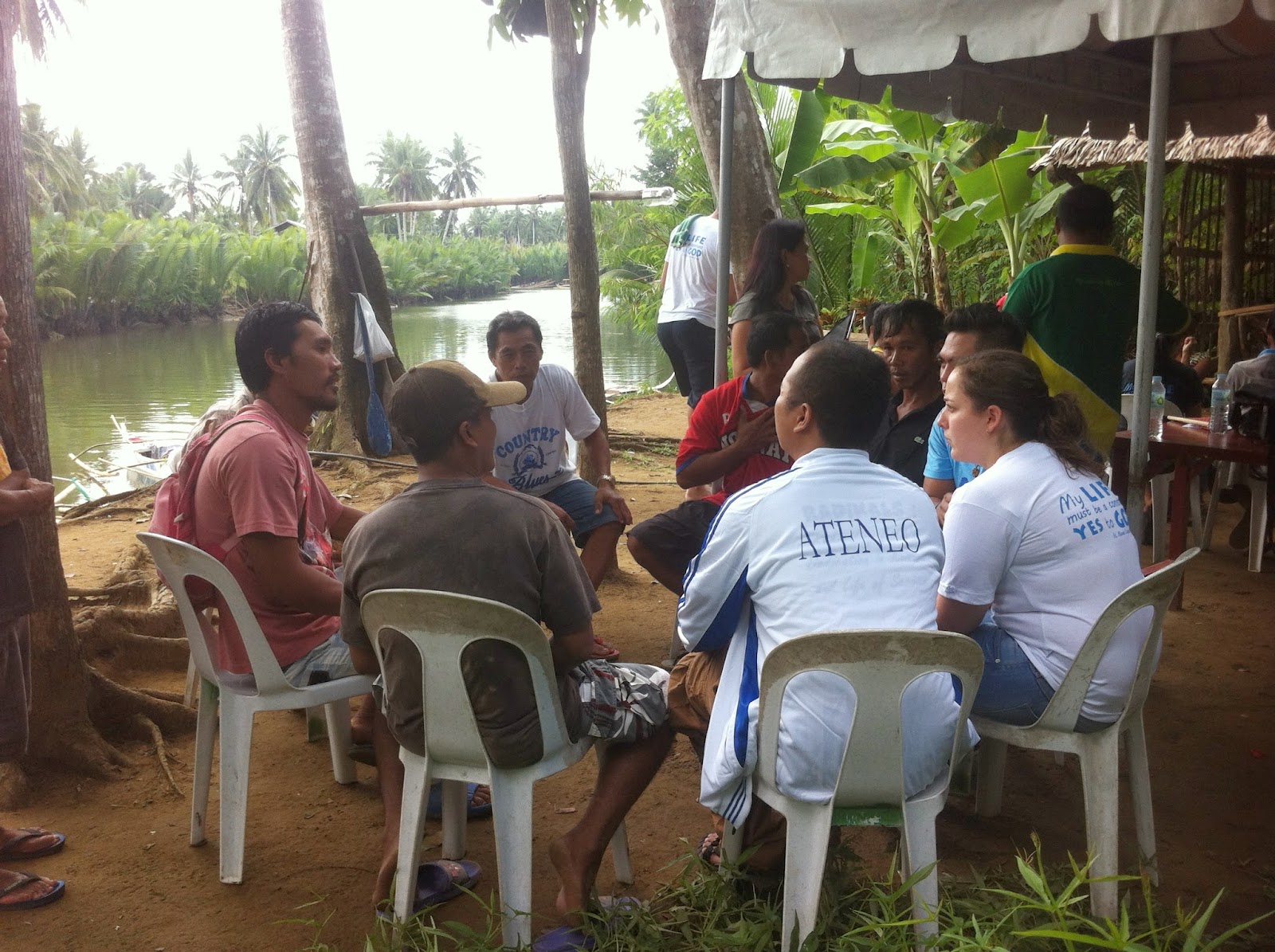
Those Assumptionistas Who Looked Back at the Jal-o a Year After Yolanda

Today is the first anniversary of Yolanda, internationally known as Typhoon Haiyan, which has been regarded as the strongest of those typhoons that ravaged communities all over the world. I intended to let it pass without so much ado, for after all, most of my trees have never recovered when she battered them last years. My neighbor is still without a decent house to live in--despite the reported many humanitarian aids coursed through either the government or the non-government organizations. But there are those who knocked on our doors today, inviting us to see through the bitter experience that we had last year and reflect on the way we chose as we tried to stand up from its havoc.

Ms. Viel Aquino Dee, Vice Chair of Assisi Development Foundation
and Mayor Bobby Calizo of Balete, Aklan surveyed the boats
made by the fisher folks themselves.
The callers are the volunteers of the Associate Missionaries of the Assumption or AMA for short. I know them not personally, but I met and befriended some of their peers sometime when they rowed down the Jal-o a long time ago--yes, but not that very long time ago. They brought with them their smiles, their friendship, their affirmation, their faith, their hopes, their stories. They came from as far as Europe and the United States (a friend and I found it amusing seeing a French animatedly chatting with a British volunteer), from Mindanao and North Luzon and even from nearby Iloilo, all to break bread with us today as we remember the sad incident of last year. They brought with them some means to help restore the lost livelihood of the fisher folks by the Jal-o. Yes,they brought us the Assisi Development Foundation which in turn capacitated the fisher folks to build boats out of the fallen trees.
Small group sharing: Here I am a year after Yolanda.

On that simple yet grace-filled gathering by the Jal-o today, we were informed that AMA and the Assisi Development Foundation opted to be with us for the occasion to witness the blessings and turn-over of boats (34 for today--and 50 last September 28) as part of the their Tabang Visayas reach-out program. And yet, they admitted that more than helping us process our trauma, they intently chosen to be with us for Balete has a special place in their hearts. One AMA "graduate" confessed that it was in Anao many years ago when she decided to give her yes to serve God through the poor by living the "Simple Life" They looked back at us to say thank you for that grand and wonderful immersion that they experienced while living with the kind people of Sitio Anao, Aranas.

The new batch of AMA volunteers rendered a special song
especially composed by one for Tabang Visayas. 
Today's interaction between those Assumptionistas, with Ms. Viel Aquino Dee and Ms. Vicky Borres, and the marginalized fisher folks by the Jal-o was a living testimony of the truism that the friendship of the rich and the poor is mutually enriching. It was a quiet yet eloquent love story of neighbors electing to carry the cross of one another.

Yolanda may have caused us much damage and even to some, tragedy; but like the Pandora's Box, she brings out with her moments of grace that lift up the human spirit to soar higher to remind one of his lost calling of living simply, kindly and responsibly along with his neighbor by the Jal-o River. A year after, may he finds the courage to echo the words of St. Marie Eugenie of Jesus, "My life must a be constant yes to my God."

Monday, November 3, 2014

The Telos of Life According to Lagumbay

My friend Lagumbay was relaxing with some buddies over a few bottles of Gold Eagle Beer Mucho in a hut by the Jal-o. Thereupon, a local politician noticed their presence and approached them in an animated fashion. As the custom of the place, the bystanders hurriedly offered the caller a glass of beer. They were not turned down and as the candidate held the bottle, he went on with his animated maneuvering. Soon, he managed to grab the attention of everyone and was already dominating the conversation.

The politician was in his element. He took out some bills from his pocket and was ready to order for more beers when Lagumbay interjected. "No sir," he declared. "The beer is on me."

This remark of Lagumbay earned him the ridicule of his peers. In rural Balete, politicians are perceived as patrons who call on the bills—be it a hospital bill or a bar chit. Thus, calling onto himself the burden of paying for the beer when there is a politician present is bordering on ridiculous. Lagumbay appears the fool, but he has the last laugh. He asserted his conviction that in a democratic society such as ours, the citizen is not a supplicant before the politician, nor is the politician a benefactor dispensing favors from his own pocket. The politician is, in the end, a public servant, and the citizen remains a citizen—with a dignity that does not have to be purchased by another man's generosity.

Perhaps this is what Lagumbay's life has been quietly witnessing: that the telos of life is not simply to survive, to prosper, or even to be remembered. It is to become, however imperfectly, what one believes a human being ought to be. Sometimes that conviction reveals itself in no grander gesture than refusing to let another man pay for one's beer.

And perhaps that is why I remember Lagumbay.  

Monday, September 29, 2014

The Center of Balete


Center. That is the way Baleten-ons referred to the Municipal Health Office since my childhood days. And it stuck until to now. I am particular to this reality as the family used to reside behind the old Puericulture Center of Balete where both my father and mother worked. When my mother got hired as Rural Health Midwife for Balete Rural Health Unit, the family decided to relocate and bought a small house behind it. It was easy to recognize one another then as there were only a handful of households in the poblacion. It was simply either one is from Ilaya or Ilawod.

The "Center" is geographically situated at the heart of the poblacion along with the old Town Hall, the Band Stand and the Church. It served as the boundary for the "taga-ilaya" and "taga-ilawod". It was implicitly regarded as a neutral place where animosity is temporarily set aside among the "warring gangs" of Ilaya and Ilawod. As the bell tolled to call the community to Angelus, any contest by the rival gangs were to be set aside, at least for a while. At nighttime, its spacious covered patio was a rendezvous for the Romeos and Juliets of the Poblacion.

The "Center" is known by many names. Originally, it was the Puericulture Center of Balete when it was first established in 1957. A cholera outbreak struck the community in the early 50's and the government relied on the humanitarian interventions of the National Federation of Women's Club of the Philippines (NFWCP) as there was no health personnel assigned in Balete at that time. While it is true that as early as 1921, the Public Welfare Commission was already tasked of supervising and organizing puericulture centers in the countryside with a mandate that all centers should have a doctor, a nurse, a midwife and a social worker, all to be paid by the government, the lack of funds delayed its establishment in Balete. It took the persistence of the strong-willed Pacita Calizo-Cortes, the chapter president of NFWCP, to bring in funds that pave for the eventual establishment of the "Center" and later on, its satellites in Aranas and Calizo.
The fine lady with a bag is the late Pacita Calizo-Cortes during her attendance to the
1st National League of Puericulture Centers National Convention
 at the Malacañang Palace in February 25, 1961
(Photo courtesy of Ms. Cecile Cortes-Vergara)

In 1961, the World Health Organization, the United Nations Children's Fund, the Philippine Charity Sweepstakes Office and provincial governors funded the construction of puericulture center buildings across the country. Remnants of the PCSO-funded centers are still standing up to now in Barangay Aranas and Barangay Calizo although the lack of appropriate documents--Deed of Donations--prevented the local government from undertaking their rehabilitation. But with the dearth of health personnel where there was only one midwife who rounded the barrios as the doctor and the nurse were "center-based", the people relied so much on the active involvement of the NFWCP for their health and sanitation needs and in their absence, from the community cirujanos (not to be confused with the cirujanos ministrates—male nurses—of the Spanish era) and herbolarios (or albularyo). Thus, that generation remembers its one and only president as the Florence Nightingale of Balete for her advocacy in promoting health and sanitation among the rural folks. Her death in 1963 therefore was regarded as a great lost that eventually led to the fading out of her Women's Club even before the onset of the Marcos years. 

During the Martial Law years, the "Center" became known as Rural Health Unit where it welcomed batches of newly graduated health practitioners doing their mandatory Rural Health Service. Nurses and midwives reached out into the barrios to provide the needed health services to complement (or counteract—whatever) the Community-Based Health Practitioners' efforts at reaching out to the rural masses. 

The passage of the Local Government Code in 1991 dramatically brought changes which devolved health services and its personnel administration under the local government units (LGUs). The "Center" took form to be called thus as the Municipal Health Office with the Municipal Health Officer as its Department Head. As if wanting to radically change everything in it, a powerful earthquake pulverized the building in June of that year. But the spirit of Pacita held on. Through the appeal of her daughter, Ma. Cecilia Cortes-Vergara, who was the confidential secretary then of Secretary Raul Manglapus at the Department of Foreign Affairs, then Department of Health Secretary Alfredo Benzon appropriated certain amount for the immediate construction of a new health center. 

With the new "Center" rising out from the rubles of the old and beloved puericulture center, the local officials were said to have committed to rename it in honor of the memory of Pacita Calizo-Cortes and a way of saying thank-you to Ms. Vergara. In as much as it was now under the LGU, the Sangguniang Bayan by virtue of the LGC can and has the power to rename it upon consultation with the National Historical Institute (now National Historical Commission of the Philippines). Eventually, a signage bearing the name "Pacita Calizo-Cortes Memorial Health Center" was installed prominently atop the new "Center" (people keep on calling it that way even if it the old structure is no more and the new one has a different feature and name).

A recent (June 26, 2014) milestone ordinance enacted by the Sangguniang Bayan of the Municipality of Balete is a ratification of the use of name "Pacita Calizo-Cortes Health Center" as the official name of the Municipal Health Office. It is a belated legislative intervention to rectify the inadvertence of the past. The people of Balete have noted the signage for the past 23 years but no one bothered to inform the public who Pacita Calizo-Cortes was and why was a public, a health edifice for that matter, has to be named after her. She was not even a government official nor held a government position during her time.

So you ask me who is Pacita Calizo-Cortes and why the “Center” is officially named in her memory. The Sangguniang Bayan provides us the clue. Allow me then to quote in toto its brief introduction to Ordinance No. 35, s. 2014:
“The late Pacita Calizo-Cortes is beloved by the people of Balete in her time for her dedication and commitment in promoting health programs especially for the poorest of the poor. She was said to have selflessly reached out to barriofolks of Balete who were maligned by cholera outbreak in the 50’s. She worked hard for the eventual establishment of the Puericulture Center, the precursor of the Rural Health Unit which was the reason why up to now, people call it with affection as the “Center.” She served as its president since its establishment until her death in January 5, 1963. The younger generation however needs to be reminded of her legacy while at the same time we deemed it proper to preserve her memory as a relevant chapter in the history of our town.
“Pacita F. Calizo – Cortes was the youngest daughter of Adriano C. Calizo, former Gobernadorcillo of Balete way back in 1882, to Doña Petra Feliciano-Calizo. Her contemporary referred to her as the Florence Nightingale of Balete. Her elder brother was Miguel F. Calizo, Presidente Municipal (Municipal Mayor) of Balete during the American period in 1923-1925; during the Japanese occupation in 1941-1945; and from 1946-1947 when the Philippines was savoring its newly gained independence.
“The Rural Health Unit of Balete has carried the name “Pacita Calizo-Cortes Memorial Health Center” for many years now. While national government agencies, particularly DOH and Philhealth recognized it as the Balete Rural Health Center, the people of Balete are well aware of the name of that venerable lady as the one imposed on its signage.
“It is for these reasons then that the Local Health Board of the Municipality of Balete, heeding the request of the Heirs of the late Pacita Calizo-Cortes, recommended the ratification of the use of her name as the official name of the Rural Health Unit of Balete, Aklan.  For aesthetic consideration per the recommendation of the National Historical Commission of the Philippines, the word “memorial” shall be omitted thus.”

The Sanggunian Bayan acted on the matter based upon a resolution unanimously adopted by the Municipal Health Board of Balete on May 8, 2014. The resolution was favorably endorsing the letter of the Heirs of the late Pacita Calizo-Cortes who were seeking its intervention to affirm with legislative mandate the use of the name of their mother as the official name of the center.
A nurse under the Nurses to the Barrio Program
reached out to the remote barangay of Guanko.

The poblacion has dramatically changed over the years and with it comes new orientations, new values, new priorities for a diversified community. The “Taga-ilawod” and the Taga-ilaya” are still there adapting and adjusting to the changes that came with the “sprouting” of new communities in growing urbanization of Balete. The rivalry is no longer as intense as before, and yet, the Center remains their spontaneously agreed boundary.  

Monday, August 18, 2014

Inspirations and Motivations


I am writing again. I discovered that I am discovering my poetry. A sign along the lonely road I thread.  
Kalipay kung Taguipusoon

Pananglitan nga rong aton nga daean
Indi eon magsub-eang sa unhan
Sa tindahan rong isda nga mub-ead
Magapadumdum kimo
Nga ikaw ro matuod nga mahae
Owa eon it iba pa.

Pananglitan nga rong aton nga eandong
Indi eon makatao it handong sa hilamon
Sa simbahan rong siga it kandila
Magapadumdum kimo
Ikaw man lang rong kasadya it taguipusoon
Owa eon it iba pa.

Ag pananglitan nga hilipatan mo
Sa madueom, matapo-tapo nga kwarto
Ro binaeaybay it kahapon magapadumdum kimo
Ikaw ratong ginatumod ko, hinigugma nga engkantada
Kalipay ag baeay ku baeatyagon nga nagapadayon
Halin pa kato hasta sa gihapon.
I write poems to express what is happening inside my heart. I write poems when the emotion is strong and wanting release. I write poems to convey my feelings of love and admiration. I write poems to tell you that you are special and I love you.

I write essays and narratives to express what is going on around. I write essays and journal to document the things as they happen that I may remember. I write journal whenever I need to process my coming to be -- a sort of psycho-analyses of the reality as it manifests itself in my consciousness.


I write when I am problematic. I write when the enchantress is nice to me. I write when I am troubled by the events as they unfold. I write to earn a living. I write from time to time to compose a book someday.

 I used to write as a form of prayer. I used to write in lieu of meditating. I used to write to contemplate on the nature of the subject matter of my thought. I used to write as a form of introspection with the hope of reconciling my brokenness and recollecting my shattered self. 

THE STORIES OF THE RINGS

  I simply want to preserve the humor that resides within the otherwise exacting relationship between the I and the Thou. That is why I am...